
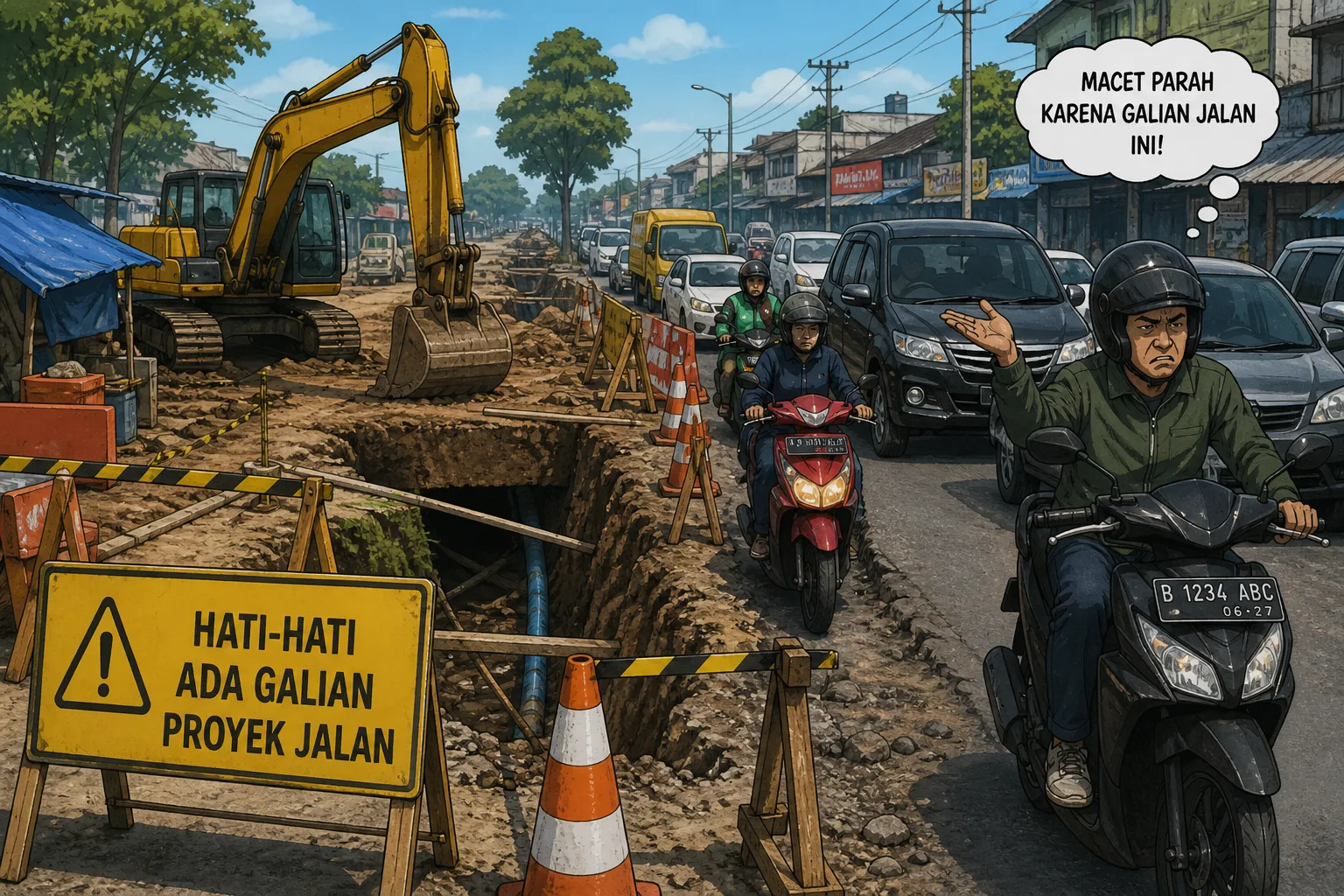
Legal Literacy - Utility excavation in Jakarta is often explained as a consequence of development, such as cables must be lowered, water pipes must be installed, sewage lines must be built, telecommunications networks must be tidied up. All of that is true. But what is often forgotten: the construction of public facilities should not be done by depriving other public rights. Jakarta residents are not rejecting clean water, internet, electricity, drainage, or a tidier underground network. What they reject is the old pattern: roads are dug up, lanes are narrowed, sidewalks are covered with materials, information boards are minimal, work is delayed, excavation marks are bumpy, then the public is only asked to "be patient". In a city as crowded as Jakarta, one poorly managed excavation can turn into hours of traffic jams, gasoline costs, work delays, accident risks, and even ambulance delays. Cases like the long traffic jam on Jalan TB Simatupang due to a utility excavation project in 2025 show that this problem is not just a minor annoyance, but a systemic disruption to citizens' mobility. In the news, the congestion was complained about because it disrupted traffic flow especially during peak working hours, while the government asked for accelerated completion of the project.[1]
The problem is not the excavation, but the governance
Utility excavation can basically be justified if it meets permits, technical standards, schedules, safety, traffic regulation, and road restoration. The problem is that in Jakarta, excavations too often look like stand-alone projects: today one agency digs, next month another operator opens the same section, then the marks are covered in a makeshift manner. The DKI Jakarta Provincial Government itself has admitted that there are many utility network excavations that cause congestion, including excavations without permits, misused permits, and poor reinstatement or repair of post-excavation roads. This is an important admission, the root of the problem is not just impatient residents, but supervision that is not hard enough.


Residents' Rights: Roads Are Not the Project's Backyard
From a legal perspective, roads are not empty spaces that can be used as they please. Roads are public infrastructure. They have traffic, safety, economic access and basic service functions. The Road Traffic and Transportation Law prohibits actions that cause damage or disruption of road functions, and prohibits interference with the function of road equipment. Perma 2/2019 regulates the guidelines for resolving government action disputes and the authority of the PTUN in PMHP cases, the focus of the responsibility is to request clarity and acceleration of the time for completing road works along with compensation that can be received by road users if the complaint mechanism to the relevant officials is ignored, thus it can be categorized as a unlawful act by the Government (PMHP).[2]
Permits are not just a formality
Government Regulation No. 34/2006 on Roads stipulates that the utilization of road benefit space and road right-of-way other than its designation must obtain a permit. The utilization must not interfere with the smoothness and safety of road users and not endanger road construction. For DKI Jakarta, the permit for utilization of road benefit space and road right-of-way is issued by the governor. This means that excavation permits should not stop at the administrative stamp. The permit must contain technical drawings, time period, obligation to maintain and safeguard public safety, risk responsibility, and obligation to restore the road space to its original state at the expense of the permit holder.
DKI Regulation 8/2025: The Rules Already Exist, It's Just a Matter of Enforcement
Jakarta already has DKI Jakarta Province Regional Regulation Number 8 of 2025 concerning Placement of Utility Networks. This local regulation was born because Jakarta as a national economic center and global city requires an adequate, organized, and controlled utility network in an integrated manner. In other words, Jakarta does not lack norms, what it lacks is execution discipline. Perda should not be a legal display, it must be felt in the field, for example, projects that close sidewalks must be reprimanded, projects that are delayed must be fined, bad excavations must be dismantled, and operators who repeatedly violate must lose their licenses.[3]
Solution: From Passive Patience to Public Control
The first solution is for the city to make a map of open excavations that can be accessed by the public. Citizens need to know which section is being excavated, who owns the project, the permit number, when it started, when it finished, who the contractor is, and the complaint channel. Second, every excavation permit should require a concrete traffic management plan: night work for congested sections, maximum length of open excavation, safe access for pedestrians, reflective signs, lighting, proper steel plates, and traffic control officers during peak hours. Third, there needs to be a road restoration guarantee or performance bond. Contractors and utility owners should put up a money guarantee before digging. If the excavation is bumpy, subsides, or not up to standard, the government will use the money to repair it, and the contractor will be fined.[4]




















Comments
0Share your perspective politely, stay relevant, and focus on the article. Comments appear after moderation.
Join the discussion
Write a clear, polite response that stays on topic.
No comments yet. Be the first to discuss.
Comments will appear after moderation.