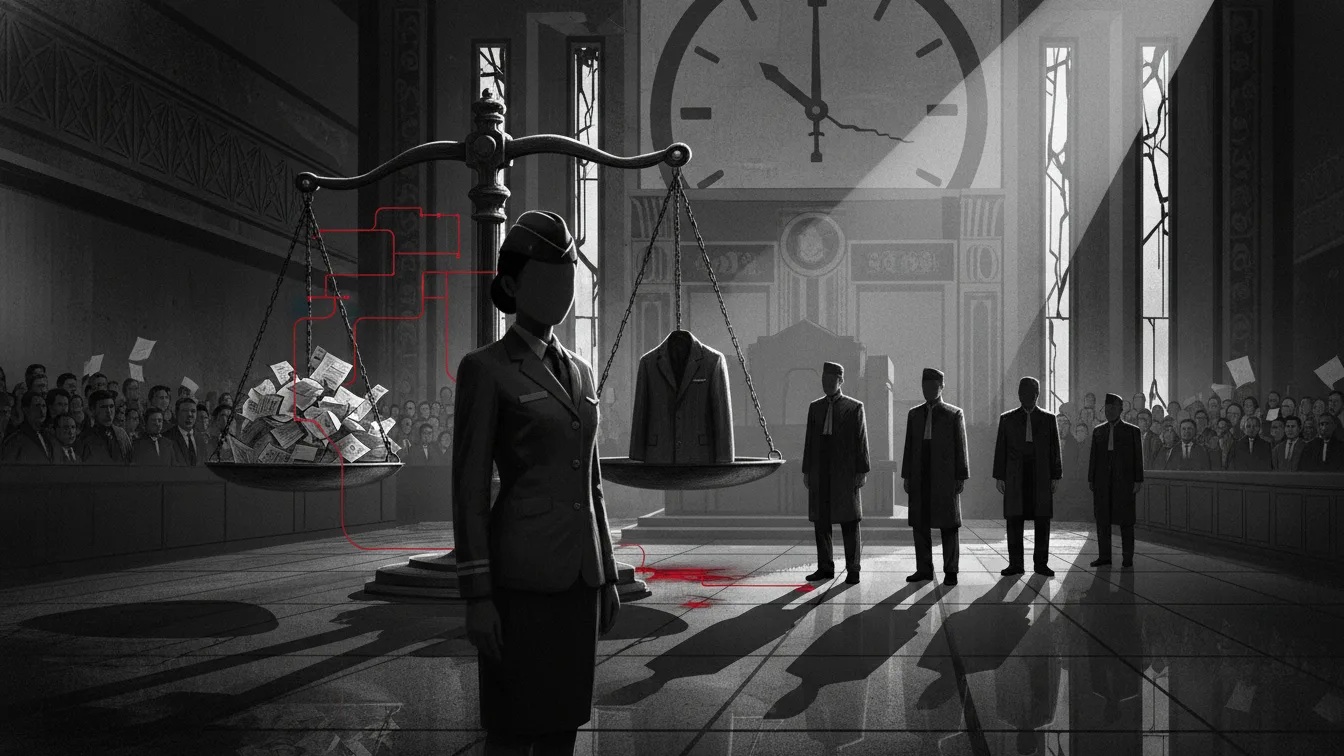
Legal Literacy - In Indonesia, uniforms often possess an almost magical power. They can transform ordinary people into figures who feel "unworthy of being questioned." Upon seeing official attributes, our reflex is almost always the same: believe first, ask later. Logic is often made to wait in line, outpaced by hesitation. So when the public hears that a woman disguised herself as a flight attendant until she was caught and investigated by the police, it is natural for us to chuckle and then fall silent.
It's funny because it sounds reckless. It's disturbing because it actually succeeded.


This phenomenon reveals a social habit that we rarely realize. We trust symbols too much. Uniforms, identity cards, and professional appearances are often regarded as the final truth. But symbols are just packaging. They can be neat and convincing, but they still need to be tested. What we often forget is the procedure.
In the collective imagination, flight attendants are symbols of discipline and part of the official system. When that symbol is used, it works like a social shortcut. No need for much explanation. No need for much verification. Those who see it feel uncomfortable asking questions, those who pass by feel it is reasonable to be let through. This is not just a matter of individual ingenuity, but a culture that is too friendly to appearances.
From a legal point of view, disguise is not automatically a criminal act. Criminal law does not punish costumes, but intent and consequences. In law, there is the principle of mens rea, namely malicious intent. If the disguise is carried out to obtain profits, access restricted areas, or cause losses, then the potential for fraud or identity falsification articles is open. However, if there is no intention to harm, the law does not automatically turn into a tool of coercion. The matter can stop at clarification and guidance.
Even so, the law does not only look at the perpetrator. There is another side that is equally important, namely the oversight system. Airports are vital objects with high security standards. When someone can get through simply with a uniform and confidence, administrative law should also ask questions. Are procedures carried out consistently? Is verification actually carried out or only assumed? In state governance, procedural negligence is not a trivial matter because it concerns public safety and trust.
This case also touches on public legal awareness. We often expect officers to always be vigilant, but forget that legal culture lives from shared habits. Asking for identification is not impolite. It is a sign of maturity. A state of law does not stand on hesitation, but on caution.
A simple analogy is this. We diligently admire the beautiful packaging of food, but are too lazy to read the label. When the stomach has problems, we are angry at the kitchen, even though we ourselves do not want to check the contents. The law is present not to kill trust, but to make it healthy. Trust without verification is just overconfident optimism.
In the end, this flight attendant disguise story is not about one person and one uniform. It's about how we interpret authority, procedures, and collective sanity. Hopefully, after the virality passes, what remains is not just laughter, but a new habit. Not easily impressed, not quick to judge, and not lazy to check. Because a strong country is not one that is fierce, but one that is orderly.
























Comments
0Share your perspective politely, stay relevant, and focus on the article. Comments appear after moderation.
Join the discussion
Write a clear, polite response that stays on topic.
No comments yet. Be the first to discuss.
Comments will appear after moderation.