
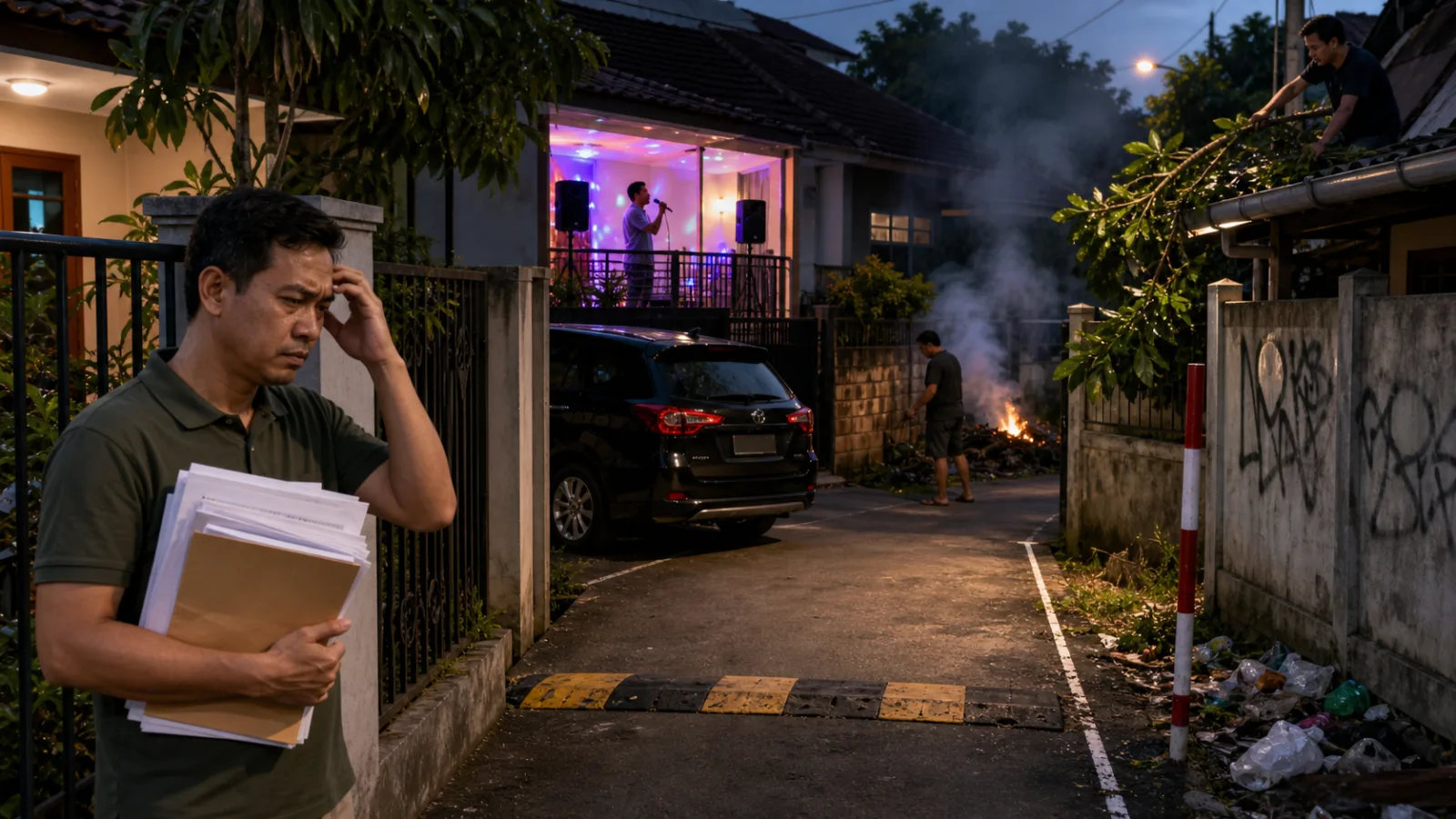
Legal Literacy - Imagine this: it's 1 a.m., and you have to get up at 5 a.m. to go to work, and your next-door neighbor is still singing karaoke with a booming voice. Or you open your door in the morning to find your gutters clogged with leaves from a neighbor's tree that has never been taken care of. Or even worse - your neighbor's car parked right in front of your fence, blocking your access in and out of the house because he doesn't have his own garage.
Neighbor conflict is one of the most common problems in Indonesian society. A survey by the Indonesian Consumer Institute in 2024 showed that 68% of people claimed to have experienced problems with neighbors, but only 23% understood their legal rights and obligations. This means that most of us choose to stay silent - not because we're not bothered, but because we don't know that the law has been around for a long time.


This article sets the record straight on seven "bad" neighbor behaviors that are often dismissed as "that's okay, they're neighbors," even though each has a clear legal article - some even with fines of up to tens of millions of rupiah based on the new National Criminal Code that took effect on January 2, 2026.
1. Noisy Neighbor in the Middle of the Night: Up to Rp 10 Million Fine in New Penal Code
This is the most classic complaint that is also most commonly asked to legal clinics. The applicable articles are layered and interesting to note.
Prior to January 2, 2026, the legal basis was Article 503 of the old Criminal Code, which provided for a maximum of three days' imprisonment or a maximum fine of IDR 225 - a figure that had been outdated for decades. After Supreme Court Regulation No. 2/2012, the fine can be doubled up to a thousand times, to Rp 225,000. Still a relatively small amount and often no deterrent.
However, since the National Criminal Code (Law No. 1 of 2023) became effective on January 2, 2026, this threat has changed dramatically. Article 265 letter a of the National Criminal Code states that any person who disturbs the peace of the neighborhood by making frenetic or noisy neighbors at night, shall be punished with a maximum fine of category II - the value of which is IDR 10 million. The nominal jump is almost 50 times.
Interestingly, this article does not only reach ordinary household neighbors. Article 265 letter a of the National Criminal Code also applies to commercial businesses that are run in residential neighborhoods and operate into the night - cafes, workshops, home karaoke bars, or shop houses that are still busy during residents' rest hours.
In addition to criminal proceedings, victims can also file a civil suit under Article 1365 of the Civil Code on unlawful act. Four elements must be met: there is unlawful act, there is fault, there is loss, and there is a causal relationship. If the noise causes you to lose sleep and your work productivity suffers, or your child cannot study for exams, the loss can be measured and sued.
How to report in order: report to the neighborhood association (RT/RW), then to the village head (lurah) or village head (kepala desa), and then to the police if the warning is not heeded.
2. Neighbor's Trees and Branches that Overhang Your House: Self-Cutting
Bamboo leaves clogging the gutter, mango branches overhanging the roof, tree roots damaging the foundation of the wall - classic complaints that often go unheeded by the owner. In fact, Indonesian law provides clear protection.
Article 666 paragraph (2) of the Civil Code reads explicitly: any person who experiences that the branches of his neighbor's tree overhang his yard has the right to demand that the branches be cut by the owner. More than just demanding, the Civil Code also gives the landowner the right to cut the roots of trees that encroach on his land. This right is zakelijk - It is a property right attached to the land, not a personal right to the neighbor.
If the damage has already been done to your building - damaged roof, seeping ceilings, damaged furniture due to flooding caused by blocked gutters - Article 1365 of the Civil Code is the basis for a lawsuit for compensation. On the criminal side, if the tree owner intentionally allows his tree to endanger other people or buildings, he can be charged under Article 489 or Article 489A of the National Criminal Code on disturbance of order causing damage to property.
Things not to do: cutting a neighbor's branch without prior written warning, especially if the branch is still in the neighbor's yard (not overhanging your yard). Doing so could turn around and make you the perpetrator of the vandalism.
3. Neighbor Parking Carelessly in Front of Your House
This is a complaint that is specific to urban areas. The neighbor who doesn't have a garage, then parks his car in front of your fence - even going so far as to lock the gate shut.
Article 671 of the Civil Code stipulates that every person is obliged to take care that the use of his rights to his own land does not prejudice the enjoyment of other people's rights to his land. Parking a vehicle on public land in front of someone else's house, so that access in and out is disrupted, is clearly detrimental to the enjoyment of the rights of the owner of the house.
Article 1365 of the Civil Code is again the basis for a civil lawsuit when there is a quantifiable loss - for example, you are late for work because you can't leave your house, you can't take your sick family to the hospital, or your property is damaged by a neighbor's careless parking.
For parking on the shoulder of a public road (not on your private land), the authority lies with the Transportation Agency and traffic police based on Law No. 22/2009 on Road Traffic and Transportation. Article 287 paragraph (3) of the LLAJ Law threatens a maximum imprisonment of one month or a maximum fine of Rp 250,000 for drivers who violate parking regulations.
Concrete steps: document the incident with photos/video, report it to the neighborhood, and if it keeps happening, coordinate with the Transportation Department to install no-parking signs in the area.
4. Neighbor Burns Garbage Carelessly: Up to Three Months of Punishment
The thick smoke in front of your house, the ash on your clothesline, and the air pollution that makes your child cough - all of these are often caused by neighbors burning trash in their yards.
Many people think that this is "normal" and that there is no legal issue. Wrong. Article 29 paragraph (1) letter g of Law Number 18/2008 on Waste Management explicitly prohibits anyone from burning waste that is not in accordance with the technical requirements of waste management. Violators are subject to a maximum imprisonment of one year or a maximum fine of Rp 200 million under Article 41 of the same law.
At the local government level, many districts and cities also have Regional Regulation on waste management with their own sanctions. For example, DKI Jakarta through Regional Regulation Number 3 of 2013 regulates fines of up to millions of rupiah for burning waste in residential areas.
For those affected, criminal proceedings can be taken by reporting to the police. Meanwhile, if the burning causes material losses - such as damage to clotheslines, burnt clothes, or medical expenses due to respiratory problems - a civil lawsuit based on Article 1365 of the Civil Code can also be filed.
5. Neighbors Build Their Own Speed Bumps: Up to a Year in Prison
This is a common practice in narrow alleyways and complex roads: people build high "speed bumps" in front of their own homes without permission, citing "safety concerns." This is despite the fact that the road is a public road, and the act is clearly criminal.
Article 28 paragraph (1) of UU LLAJ states that every person is prohibited from committing acts that result in damage to or disruption of road functions. Sanctions for this offense are contained in Article 274 paragraph (1) of UU LLAJ - imprisonment for a maximum of one year or a maximum fine of IDR 24 million.
Legal speed bumps must be licensed by the local government and built to the technical specifications set out in Ministerial Regulation Transportation Number 82 of 2018 on Road User Control and Safety Devices. The maximum height of speed bumps is 12 cm with a 15% slope. Speed bumps that exceed these specifications pose a risk of causing vehicle damage - and when they do, victims have the right to sue the builder for damages.
Concrete steps if you become a victim: report to the local Transportation Department for dismantling. If there is damage to the vehicle, keep proof of repairs and file a small claims case in the district court.
6. Neighbors Vandalize or Throw Trash at Your House
Conflicts that have escalated usually end up in vandalism: walls are graffitied, glass is stoned, trash is deliberately thrown into the yard. Many think, "The important thing is not to get hurt, so it's okay." Even though the law already has a strict noose.
Article 406 paragraph (1) of the Criminal Code - retained in the National Criminal Code as Article 521 - imposes a maximum imprisonment of two years and eight months on any person who intentionally and unlawfully destroys, damages, renders useless or removes property which wholly or partially belongs to another person.
Article 489 of the Criminal Code also imposes a fine for minor acts of vandalism that disturb public order. If committed less than a year after conviction for a similar offense, the fine may be replaced by a maximum of three days' detention.
For more serious acts - such as throwing stones at the glass of a house until it breaks - Article 170 paragraph (1) of the Criminal Code on violence against persons or objects in public can also be applied, which carries a maximum imprisonment of five years and six months.
Evidence to be collected: cCTV footage (if any), photos of the damage along with the date and time, other neighbor witnesses, and proof of repair expenses. A report can be made directly to the nearest police department with these documents.
7. Neighbor Builds on Your Land or Closes Road Access
This is the conflict that has the most value and is most prone to escalation. A neighbor builds a fence outside the boundary of his land, erects a building that encroaches on the boundary, or even closes the access road in and out of your house.
In the case of construction on your land, the legal basis is the right of ownership, which is protected by Article 570 of the Civil Code and Article 16 paragraph (1) of Law Number 5 of 1960 on Agrarian Principles (UUPA). Hak milik is the strongest and fullest right to land, so any violation of it opens the path to civil and criminal lawsuits.
Article 167 of the Criminal Code - which is also retained in the National Criminal Code - imposes a maximum imprisonment of nine months on any person who forces his way into the enclosed yard or cultivates the land of another without permission. When construction is carried out unlawfully on someone else's land, this penalty becomes relevant.
In the case of road closures, Article 667 and Article 668 of the Civil Code provide a basis for demanding that neighbors provide access by giving up some of their land. The Civil Code recognizes the concept of erfdienstbaarheid or hak servitut, which is the right of passage over someone else's land for the enjoyment of one's own land that does not have access to a public road. This right applies mainly to houses that are at the back and do not have direct access to the main road.
Legal steps that need to be taken: first, have the land re-measured by a National Land Agency (BPN) official to ascertain the actual land boundaries. Second, apply for mediation through RT/RW or urban village. Third, if there is no agreement, file a lawsuit with the authorized District Court with the land certificate, proof of BPN measurement, and documentation of the violation.
When to report to the police, when to sue in court?
One of the most common fallacies in neighbor issues is that people run straight to the police, when many conflicts are more effectively resolved through civil litigation or mediation. Here are the basic principles.
Report to the police (criminal track) if the neighbor's actions meet the elements of a criminal offense - vandalism, destruction, threats, violence, burning garbage, or consistently repeated violations of public order. The main punishment: imprisonment and/or fines that go to the state treasury, not to the victim's pocket.
Suing the district court (civil action) if you want to claim compensation for the material or immaterial losses you have suffered. Under Article 1365 of the Civil Code, the victim has the right to sue for compensation for all losses caused by the neighbor's unlawful act. The compensation money won goes into the victim's pocket.
Mediation through RT, RW, kelurahan, or lurah is the first route that must be taken based on the principle of deliberation recognized in Indonesia's customary law system and judicial practice. For many neighboring cases, mediation facilitated by community leaders is sufficient to resolve the issue without having to escalate to formal channels.
A combination of both - both criminal and civil - are often pursued in serious cases. A criminal conviction can serve as an evidentiary basis in a subsequent civil suit, making it easier for victims to win compensation claims.
Some Articles are Complaint Offenses, Not Ordinary Offenses
An important note that is often overlooked by the public: not all offenses can be automatically processed by the police. Many of the articles governing the behavior of "bad neighbors" are complaint offense - which means that criminal proceedings can only take place if the victim files a formal complaint.
As a Trisakti University legal expert stated, the articles that ensnare bad neighbors are more about personal harm than public order. The implication: even if there is a report from another party (e.g. RT or other residents), the police still need a formal complaint from the victim directly to process the case. The complaint can be withdrawn before the verdict, and if it is withdrawn, the case stops.
Exceptions: for offenses that cause widespread impact such as burning garbage that pollutes the environment, destruction of public facilities, or massive public order violations, the ordinary offense track still applies and the police can process without a complaint.
Why do so many people stay silent when the law is on their side?
The most important question is the one that is least often asked: if the law is so clear, why do so many people choose to remain silent when they are harmed by their neighbors?
Legal sociologist Satjipto Rahardjo in Law in the Realm of Order (UKI Press, 2006) mentions three factors that make the law not work optimally at the community level. First, legal awareness - awareness that certain actions are protected or prohibited by law - is still low among ordinary people. Second, cost-benefit calculation which often puts the emotional and social costs of conflict with neighbors higher than the benefits derived from law enforcement. Third, cultural restraint - a culture of community and malaise that prevents people from exercising their rights.
These three factors are valid and human. But there is a limit. When a bad neighbor has been repeatedly reprimanded and remains unchanged, when the harm is real and measurable, when family health or home security is threatened - the law is not the enemy of neighborly relations. Instead, the law is the mechanism that saves the relationship from a more dire escalation.
Continued silence also has its costs. Unclaimed material losses will continue to be suffered. Prolonged stress will damage health. And most importantly: neighbors who are never faced with legal consequences will never learn that their actions are wrong.
Summary of Seven Articles You Should Take Note of
| Neighbor Behavior | Main Article | Sanctions |
|---|---|---|
| Noisy at night | Article 265 of the National Criminal Code | Fines of up to IDR 10 million |
| Tree damages house | Article 666 paragraph (2) Civil Code + Article 1365 Civil Code | Compensation |
| Indiscriminate parking | Article 671 of the Civil Code + Traffic Law | Fines + damages |
| Burning garbage | Article 29 jo. 41 OF LAW 18/2008 | 1 year in prison + IDR 200 million fine |
| Illegal speed bumps | Article 28 jo. 274 OF THE TRAFFIC AND TRANSPORTATION LAW | 1 year in prison + IDR 24 million fine |
| Vandalism | Article 521 of the National Criminal Code (former Article 406 of the Criminal Code) | 2 years 8 months imprisonment |
| Build on your land / close access | Article 167 of the Criminal Code + Articles 667-668 of the Civil Code | 9 months imprisonment + compensation |
Cover
Neighborhood living is a social complexity that cannot be solved by law alone. Communication, empathy and compromise are still the first order of business. But when all is said and done and the neighbor keeps misbehaving, knowing your legal rights is not an act of aggression - it is legitimate self-protection.
Each of the articles discussed above is a safety net that Indonesian law has prepared for citizens whose peace is threatened. What is needed now is the awareness that the net exists, and the willingness to use it when all peaceful channels have been exhausted. Laws are made not to be the first weapon, but the last bastion.
If you are currently facing a conflict with a neighbor and don't know where to start, the first step remains the same for all cases: document the incident with photos, videos, and witnesses; report it to the RT/RW in writing; and then, if the warning is ignored, escalate it to the formal channels appropriate to the type of violation.
Bibliography
Legislation
- Republic of Indonesia. Civil Code (Burgerlijk Wetboek voor Indonesie).
- Republic of Indonesia. Criminal Code (Old Criminal Code).
- Republic of Indonesia. Law No. 5 of 1960 on the Basic Regulation of Agrarian Principles.
- Republic of Indonesia. Law Number 18 of 2008 on Waste Management.
- Republic of Indonesia. Law No. 22/2009 on Road Traffic and Transportation.
- Republic of Indonesia. Law Number 1 of 2023 on the Criminal Code. State Gazette of the Republic of Indonesia Year 2023 Number 1.
- Supreme Court Republic of Indonesia. Supreme Court Regulation Number 2 Year 2012 on the Adjustment of the Limitation of Minor Offenses and the Amount of Fines in the Criminal Code.
- Minister of Transportation of the Republic of Indonesia. Ministerial Regulation Transportation Number 82 Year 2018 on Road User Control and Safety Devices.
Books and Journals
- Hamzah, Andi. Speciale Delicten in the Criminal Code. Second Edition. Jakarta: Sinar Grafika, 2015.
- Rahardjo, Satjipto. Law in the Realm of Order. Jakarta: UKI Press, 2006.
- Soesilo, R. Kitab Undang-Undang Hukum Pidana (KUHP) and its Commentaries Complete Article by Article. Bogor: Politeia, 1995.
- Subekti, R. Principles of Civil Law. 31st print. Jakarta: PT Intermasa, 2003.
- Harsono, Boedi. Indonesian Agrarian Law: History of UUPA Formation, Content and Implementation. Jakarta: Djambatan, 2008.
Online Source
- "Articles that can ensnare naughty neighbors, from burning trash to parking on the street." Kompas.comnovember 15, 2025.
- "Neighbor Karaoke and Noisy Songs at Midnight, Can You Be Punished?" Detik.comaugust 31, 2024.
- "Disturbed by a Noisy Neighbor's Business, Take This Step." Online Legal Clinicfebruary 23, 2026.
- "Here's What Your Neighbor Can Do." Master of Law Sciences, University of Medan Area, 2023.
- "Rights and Obligations between Neighboring Yard Owners." Sumatran Lawyermay 28, 2025.
- "Legal Steps if Harmed by Neighbor's Tree." Online Legal Clinic, 2024.
Disclaimer. This article has been prepared for general legal education purposes. The application of the articles mentioned depends on the facts and circumstances of the specific case. Readers who face concrete conflicts with neighbors are advised to first take the mediation route through RT/RW or the village head, and if unsuccessful, consult directly with an advocate or Legal Aid Institution in their respective cities.























Comments
0Share your perspective politely, stay relevant, and focus on the article. Comments appear after moderation.
Join the discussion
Write a clear, polite response that stays on topic.
No comments yet. Be the first to discuss.
Comments will appear after moderation.