
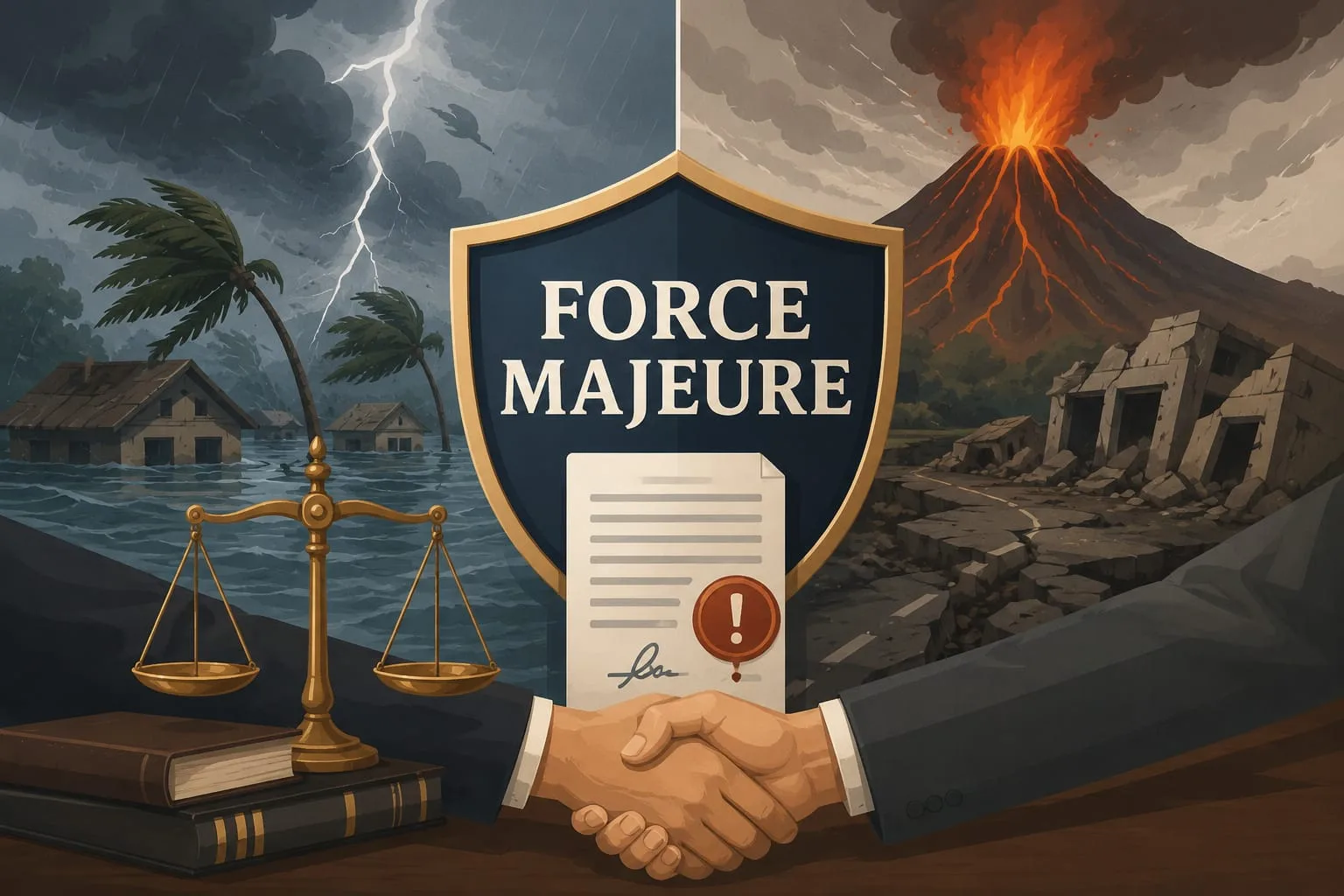
Legal Literacy - In an agreement, basically the parties are obliged to fulfill the performance that has been mutually agreed upon. However, in practice, there are certain conditions that cause a person to be unable to carry out his obligations. This is due to an event that is beyond human reach to avoid the event. Such as natural disasters, pandemics, or government policies. [1]. This condition is known as force majeure or force majeure (overmacht).
Force majeure is often used as an excuse to exempt certain parties from breach of contract demands. However, not all circumstances can necessarily be categorized as breach of contract force majeure. Therefore, it is important to understand the definition, legal basis, requirements, and legal effects of force majeure in an agreement.


Definition of Force Majeure
According to Prof. Subekti, compelling circumstances or force majeure is a defense of the debtor to show that the non-performance of what was promised was caused by things that were completely unforeseeable and where he could not do anything about the circumstances or events that arose beyond expectations, so that it can be concluded as a reason to release the debtor from the obligation to pay compensation on the basis of breach of contract raised by the creditor. [2] In legal practice, force majeure is often defined as a force majeure that cannot be foreseen and cannot be accounted for by the party experiencing the situation. Although the term force majeure is not explicitly mentioned in the Civil Code, its regulation can be found in Article 1244 and Article 1245 of the Civil Code which regulates the exemption of compensation due to force majeure.





















Comments
0Share your perspective politely, stay relevant, and focus on the article. Comments appear after moderation.
Join the discussion
Write a clear, polite response that stays on topic.
No comments yet. Be the first to discuss.
Comments will appear after moderation.