
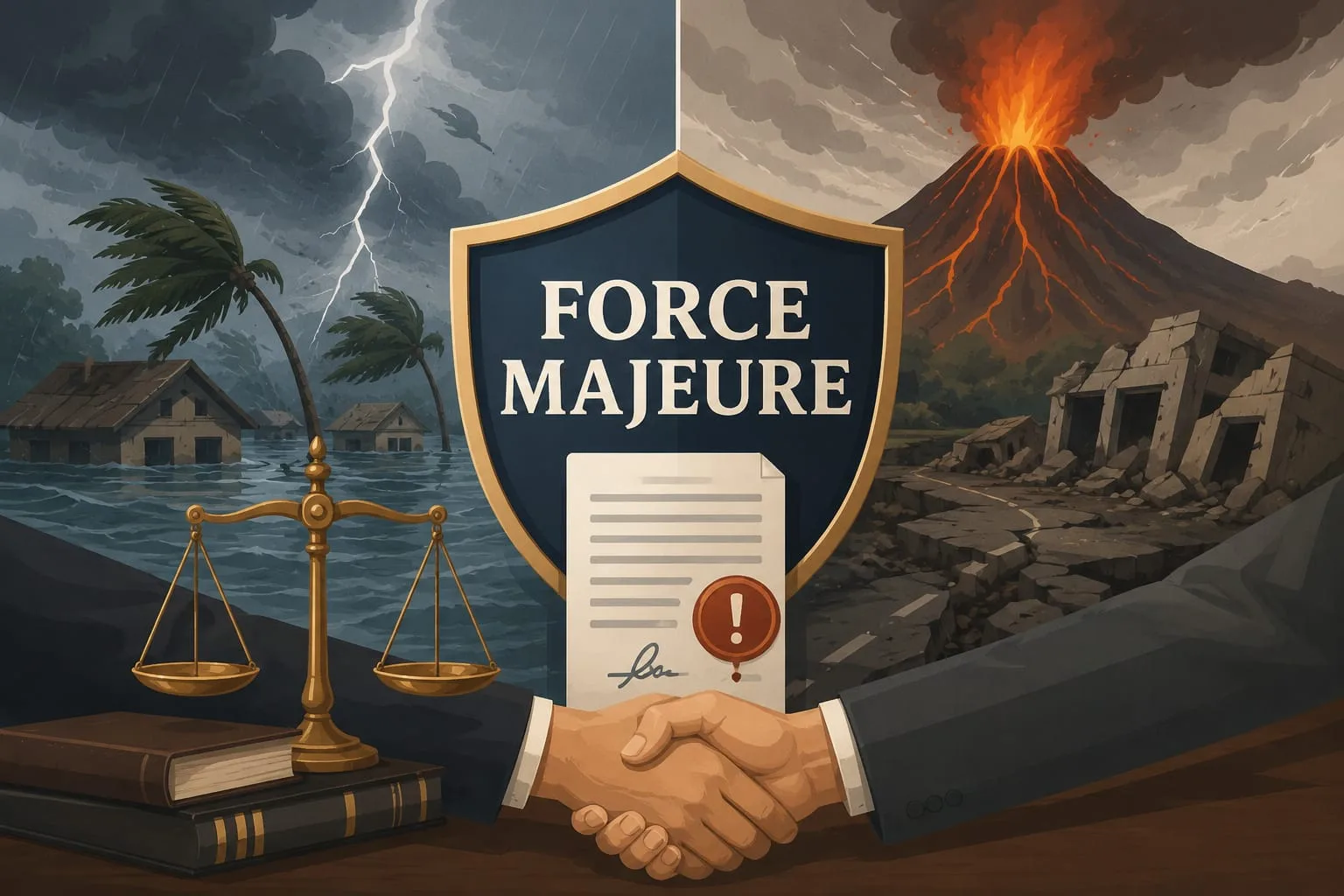
Legal Literacy - In an agreement, basically the parties are obliged to fulfill the performance that has been mutually agreed upon. However, in practice, there are certain conditions that cause a person to be unable to carry out his obligations. This is due to an event that is beyond human reach to avoid the event. Such as natural disasters, pandemics, or government policies. [1]. This condition is known as force majeure or force majeure (overmacht).
Force majeure is often used as an excuse to exempt certain parties from breach of contract demands. However, not all circumstances can necessarily be categorized as breach of contract force majeure. Therefore, it is important to understand the definition, legal basis, requirements, and legal effects of force majeure in an agreement.


Definition of Force Majeure
According to Prof. Subekti, compelling circumstances or force majeure is a defense of the debtor to show that the non-performance of what was promised was caused by things that were completely unforeseeable and where he could not do anything about the circumstances or events that arose beyond expectations, so that it can be concluded as a reason to release the debtor from the obligation to pay compensation on the basis of breach of contract raised by the creditor. [2] In legal practice, force majeure is often defined as a force majeure that cannot be foreseen and cannot be accounted for by the party experiencing the situation. Although the term force majeure is not explicitly mentioned in the Civil Code, its regulation can be found in Article 1244 and Article 1245 of the Civil Code which regulates the exemption of compensation due to force majeure.
Legal Basis
Provisions regardingForce Majeure we can find it in Article 1244 and Article 1245 of the Civil Code, namely:
- Article 1244 of the Civil Code: "The debtor shall be liable to pay costs, damages and interest if he cannot prove that the non-performance of the obligation or the delay in performing the obligation was caused by an unforeseeable, uninsurable event."
- Article 1245 of the Civil Code: "There shall be no reimbursement of costs and interest if, due to force majeure or a fortuitous event, the debtor is prevented from rendering or performing an act that is required of him, or from performing an act that is prohibited to him." [3]
Based on this provision, breach of contract can be used as a reason for exemption from liability as long as the debtor is able to prove the existence of such force majeure.
However, not all failures to fulfill the agreement are automatically considered as breach of contract for which compensation can be sought.
Conditions of Occurrence Fource Majeur:
A situation can be categorized asforce majeure if it meets several conditions, among others:
- Natural disasters;
- Non-natural disasters;
- Social disaster;
- Strikes;
- Fire;
- Other industrial disturbances as declared through a joint decree of the Minister of Finance and relevant technical ministers.
A simple example: suppose a company cannot ship goods because the port is closed due to a natural disaster that hit the city in the port. In this condition, the situation can be used as a basisforce majeure if it really hampers the implementation of the achievement.
In case of force majeure, then the provider notifies PPK no later than 14 (fourteen) days after the occurrence force majeure, by including the statement force majeure from an authorized official, in accordance with the provisions of laws and regulations. [4]
Legal Effects of Fource Majeure
When force majeure proven, then the debtor can be released from the obligation to pay compensation, costs, or interest due to non-fulfillment of performance. Under certain conditions, force majeure can also cause a delay in the performance of an agreement or even the termination of an engagement. [5]














Comments
0Share your perspective politely, stay relevant, and focus on the article. Comments appear after moderation.
Join the discussion
Write a clear, polite response that stays on topic.
No comments yet. Be the first to discuss.
Comments will appear after moderation.