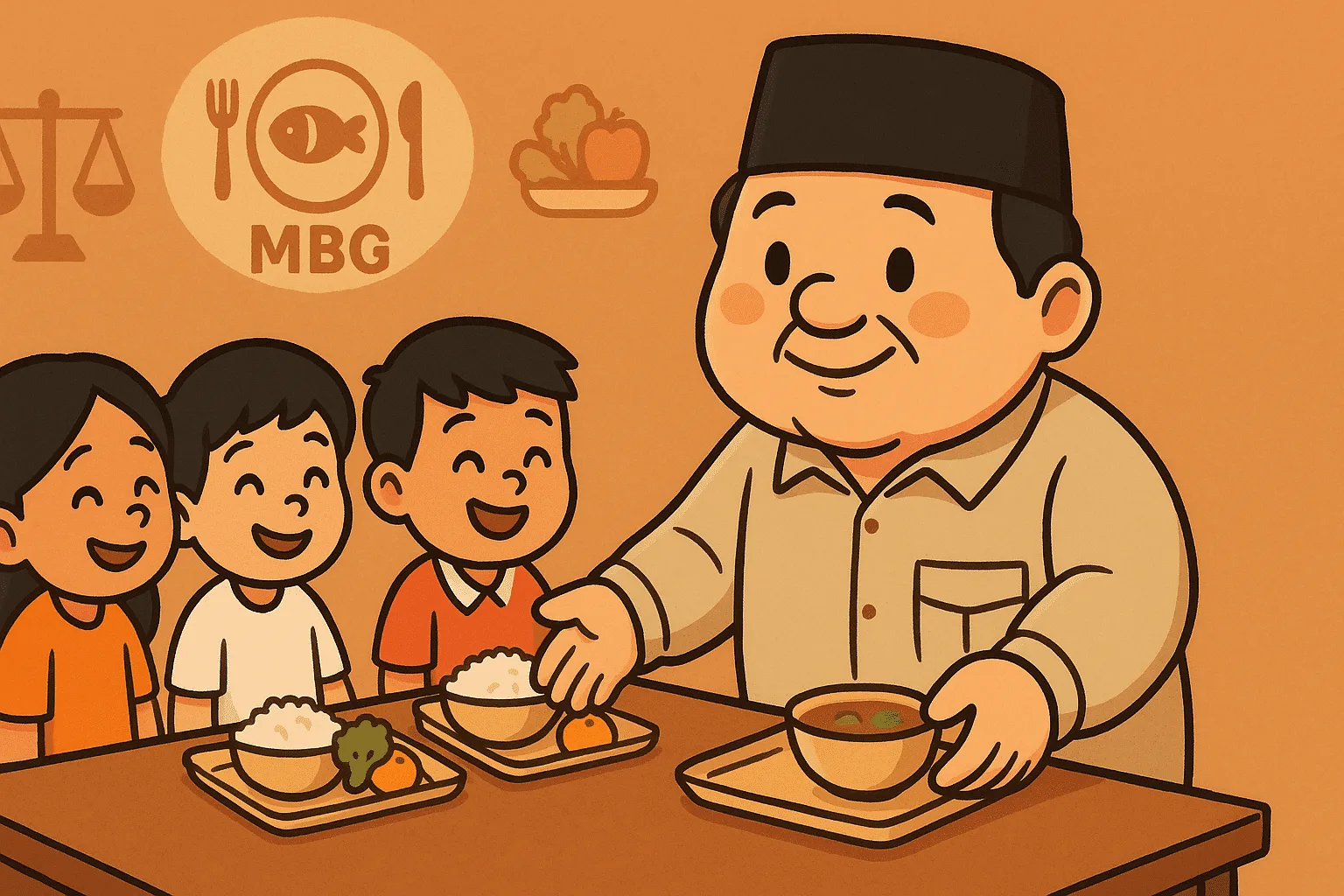
Legal Literacy - The Free Nutritious Food and Drink Program (MBG) implemented by the Prabowo Subianto administration brings a breath of fresh air to social policy. This policy is not only an instrument to reduce malnutrition rates among Indonesian children but also reflects the basic principles of human rights, especially the right to life and the right to adequate food. If implemented with a clear vision and mature strategy, this policy has the potential to be a milestone in systemic change in ensuring people's welfare, in line with AstacitaPrabowo and the mandate of the constitution UUD NRI 1945.
Human Rights, Right to Life, and Right to Food
The right to food is not just assistance. It is a human right recognized in the Indonesian constitution and in international law. Article 28A of the 1945 Constitution guarantees the right to life, while Article 28C affirms the right to achieve welfare, including access to nutritious food. Article 34 even clearly states that the state is responsible for meeting the basic needs of the people. The Universal Declaration of Human Rights (UDHR) and the International Covenant on Economic, Social, and Cultural Rights (ICESCR) also affirm that everyone has the right to an adequate standard of living, including access to nutritious food. This means that MBG is not just a policy of state generosity, but a concrete form of government responsibility in guaranteeing the rights of the people.


Lessons from India: Amartya Sen's Thoughts and the Free Lunch Scheme
Economist and thinker Amartya Sen from India argues that hunger is not just a result of food scarcity, but more of a failure of distribution and unequal economic access. In this context, MBG can be a strategic tool to overcome social inequality by ensuring that all children, regardless of economic status, have equal access to nutritious food. Learning from the experience of other countries, India has a similar program calledMidday Meal Scheme, a free lunch program for every student in school that aims to overcome malnutrition while increasing education participation rates. This program has shown that rights-based and inclusive food policies can create long-term impacts on people's welfare. Indonesia can learn from India's experience by ensuring that MBG is not just a short-term project, but also has an efficient distribution system, transparency in implementation, and a strong evaluation mechanism so that this program does not just become a temporary political promise.
Critical Pedagogy and Social Justice in MBG Policy
In the context of social justice, MBG policy must be designed to reduce the inequalities that have been the main cause of malnutrition in Indonesia. John Rawls, in his theory of justice, emphasizes that justice is not just about equality, but also about giving special attention to the most vulnerable groups. MBG is in line with this principle because it provides fairer access for those who are less able to meet their daily nutritional needs. Furthermore, this policy reflects the values ofAstacitaPrabowo, especially in aspects of equitable welfare, poverty alleviation, and improving the quality of life of the community. If implemented well, MBG could be a concrete step to build a more sustainable foundation of welfare for future generations.
In the perspective of critical pedagogy developed by Paulo Freire, public policy should not only betop-downand technocratic, but must also involve the community in the process. This means that the community must understand that food is a right, not just social assistance provided voluntarily by the government. This critical awareness is important so that the community does not only become passive beneficiaries, but also actively ensures that MBG policy runs transparently and effectively. If the community only sees MBG as a form of state generosity without understanding their right to food, then this program risks becoming a populist policy that loses its long-term impact. Therefore, Freire emphasizes that critical education must be part of this policy, by educating the community to be able to actively participate in ensuring that this policy runs well and sustainably.
Although MBG is a big step in ensuring social welfare, this program must be faced with good infrastructure readiness and distribution mechanisms. Some of the main challenges that must be anticipated include:
- Budget Sustainability– The government must guarantee that MBG funding is not dependent on short-term political or economic conditions.
- Equitable Distribution– An effective logistics system must be built so that every child throughout Indonesia, including in remote areas, can benefit from this program.
- Food Quality and Safety– The government must ensure that the food provided in the MBG program meets high nutritional and food safety standards.
- Transparency and Accountability– The public must be involved in the supervision and evaluation of this program to prevent misuse of the budget or inefficiencies in its implementation.
Concluding Remarks
The MBG program is not just a social assistance policy, but also an implementation of human rights, especially the right to food and the right to life guaranteed in the Indonesian constitution. By examining the experiences of India and the thoughts of Amartya Sen, Indonesia has a great opportunity to make this policy a transformative instrument that is not only oriented towards meeting short-term needs, but also as a foundation for building a more just and prosperous society.
For this program to be truly effective and sustainable, public participation in overseeing its implementation is a key factor. With critical awareness and active public support, MBG can be a real step in creating a healthier and more empowered generation. Now is the time for the government and the public to join hands to ensure that the right to food is truly realized for all Indonesian citizens.















Comments
0Share your perspective politely, stay relevant, and focus on the article. Comments appear after moderation.
Join the discussion
Write a clear, polite response that stays on topic.
No comments yet. Be the first to discuss.
Comments will appear after moderation.