

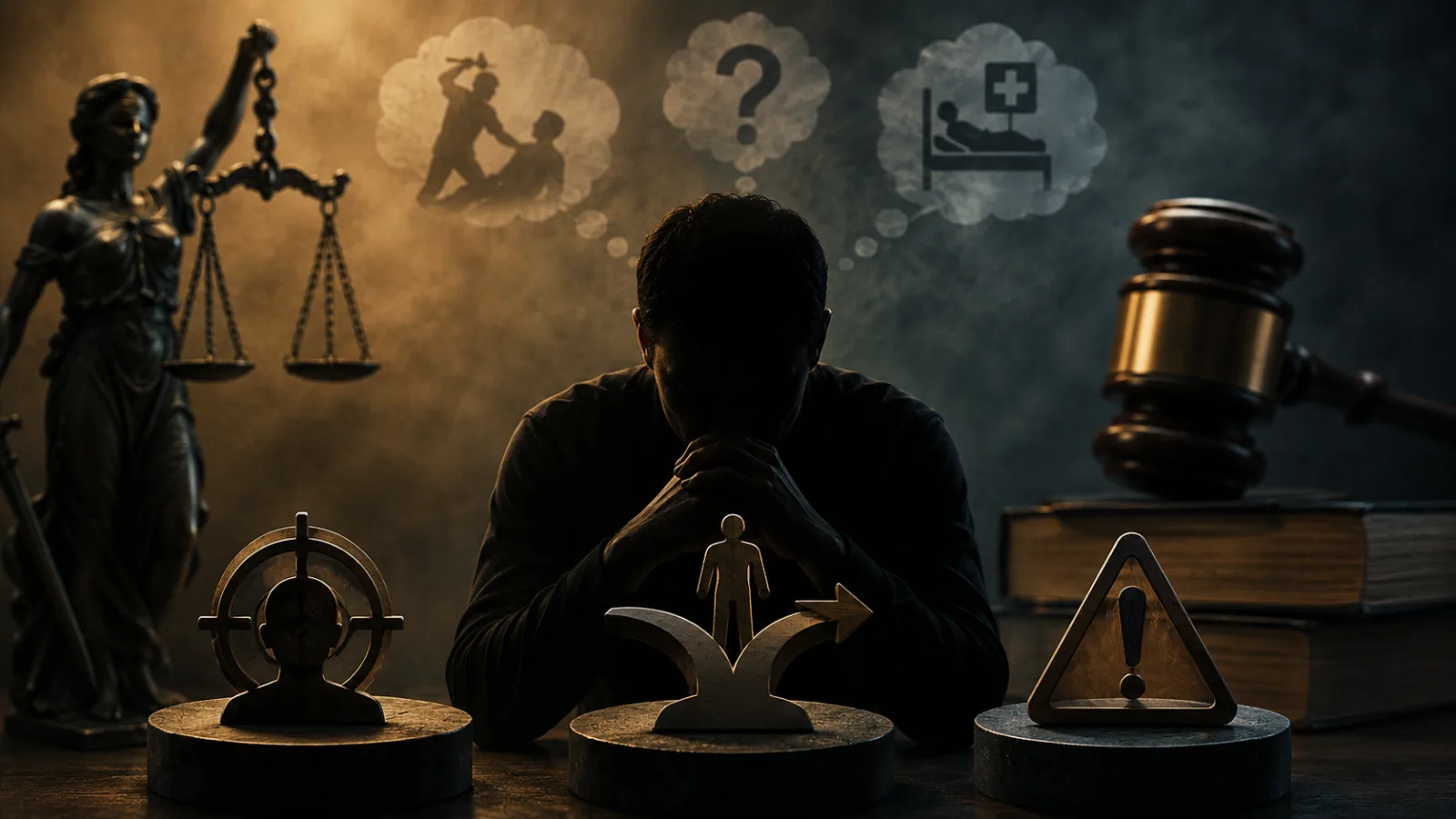
Legal Literacy - In the criminal justice system, not all harmful acts can be immediately punished. One of the most fundamental distinguishing keys is a crucial concept called mens rea or evil intent. The process of proof mens rea is at the heart of criminal law enforcement, an effort to uncover the "inner state" of a perpetrator at the time the crime occurred (tempus delicti).
Without proof of this subjective element, an act—even if it results in great loss or loss of life—may simply be an accident without criminal liability. The biggest challenge is its nature mens rea which is abstract and hidden. No technology can scan the contents of a person's mind. Therefore, the law provides a set of instruments through legal evidence to build a logical bridge from visible facts to invisible intentions.


Understanding the Spectrum of Intent: From Dolus to Culpa
Before discussing how to prove it, it is important to understand that evil intent has several levels or gradations. Legal doctrine, which is now also affirmed in the New Criminal Code (Law No. 1 of 2023), categorizes it as follows:
1. Intent (Dolus)
This is the most severe form of error, where there is a will to commit the act and full awareness of the consequences.
- Dolus Directus (Intent as Purpose): This is the purest form of intent. The perpetrator desires the act and actively aims to achieve the consequences prohibited by law.
- Concrete Example: A hitman accepts a contract to eliminate the life of a target. He then studies the victim's routine, buys a weapon, and shoots the victim to death. Here, the loss of the victim's life is the main goal of the entire series of actions.
- Dolus Indirectus (Intent with Certainty Awareness): The perpetrator does not directly aim to achieve the prohibited consequence, but he is aware that the consequence is certain or very likely to occur as a logical consequence of his actions.
- Concrete Example: Someone wants to get an insurance claim by burning down his shop. He knows for sure that inside the shop there is a night watchman who is sleeping and cannot escape. Although his goal is insurance money, he is aware that the death of the guard is an inevitable consequence of his actions.
- Dolus Eventualis (Conditional Intent): This is a more complex concept. The perpetrator does not want the prohibited consequence to occur, but he is fully aware of the possibility (not certainty) that the consequence will arise. Nevertheless, he still commits the act and accepts whatever the risk, or acts "carelessly".
- Concrete Example: A group of people are racing illegally on a busy highway. They do not intend to hit anyone, but they are aware that their very dangerous actions carry a high risk of causing a fatal accident. When one of them hits and kills a pedestrian, he can be prosecuted on the basis of dolus eventualis because he was aware of the risk and still chose to continue his dangerous actions.
The Art of Assembling Evidence: Instruments for Proving Mens Rea in Court
To prove one of the above forms of intent, the public prosecutor will use legal evidence according to the Criminal Procedure Code to build a solid argument.
1. Analysis of Actions (Actus Reus) as a Reflection of Intent
The act itself is the starting point. Modus operandi or the way the crime was committed is often enough to imply the intent behind it.
- Substantive Examples (White-Collar Crime): In cases of corporate embezzlement, the defendant does not merely "mistakenly transfer" funds. They may create a series of fictitious invoices, forge signatures, and funnel funds through multiple layers of accounts to conceal their tracks. The complexity and sophistication of these methods alone refute the excuse of "error" (culpa) and strongly indicate a planned and deliberate scheme (dolus).
2. The Power of Circumstantial Evidence (Circumstantial Evidence)
This is the backbone of proof. A clue is a conclusion drawn from the correspondence between one fact and another, which together build an undeniable storyline. mens reaExample of a Chain of Circumstantial Evidence (Premeditated Murder Case):
- Pre-Incident:
- The defendant was known to have a large debt to the victim. Witnesses heard the defendant utter threats. The defendant's device's internet search history shows searches for "odorless poison" or "how to disable car brakes". During the Incident:
- CCTV footage shows the defendant being the last person with the victim or being seen at the scene at an odd time. Post-Incident:
- After the victim was found dead, the defendant fled, attempted to destroy evidence (e.g., selling their car), or provided a false alibi that was proven false through cell phone location data. Separately, these facts may not be strong enough. However, when pieced together, this mosaic forms a clear picture of planned malice.
Testimony from witnesses, experts, and the defendant can fill in important parts of the evidentiary narrative.
Example of Expert Testimony:
- Contoh Kesaksian Ahli: In cases of domestic violence, a clinical psychologist can be presented as an expert. Their testimony regarding the defendant's psychological condition or behavioral patterns can help the judge understand the mental state underlying the violence, while also refuting claims of "spontaneous actions without intent to harm."
4. Documents and Digital Evidence as "Written Confessions"
In the digital age, traces of online activity are a goldmine for proving intent.
- Examples of Digital Evidence: In cases of spreading false news (hoaxes), a digital forensics team can recover drafts of provocative narratives from the defendant's computer. Conversations were also found in online groups where the defendant discussed how to spread content to make it viral and trigger unrest. This evidence clearly shows a conscious intention to create chaos.
Conclusion: A Logical Reconstruction
Ultimately, proving mens rea is about presenting a logical reconstruction before the judge. It's not about finding one "ultimate proof," but rather building a solid and layered argument from various pieces of evidence that reinforce each other. The prosecutor must be able to show that from all the facts revealed, the only reasonable conclusion is that the defendant has a mental attitude or malicious intent that is prohibited by law. Understanding this process shows that criminal law not only judges actions, but also considers the underlying mental fault, a fundamental pillar of justice.























Comments
0Share your perspective politely, stay relevant, and focus on the article. Comments appear after moderation.
Join the discussion
Write a clear, polite response that stays on topic.
No comments yet. Be the first to discuss.
Comments will appear after moderation.