Legal Literacy - Gunung Anyar is a name that sounds like a place for hiking, even though if you look for a mountain there, what you usually find is just: new housing, increasingly busy streets, and wind that sometimes carries the aroma of ponds—if you are close enough to the side that still manages to leave traces of the Surabaya coast. The name is “anyar”, all new, all growing, all “wow, there’s this here now”. But precisely because it’s all new, there’s one thing that makes Gunung Anyar feel like it still has a soul: the dinner cart whose sound is more honest than property slogans.

The sound: “tek-tek.”

Not the sound of office chat notifications. Not the sound of meeting calendars. Not the sound of incoming emails that usually make the chest automatically tighten. This “Tek-tek” sound is more humane. A sound that doesn't demand you to be productive. A sound that only says one simple thing: “Hey, eat first.”

And for some reason, in Gunung Anyar, that sound often means one menu that is like the cultural identity of Surabaya people: Tahu Tek (Tofu with Peanut Sauce).

I like to imagine that tahu tek is not just food, but a kind of event. If nasi goreng (fried rice) is a quick decision when hungry, tahu tek is more like an internal negotiation process. There is a ritual. There is waiting. There is a small dialogue that, if written, could become a family drama: “Eat tahu tek, but diet tomorrow.” Then the next day, tahu tek again, because life sometimes doesn't need consistency, it needs a sense of security.

And tahu tek in Gunung Anyar has an interesting social context: it lives in a space that is changing. On one side, there are cafes and restaurants with warm lights, menus in English, and drink prices that sometimes make us stare at the bill while asking, “Is this coffee or an installment?” On the other side, there is a simple cart that, when viewed up close, has faded paint, its small wheels seem to hold many stories of potholed roads, but the aroma—that aroma never fails to awaken something in the head.

The aroma of fried onions meeting hot oil. The aroma of crushed peanuts. And especially: the aroma of petis (fermented shrimp paste) that for some people is “Surabaya's fragrance”, for others it is “why does it smell fishy”, and for me personally it is a kind of honesty test: you can pretend to like many things, but in front of petis, people are usually immediately exposed.

Tahu tek is a food that doesn't really care about image. It doesn't need plating. It doesn't need artisanal ceramic plates. It comes with a portion that is what it is and a sauce that doesn't fall into the “instagrammable” category, but falls into the “if it gets on clothes, welcome to eternal stains” category.

I always believe that good food usually has one characteristic: it is not afraid to make you a little messy.

In Gunung Anyar, tahu tek often appears as the end of the day. You just got home from work, your head is still hot from targets and group chats, or after college, or after picking up the kids, or after a small argument with your partner over trivial matters that are actually not trivial. Then you pass the road, see the cart, hear “tek-tek”, and suddenly life feels like it has other options besides thinking about things you can't fix that night.

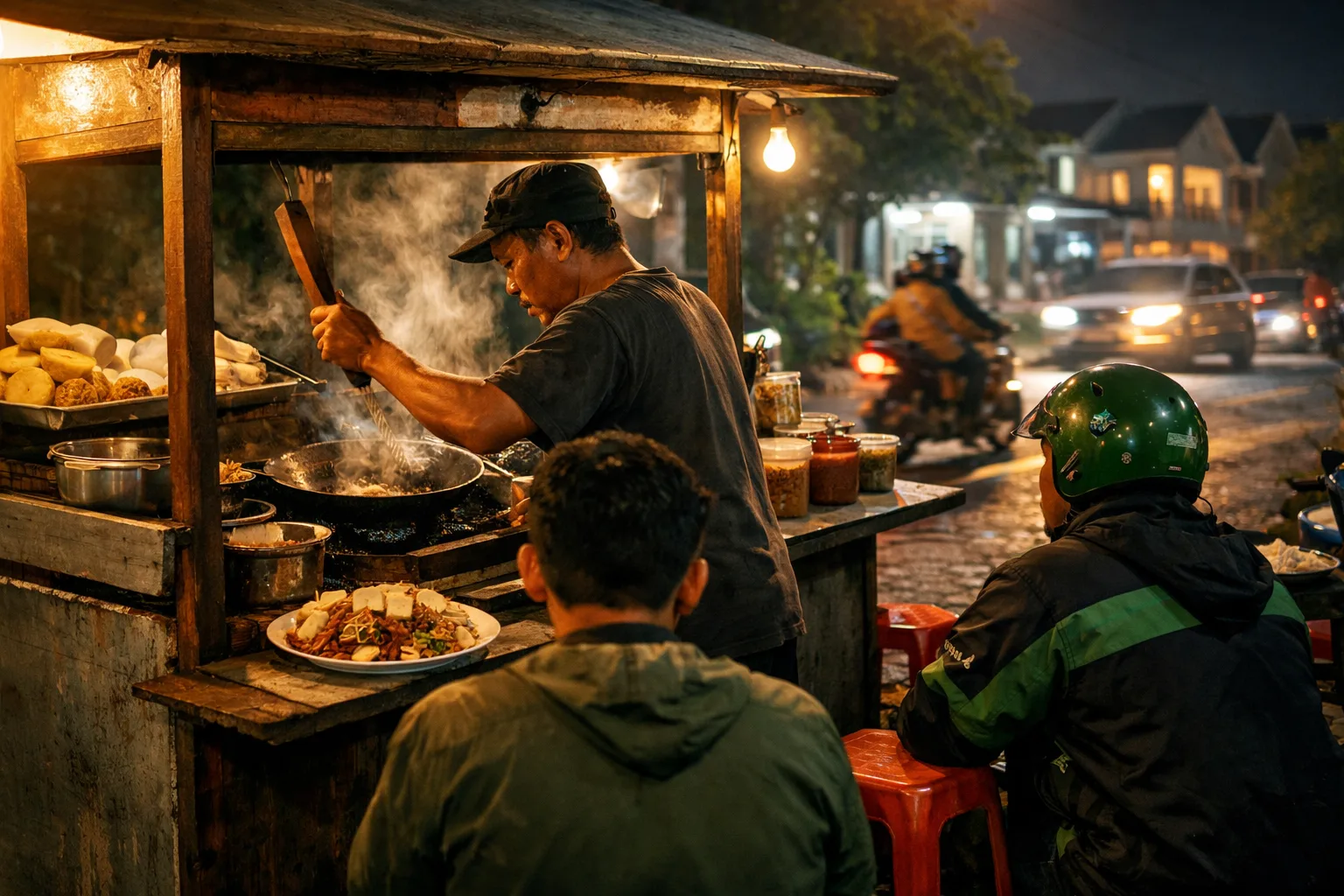
You stop. Sit on a plastic chair that makes a sound like a subtle protest when occupied. In front of you, the seller—usually called “Cak”, even if that's not their name on their ID card—starts working with a rhythm that, when you think about it, resembles a musician. Knife, mortar, pestle, spoon, all have a role. The “tek-tek” sound sometimes comes from the cutting tool, sometimes from the collision of tools in the pan, sometimes from the way the seller sets the tempo. The sound is repetitive but calming, like a metronome reminding: take it slow, everything has a process.

Advertisement
Read without ads.
Join Membership

On his work table, there is cut lontong, prepared fried tofu, potatoes that are often a surprise because tahu tek secretly has two camps: the camp that likes lots of potatoes and the camp that considers potatoes a distraction. There are bean sprouts that are sometimes given, sometimes people forget to ask for them, then regret it when they see a neighbor's portion that looks “more complete”. There are crackers that almost always serve as a closing, like an epilogue that makes the story feel complete.

The most decisive thing is of course the sauce. Peanuts, petis, garlic, chili—a composition that, if measured incorrectly, can be a tragedy. Too sweet, tahu tek turns into a children's birthday snack. Too salty, it becomes a punishment. Too spicy, it becomes an unnecessary masculinity challenge. But if it's just right, tahu tek turns into something difficult to explain other than with the sentence, “Nah, iki loh.” (Well, this is it).

And that's where I see the small miracle of tahu tek in Gunung Anyar: it is often more consistent than many things in our lives.

You can move to a different rented house, change jobs, change crushes, change life principles from “I want to live healthy” to “I need happiness”, but when the tahu tek sauce is just right, you will feel a stability that is rarely found in weekly meetings.

Tahu tek, in a very Surabaya way, teaches that delicious taste doesn't have to be complicated. It only needs someone who understands when to add petis and when to stop. This is a lesson that, if applied in life, might reduce many conflicts: knowing when enough is enough, knowing when to continue, knowing when to add more, knowing when to say “wes, segini ae.” (okay, this much is enough).

In Gunung Anyar, tahu tek is also a meeting place for people from various social classes without the need for a “team building” session. One table can be filled with students whose wallets are thin but their spirits are high, sitting next to fathers who have just come from the minimarket to buy cigarettes and mineral water, or mothers who will soon be going home to their cluster houses but tonight want to experience “street snacks” to remember that life doesn't always have to be neat.

I once saw a scene that I thought was very typical of Surabaya: an ojol driver came, ordered tahu tek to go, while one hand was still holding his cellphone, his eyes monitoring the application. Behind him, there was a young man complaining of hunger while joking, “Cak, hurry up, I'm like someone who's lost.” The Cak just chuckled, his hands still working. There is no drama. There is no artificial “service excellence”. All that exists is reality: everyone is hungry, everyone wants it fast, but good food has its own tempo.

And that time, strangely, taught us to be patient. At least five to ten minutes of patience—which for a generation accustomed to instant delivery is like spiritual practice.

Advertisement
Read without ads.
Join Membership

If you eat on the spot, the *tahu tek* experience is not just about taste. There are visual and social aspects that cannot be delivered via application. You see the seller's hands that already memorize the pattern. You see how he measures without scales. You hear how he interacts with customers: short, straightforward, sometimes sarcastic, but never feels mean. You see the people around you who are equally hungry, equally waiting, equally wanting to go home with a full stomach and a slightly lighter head.

In Gunung Anyar, which is increasingly modern, *tahu tek* is like a marker that the city has not completely turned into a showcase. It reminds us that Surabaya, with all its development and housing, still has room for things that are not polished.

*Tahu tek* also has a honesty that is difficult for “viral” foods to compete with. It does not ask to be validated through content. You don't need to record slow motion peanut sauce flowing. You don't need to make a “hidden gem” caption as if the seller is a treasure that has just been discovered, even though he has been selling since before you had an ID card.

*Tahu tek* doesn't need you. You need *tahu tek*.

Because *tahu tek* is Surabaya's version of comfort food: not spoiled, not romantic, but loyal. It doesn't say “I will heal your inner wounds”, but it does something more realistic: making you forget for a moment that the inner wounds exist, because your mouth is busy chewing and your head is busy saying, “Wow, the *petis* is great.”

There is one thing that is also interesting: *tahu tek* is often a food that forces you to come to terms with your local identity. For example, about *petis*. *Petis* is an ingredient that has a unique reputation: fanatically loved and hated very personally. People who like *petis* can talk at length about its “distinctive aroma”, “the umami taste comes out”, “this is what makes it different”. People who don't like *petis* can also talk at length, but the content is usually about trauma.

In Gunung Anyar, I see *petis* as a kind of intergenerational bridge. Parents who are used to it will say, “This needs more *petis*, Cak.” Young people who are just trying it will start with a defensive sentence, “I'll try a little first.” Five minutes later, the young person is usually silent, then orders again another time with a pretend casual style: “Cak, the usual.”

*Tahu tek* has the ability to change people without lecturing.

And don't forget the texture element, which if dissected can be a serious discussion material even though this is just food: the softness of the *lontong*, the tenderness of the tofu, the crispness of the crackers, the freshness of the sprouts, and the sauce that binds everything together like a social adhesive. Everything meets in one plate, balancing each other, and making you realize that a good life is often not a perfect life, but a life with the right composition.

Gunung Anyar itself is a fitting backdrop for it. It is not a city center with colonial nostalgia or photogenic old buildings. It is more like a transitional space: a region that grows, changes, and constantly adjusts. In such a space, tahu tek is present as something constant. It is like a small reminder that in the midst of change, we need familiar things.

Advertisement
Read without ads.
Join Membership

There are moments when you come home late at night, the streets of Gunung Anyar are not as crowded as during the day, the wind is a bit damp, and the lights of new houses look like residential versions of stars. Then you see a tahu tek cart, and you realize: what we are looking for after a day of “being an adult” is not motivation, not Instagram quotes, not aesthetic “me time”. What we are sometimes looking for is just: sitting for a while, eating something warm, and hearing the “tek-tek” sound that seems to say, “Wes, ojo dipikir abot-berat.”

And that's where tahu tek in Gunung Anyar wins, not as a luxury food, but as a small experience that makes life feel more sensible.

Even if you take it home, eat it at home, that experience is still there. The paper or styrofoam wrapping will be opened with simple enthusiasm. The smell of petis will spread like an announcement that today is over. The crackers will still be crispy if you are quick. If you are not quick, the crackers will be soggy and you will learn another philosophy of tahu tek: some things must be enjoyed in their time.

Tahu tek also teaches that happiness is sometimes not a big goal. It can be a small decision: stopping for a moment on the side of the road, ordering a regular portion, maybe adding an egg if you want to pamper yourself, then eating without thinking about whether it is “healthy” or not. Because a healthy life is ideal, but a happy life is an urgent need, especially when your day has just been crushed by work.

Of course, there are always small dramas. Sometimes you come and the seller is sold out. Sometimes you come and the queue is long. Sometimes you come and it rains, making you have to wait while enduring the cold air that rarely appears in Surabaya. But those dramas actually make tahu tek feel like a part of life, not a product that you can click and finish.

Gunung Anyar may not have mountains, but it has something more useful for urban humans: a small place to stop and remember the taste. And tahu tek is one of the markers.

In the end, it may be true that the city is changing. Roads are increasing, shophouses are growing, housing is getting denser, and everything is moving in a more modern direction. But as long as there are still people pushing carts, hitting their tools to make a “tek-tek” sound, mixing peanut-petis sauce with hands that know it by heart, and serving a plate of tahu tek to anyone who is hungry—as long as that still exists, Gunung Anyar will still have something that applications cannot replace: a taste that makes us feel like we are home, even if we only stop for a moment.

And perhaps that is the most important thing about tahu tek in Gunung Anyar: it is not just food. It is Surabaya's way of saying, in a style that is not romantic but very sincere, “Wes, mangan sik. Mengko dipikir maneh.”