
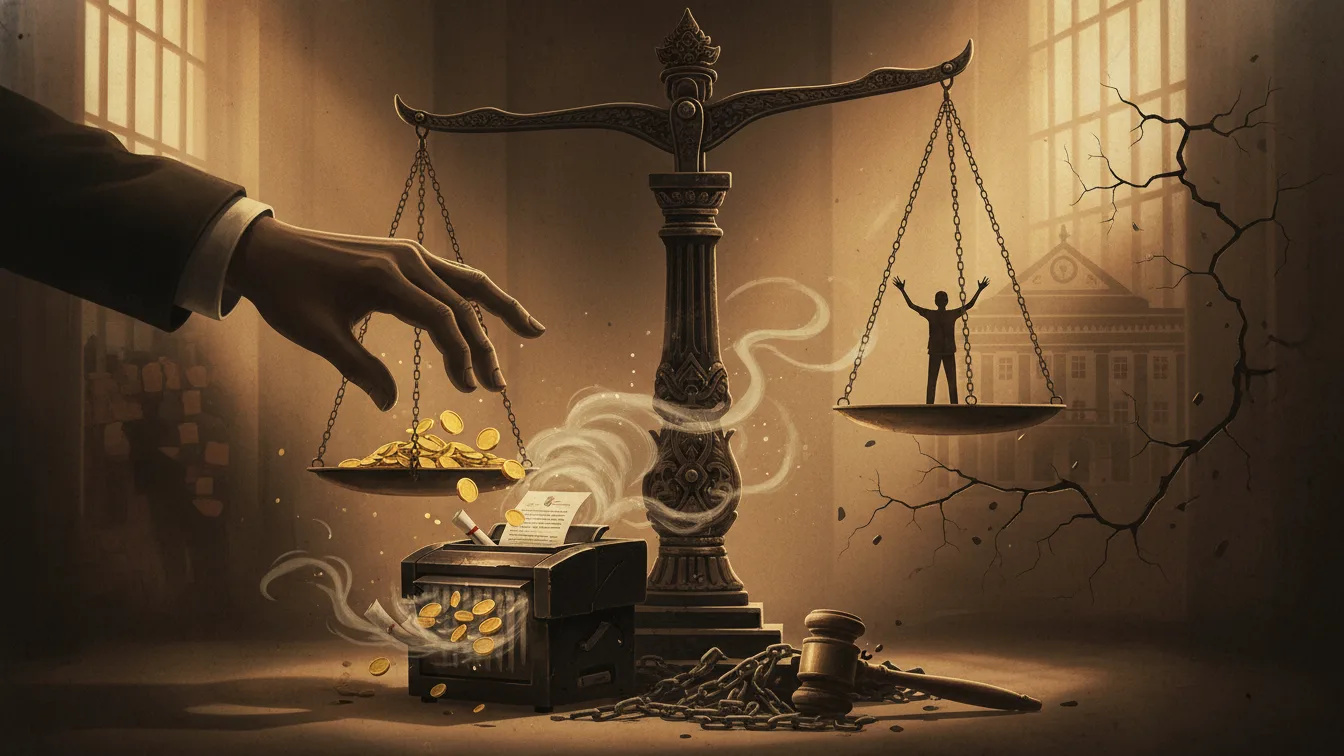
Systemic Damage
The reason often used to justify the President's move is that the case is not worthy of being included in the realm of corruption crime. For example, an official's discretion that does not benefit himself but harms the state due to external factors is often beaten with Article 2 or Article 3 of the Anti-Corruption Law. This is where the root of the real problem lies. If we agree that the act does not deserve to be criminalized, then what is wrong is not only the fate of the defendant, but the formulation of the law.
The use of amnesty and abolition in cases like this is a tacit admission by the state that our Anti-Corruption Law is problematic. There is over-criminalization there. There is a blurring of the lines between state administrative law and criminal law. However, the state's response is paradoxical. Instead of conducting a legislative review or revising the law, the President chooses to use his prerogative. This is like patching a flat tire with duct tape, while the nail is still stuck there.


Ideally, that great political energy should be directed at fixing the root of the problem. The President, as the holder of legislative power together with the DPR (Article 5 paragraph (1) jo Article 20 of the 1945 Constitution), has a much more powerful and have a long-term impact rather than just an amnesty.
This condition is exacerbated by the overlapping of our legal regimes. The Law on Governmental Administration actually provides a corridor that administrative errors should be resolved administratively, not criminally (the principle of ultimum remedium). However, in practice, law enforcement officials often ignore the Law on Governmental Administration and immediately jump to the Anti-Corruption Law. If the President wants to protect state apparatus and its citizens from criminalization, the right step is to order the Attorney General and the Chief of Police (who are directly under his command) to create strict prosecution guidelines, or issue a Government Regulation that reinforces these limitations. Not by waiting at the end of the process and giving a "gift" of forgiveness.
Total Reform
It is time for us to stop idolizing shortcuts. The solution to the mess in corruption law enforcement—where innocent people can get caught—is legal reform, not a fire sale of forgiveness. The President must dare to take unpopular but strategic steps: leading the reform of corruption crime regulations.
The first thing to do is to revise the articles in the Anti-Corruption Law that have been the entry point for policy criminalization. The element of "detriment to state finances" must be strictly redefined so that it does not target losses that are administrative or business risks alone. Second, the President must ensure harmonization between the Anti-Corruption Law and the Law on Governmental Administration works at the implementation level. Law enforcement must be forced to submit to the internal oversight mechanism of government apparatus (APIP) before moving into the criminal realm.
If the President continuously uses amnesty and abolition as solutions, we are concerned that the presidential institution will turn into a kind of "Presidential Decree counterpart" that decides cases based on political discretion, not juridical considerations. History records that excessive power in granting pardons without being balanced by system improvements will only create new legal uncertainties.
In the end, the legacy (legacy) of a President is not how many people he saved from prison through a piece of Presidential Decree, but how solid a legal system he built so that no more innocent people go to jail. We long for a country where justice is present through the judge's gavel and the clear sound of the articles of law, not through the golden ink of clemency or amnesty that is anxiously awaited. Stop this shortcut "habit", and start repairing our legal highway that has been damaged and riddled with holes for too long.














Comments
0Share your perspective politely, stay relevant, and focus on the article. Comments appear after moderation.
Join the discussion
Write a clear, polite response that stays on topic.
No comments yet. Be the first to discuss.
Comments will appear after moderation.