

Indigenous People and Administrative Rights Revocation
One of the most serious dimensions of mining cruelty in Kalimantan is the revocation of indigenous people's rights through legal mechanisms. Land that has been collectively managed for hundreds of years is remapped as a concession area. The legal identity of indigenous people is questioned, while company permits are considered valid without free and informed consent.
This is not merely an agrarian conflict; it is a denial of the principle of substantive justice. When the law trusts investment documents more than the living testimony of the people, then the law has lost its ethical function.


The state cannot claim justice if it only recognizes rights that are easily administered, but rejects rights that are born from history and human relations with the land.
Economic Arguments and Accountability Failures
Mining is often justified on the grounds of its contribution to state and regional revenue. However, this argument is rarely accompanied by a complete accountability calculation. What is the cost of environmental restoration? What is the burden on public health? What is the lost economic value due to damage to agriculture, fisheries, and forests?
Without honest ecological and social accounting, claims of economic benefits become an illusion. The state appears to gain revenue, but the community bears long-term losses. When costs are socialized and profits are privatized, then development has turned into institutionalized injustice.
An economy separated from legal responsibility is not rationality, but deliberate neglect.
Reset Indonesia
Reset Indonesia cannot begin with new projects or green slogans. It must begin with firm and unambiguous legal reforms.
First, environmental law enforcement must be repressive and preventive. Serious violations should not be resolved with administrative sanctions alone. Serious pollution and neglect of reclamation must be treated as crimes, with real and consistent criminal consequences.
Second, the licensing system must be restructured transparently. A thorough audit of mining permits in Kalimantan must be carried out, with the courage to revoke permits that violate the law or are in critical ecological areas. A moratorium on new permits in primary forest areas and river basins must be a legal policy, not just discourse.
Third, reclamation guarantee funds must be managed strictly and independently. The state should no longer trust corporate promises without public oversight mechanisms. Reclamation must be measured through clear and verifiable ecological indicators.
Fourth, the rights of indigenous peoples must be recognized as full legal subjects. Without this recognition, conflicts will continue to recur, and the law will continue to favor the powerful.
The Politics of Courage and State Responsibility
Reset Indonesia demands the political courage to confront vested interests. There is no change without risk, and no justice without courage. The state must choose: protect destructive investments or protect the lives that sustain this nation.
Legal courage is not an anti-development stance. On the contrary, it is the foundation of long-term development. A state that fails to protect the environment and its citizens will pay a much higher price in the future in the form of ecological crises, social conflicts, and loss of legitimacy.
A State Worthy of Being Called Just
A state deserves to be called just not because it is rich in resources, but because it is able to restrain itself. Kalimantan today is a stark reminder that without strict legal restrictions, natural wealth turns into a curse.
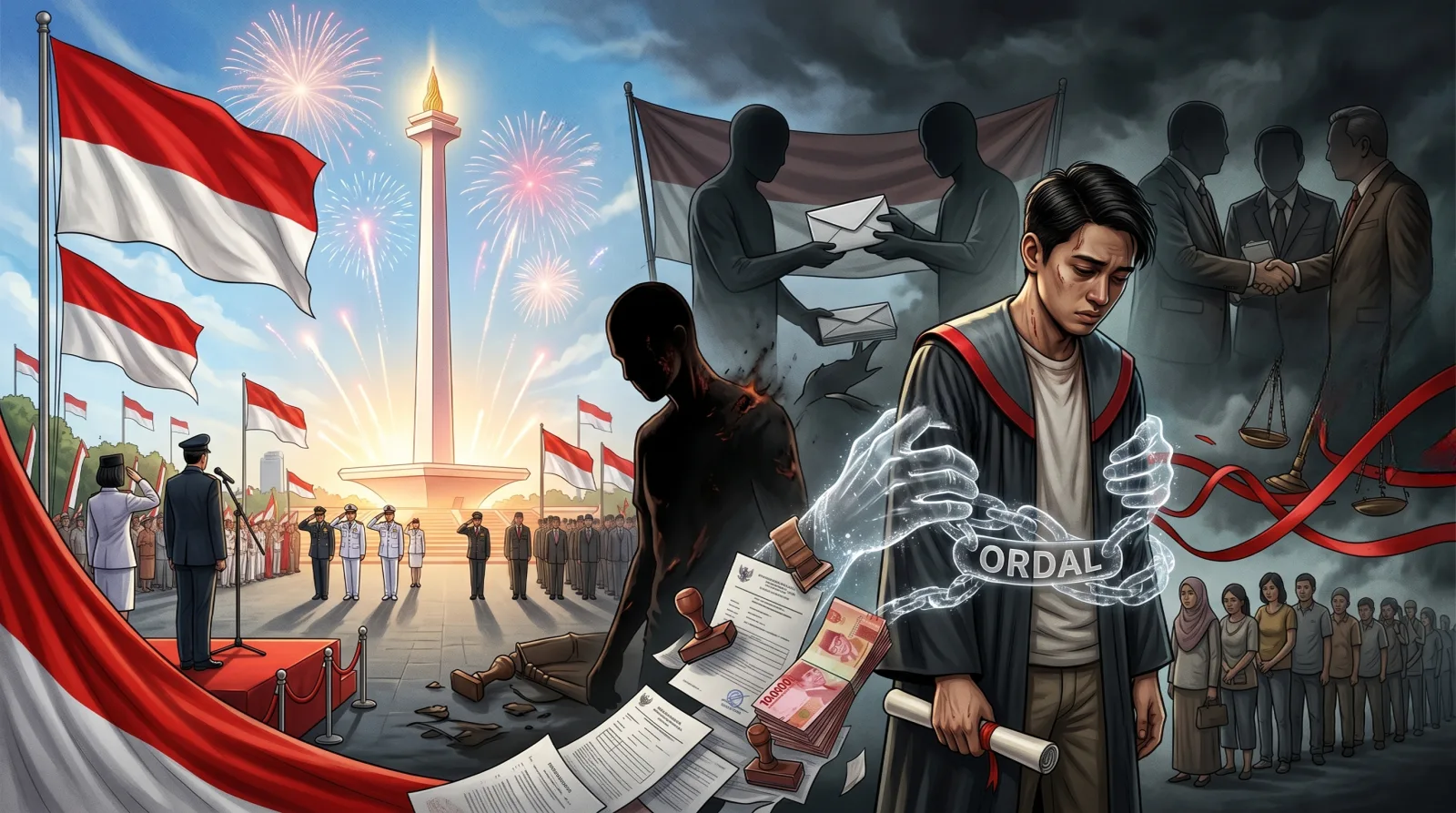
Resetting Indonesia means breaking the cycle of legalized cruelty. It means restoring the law to its most fundamental function: protecting the weak, limiting the strong, and protecting life from justified greed.
If the law continues to negotiate with destruction, then what collapses is not only forests and rivers, but also the meaning of justice itself. But if the state dares to stand firm, say enough, and act consistently, then Kalimantan will not be remembered as a victim of development, but as a turning point in national courage.
That is where resetting Indonesia is no longer a promise, but a decision.













Comments
0Share your perspective politely, stay relevant, and focus on the article. Comments appear after moderation.
Join the discussion
Write a clear, polite response that stays on topic.
No comments yet. Be the first to discuss.
Comments will appear after moderation.