
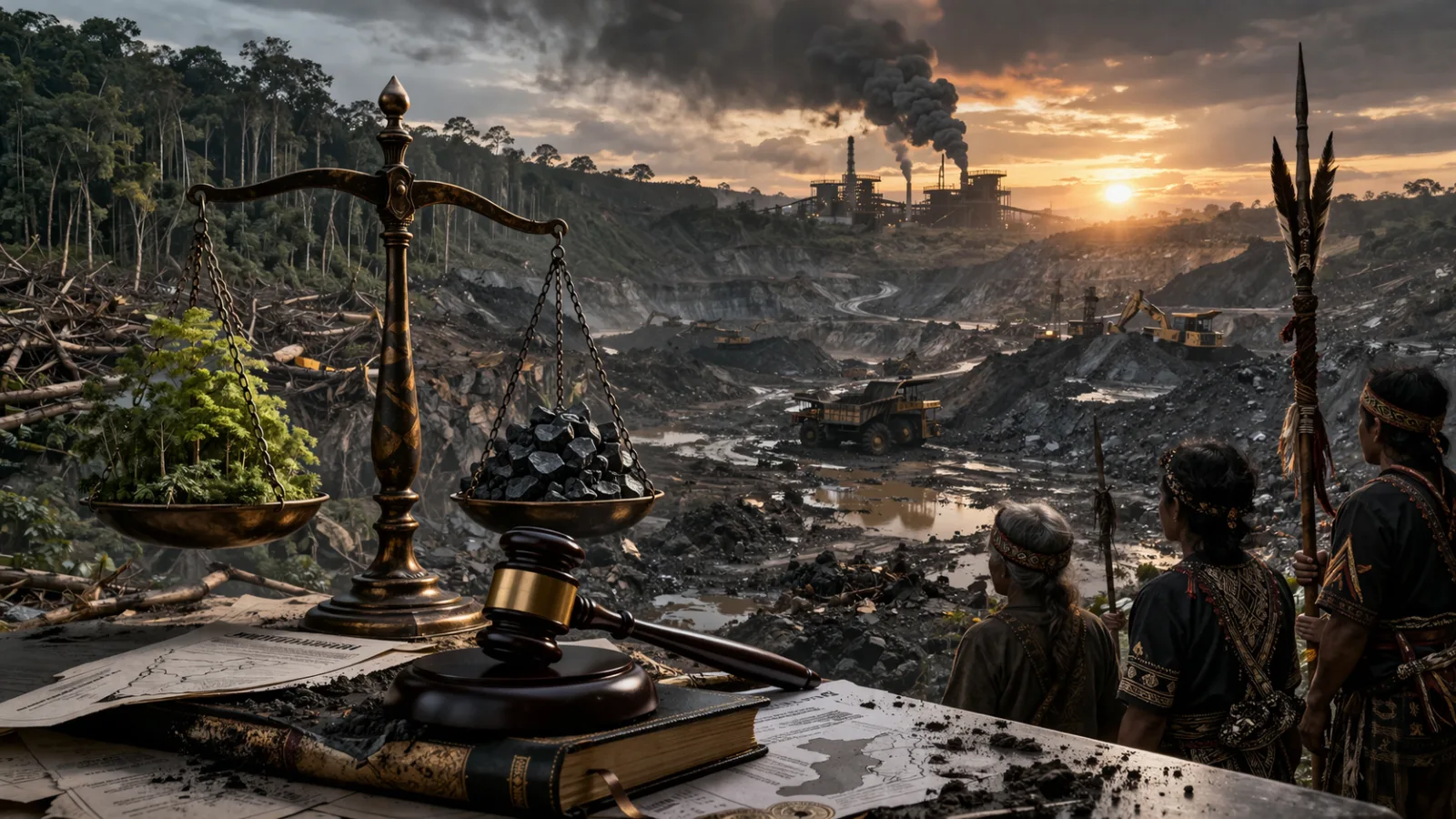
Ecology as a Victim of Development Politics
Ecological damage in Kalimantan cannot be separated from the political choices of national development. When economic growth is positioned as the highest goal, while the environment is treated as a negotiable variable, then the destruction of nature becomes a cost considered reasonable.
Lost forests mean the loss of life support systems: water storage, local climate control, and biodiversity. Polluted rivers mean the loss of access to clean water and food sources. Damaged land means the disappearance of the community's economic independence. All of these are not side effects; they are the predictable results of policies that prioritize extraction over sustainability.


However, the state often speaks about the environment as if it were a matter for technocrats—regarding standard quality standards, Environmental Impact Assessments (AMDAL), and compliance reports. This approach fails to understand that ecology is a matter of politics and law: who has the right to damage, who must bear the impact, and who is protected by the system.
The Illusion of Law Enforcement
Indonesia has no shortage of environmental laws. The problem is not the absence of norms, but the selectivity of enforcement. When violations are committed by small actors, the law can work quickly and harshly. But when violations involve major interests, the law often loses its courage.
In many mining cases, environmental violations are resolved through administrative sanctions that do not change behavior. Fines are paid as operating costs, not as punishment. Reclamation is promised, but not seriously monitored. At this point, the law is no longer corrective; it becomes part of the business model.
Even more dangerously, the legal system often fails to provide effective protection for affected communities. When citizens protest pollution or land grabbing, they often face criminalization. The state, which should protect its citizens, is instead present as a tool of repression to maintain investment stability.
A just law is not measured by how neatly it is written, but by who it dares to protect and who it dares to limit.















Comments
0Share your perspective politely, stay relevant, and focus on the article. Comments appear after moderation.
Join the discussion
Write a clear, polite response that stays on topic.
No comments yet. Be the first to discuss.
Comments will appear after moderation.