Between Tom Lembong and Budi Arie: Like Cinderella and a Wolf in Sheep's Clothing

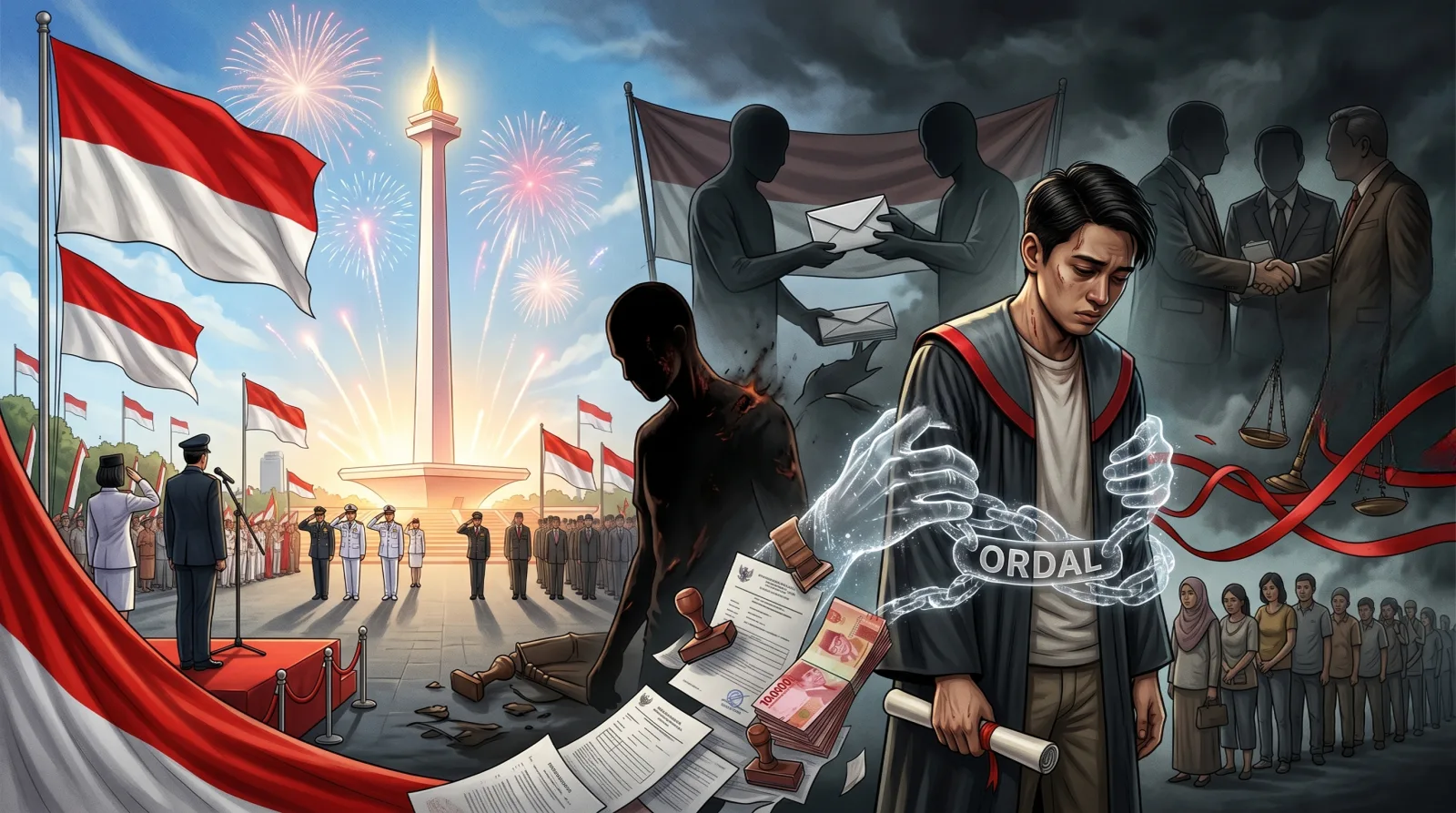
Through the allegory of Cinderella and a wolf in sheep's clothing, this writing criticizes double standards in law enforcement and political loyalty.

Opinion Note
This opinion article was written by a contributor/columnist. The views expressed are entirely the responsibility of the author and do not necessarily represent the views of the editors.
CONTRIBUTOR PROGRAM
You can become a columnist at Legal Literacy.
Submit your legal opinion/analysis writing. If it is published, you have the opportunity to obtain a payout/honorarium in accordance with the provisions.
Legal Literacy - In classical epics, Cinderella never broke her glass slipper. She only lost it—accidentally, without a plan—in a hasty step leaving the party, because the time allowed for her had come to an end. It was from a piece of property left behind that the prince was able to track down and recognize who the owner was: a noble-hearted woman who had been hidden behind the soot of oppression. The fairy tale ends with a resolution that satisfies the conscience: goodness is recognized, falsehood is revealed, and honesty finds its throne.
However, the political stage of this country is not a kingdom in a fairy tale. Here, glass slippers are no longer a guarantee of recognition, let alone legitimacy.
Thomas Lembong, perhaps, came to the power party with a pair of glass slippers called integrity and public conscience. He is not just a technocrat; as a former high-ranking official, he has been in the inner circle of the palace and understands the aroma of power from the closest distance. However, unlike most party participants, Tom chose to speak out openly: about the deviations of democracy he observed, about giant projects that threaten the rationality of public policy. When he did, we immediately realized that the end of his story would not be like a fairy tale.
It was not a prince who came looking for him, but officials who started an investigation. It was not a throne that awaited him, but the potential for a courtroom that awaited him. Tom Lembong is the archetype of Cinderella in the contemporary Indonesian political context: he was removed from the dominant narrative of power because of one "sin"—speaking too early and too brightly. His glass slipper cracked not because of a misstep, but because the palace was more afraid of the reflection of honesty than the echo of soothing lies.
Here we witness an eternal paradox of legal philosophy. Hans Kelsen, in his Pure Theory of Law, views law as an autonomous and neutral normative order from morality. However, Gustav Radbruch, with the bitter experience of the Nazi regime, sharply corrected it: when positive law irreconcilably contradicts justice (unerträgliches Unrecht), then the law loses its validity and substantive justice must be prioritized. Tom Lembong's case drags us into the Radbruchian question: who dares to side with justice when it clashes with the comfort of positive law driven by power?
If the glass slipper of honesty is destroyed, then another costume is celebrated in the palace: a weasel's coat with sheep's wool. In the treasury of fables, the weasel is a symbol of hidden deception. He does not come with roars or aggression; he disguises himself, blends into the crowd, and exploits the naivety of the system for his own benefit. This fable is eternal not because it is fictitious, but because it reflects a recurring political reality.
In contrast to Tom Lembong who was alienated for voicing disruption, Budi Arie Setiadi was present at the palace party in the right costume. He does not disturb the rhythm, but dissolves in it. His name was explicitly mentioned in the indictment of the BTS Kominfo corruption case, related to the alleged flow of funds. But until now, there has been no official summons from law enforcement officials, no adequate public clarification, and no ethical sanctions from the President. His position as minister remains intact.
This phenomenon can be read through the lens of Michel Foucault, who theorized that modern power no longer works repressively, but normatively. Power does not need to silence harshly; it is enough to control discourse—determining who deserves to speak and who must remain silent. Budi Arie seems to understand that in this ecosystem, compliance (compliance) is more valuable than truth. He appears calm, speaks in the jargon of digitalization, and maintains the rhythm so as not to disturb the elite consensus. His loyalty is wrapped in the language of work programs, and therefore, he seems "safe".
Thus, a logic is seen working beneath the surface: violations of ethics and potential violations of the law can be negotiated, as long as they do not threaten political stability. Conversely, moral rebellion—especially when voiced openly—is considered a subversive threat that cannot be tolerated.
Contributor
Support
• Indonesian Legal Literacy
Read more comfortably, while supporting literacy.
Join Membership or submit your article for publication.
Membership
Read without ads, focus more, and access premium features.
Submit Article
Submit your writing—we curate and help publish it. If it is published, you have the opportunity to earn points/payouts according to the terms.



















Comments
0Share your perspective politely, stay relevant, and focus on the article. Comments appear after moderation.
Join the discussion
Write a clear, polite response that stays on topic.
No comments yet. Be the first to discuss.
Comments will appear after moderation.