

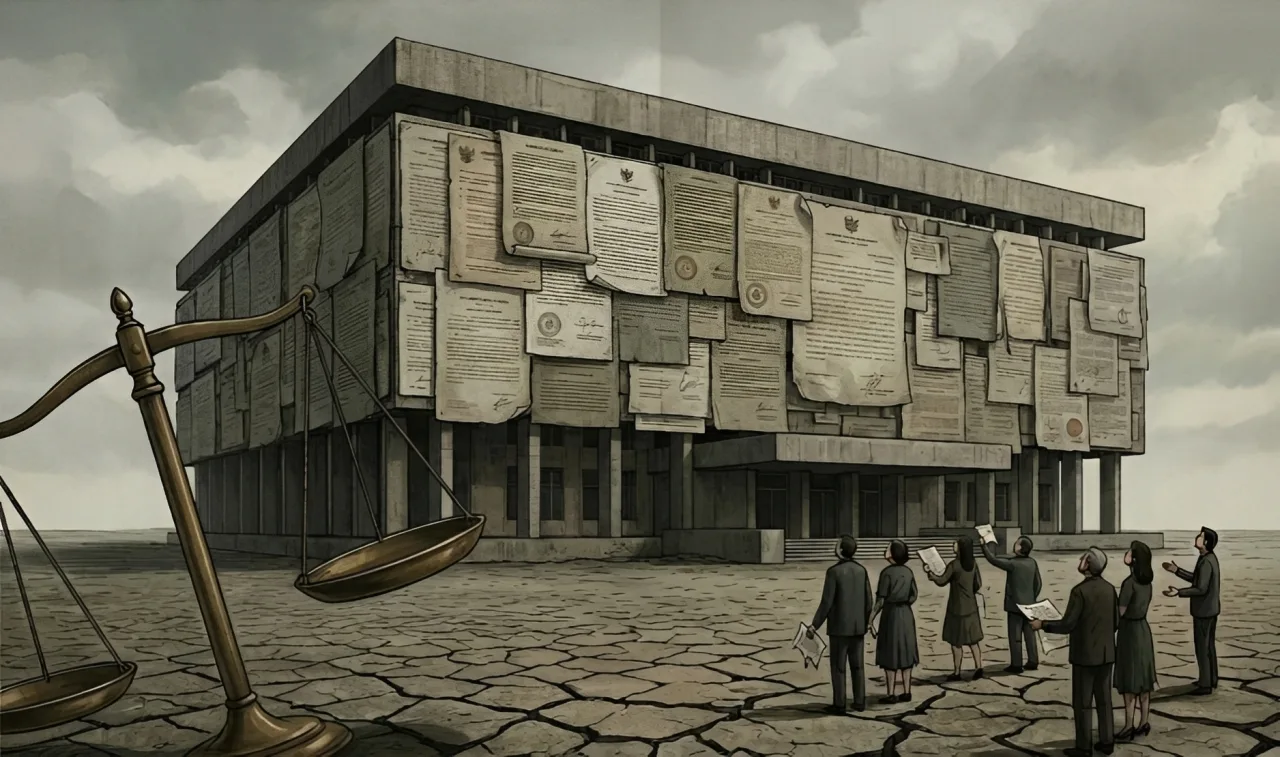
Legal Literacy - Every time the drums of the democratic party are beaten, our public space is filled with a sacred mantra called "neutrality." Circulars are issued massively, integrity pacts are signed, and alert roll calls are held from Sabang to Merauke. However, behind the grand legal ceremonial, reality works with its own logic. In the corridors of government offices, the fate of bureaucrats' careers is often not determined by public service performance, but by the agility to read the direction of the wind of power. This phenomenon is no longer a secret, but a reflection of the distortion of institutionalized legal design. This paper does not merely criticize the failure of practice, but proposes a theoretical proposition that the neutrality of state apparatus today has mutated into a political legal fiction, a juridical construction that is consciously designed not to create impartiality, but to cover up the power relations that grip the bureaucracy.
Distortion of Legal Design and Conceptual Confusion of ASN Neutrality
We are often lulled into the assumption that if the rules are written, the problem is solved. In fact, our positive law tries to build a dividing wall between administration and politics, but structurally hands over the key to politicians. In the framework of institutional theory, this condition is a concrete manifestation of bureaucratic capture. In Indonesia, this theory is not just a concept in an ivory tower, but a living practice: from mobilizing ASN for covert campaigns to politicizing social assistance. If left unchecked, this will evolve into state capture (Hellman et al., 2003), where the state apparatus, including regulations, is fully controlled by the oligarchy for private gain. It is at this point that legal design meets the reality of power, producing a bureaucratic architecture that systematically functions as if designed to fail in stemming intervention.


It is important to clarify this matter clearly so as not to fall into confusion of terms. Neutrality is essentially a normative claim of law that requires impartiality. However, this claim requires independence, namely an institutional structural condition that frees bureaucrats from dependence on politicians. Without structural independence, professionalism is merely a paralyzed ethical-operational mechanism. The problem is, our law demands neutrality (norm) and professionalism (ethics), but consciously refuses to grant independence (structure). As a result, we force bureaucrats to run with their feet tied.






















Comments
0Share your perspective politely, stay relevant, and focus on the article. Comments appear after moderation.
Join the discussion
Write a clear, polite response that stays on topic.
No comments yet. Be the first to discuss.
Comments will appear after moderation.