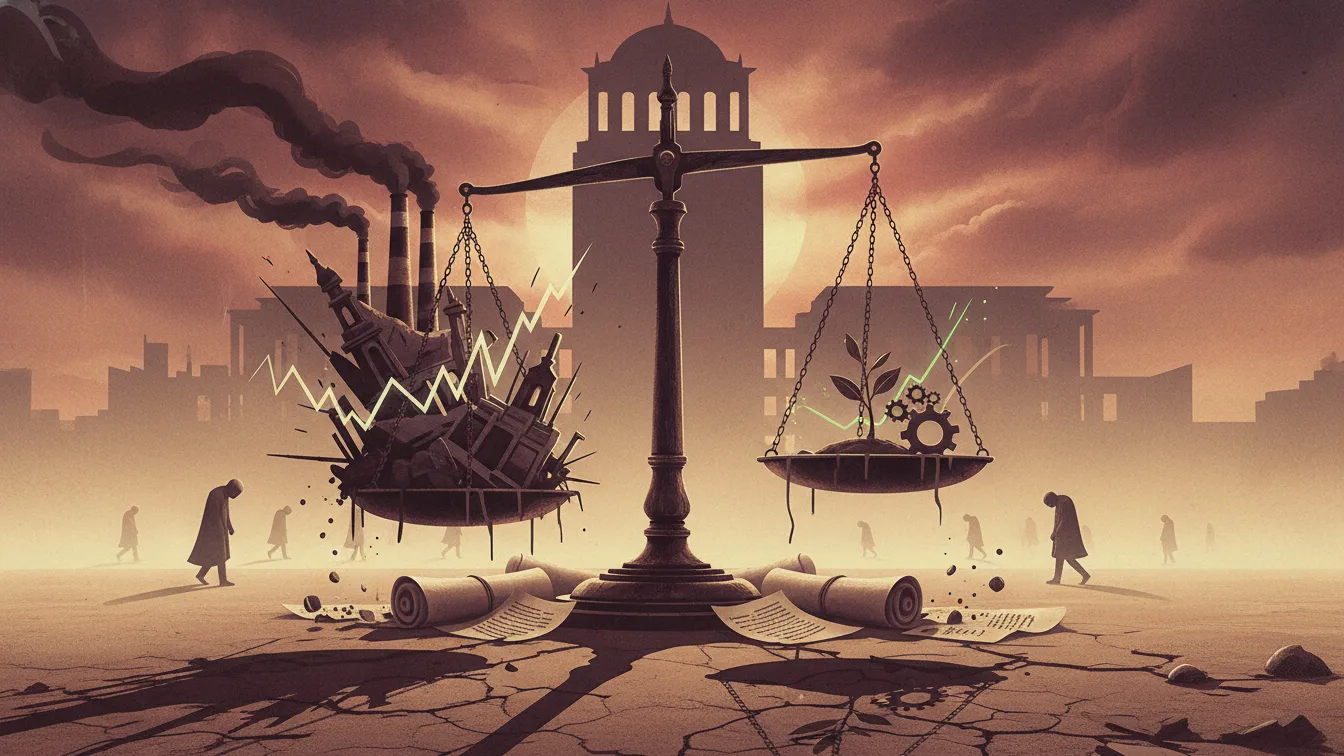
Who bears the cost?
This issue is also not just a matter of the order of time between growth and recovery. This is a matter of power distribution. Who enjoys the benefits of development, and who is forced to bear the burden?
In practice, the economic benefits of extractive projects are often concentrated on business actors, investors, and power networks that have access to policies. Conversely, the ecological costs are distributed to those whose bargaining position is the weakest: indigenous peoples, farmers, fishermen, coastal communities, and communities living around industrial areas, mines, or other large-scale projects. Those whose contribution to the damage is the smallest often bear the greatest impact.


Therefore, the “damage first” logic is never truly neutral. It always contains a political choice about who can be benefited and who can be sacrificed. In this form, development no longer appears as a shared welfare agenda, but as a mechanism for transferring the burden to the most socially and legally vulnerable groups.
The old logic is increasingly difficult to defend.
The argument that the state must first go through a “dirty” development phase is also increasingly difficult to defend. We do not live in the same historical context as the countries that first carried out industrialization without clear environmental boundaries. Today, the ecological consequences of an exploitative economic model are very well known. Cleaner technology options, more preventive policy instruments, and more sustainable development approaches are no longer foreign.
Therefore, modern environmental law should not work with the logic of accepting damage and then fixing it later. Environmental law must move with the principles of prudence, prevention, and intergenerational justice. The task of public policy is not only to manage the consequences after damage occurs, but to limit the causes that from the outset have the potential to destroy the environment and the right to life of citizens.
In the end, the benchmark for development should not stop at how quickly permits are issued or how much investment comes in. A more important measure is whether the state is able to maintain ecological boundaries without sacrificing the constitutional rights of citizens. Because development that is administratively legal is not necessarily constitutionally legal. And when the law is used to normalize damage, that is where the law loses its protective function.


















Comments
0Share your perspective politely, stay relevant, and focus on the article. Comments appear after moderation.
Join the discussion
Write a clear, polite response that stays on topic.
No comments yet. Be the first to discuss.
Comments will appear after moderation.