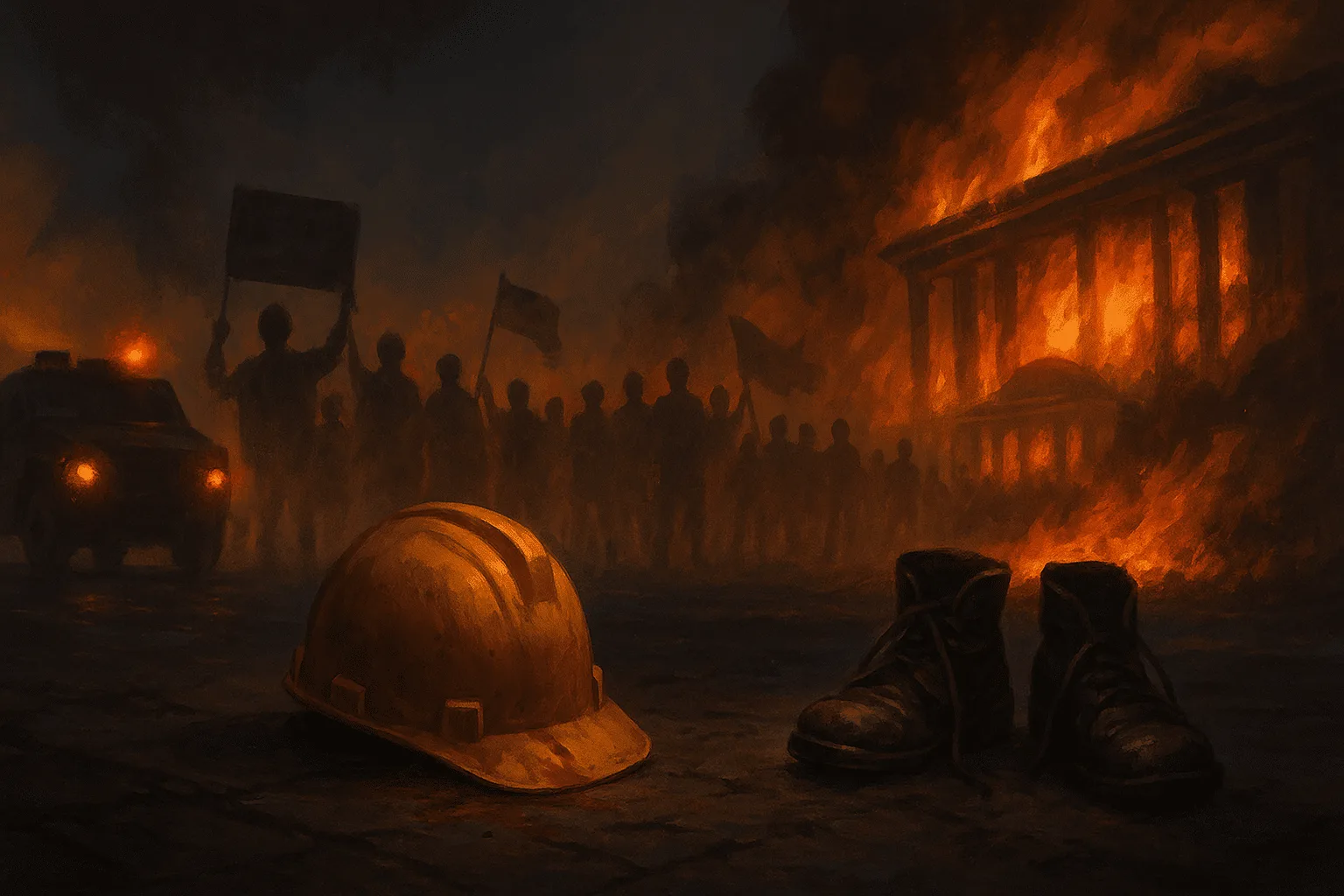
On Thursday, August 28, 2025, thousands of workers took to the streets in Jakarta. The action, centered in front of the DPR/MPR Building and the State Palace, was held under the banner of the “HOSTUM” movement (Abolish Outsourcing, Reject Low Wages). The workers brought six main demands, starting from the abolition of outsourcing to labor tax reform. These demands confirm that the voice of labor is still loud, even though the space to voice aspirations is often narrowed.
However, the aspirations guaranteed by the constitution ended in tragedy. Instead of being a space for dialogue, this series of demonstrations was colored by grief with many lives lost.
Senayan Tragedy: Tactical Wheels That Claimed Lives
Affan Kurniawan, a 20-year-old online motorcycle taxi driver, died after being run over by a Brimob tactical vehicle during a demonstration in the Senayan area on Thursday (8/28/2025). He was treated at RSCM, but eventually died. According to witnesses, the incident occurred around 20.30 WIB when residents protested the tear gas shots that reached the settlement. As the crowd approached the Brimob vehicle, one of the tactical vehicles sped towards the crowd. The crowd scattered, but Affan did not have time to save himself. The Propam Division of the National Police has secured seven members of the Sat Brimob Polda Metro Jaya who were in the vehicle. National Police Chief General Listyo Sigit Prabowo also conveyed a direct apology to the victim's family and promised to bear all funeral needs. Even so, the apology does not answer the public's fundamental question: how could a crowd control vehicle take the lives of citizens who should be protected by the state? This incident clearly contradicts Article 28A of the 1945 Constitution which guarantees the right to life and violates the mandate of the Police Law. Ironically, the apparatus that should guarantee safety is actually the cause of the loss of life.Embers in Makassar: Heroism Amidst Fire and Neglect of the Apparatus
The fire that struck the Makassar DPRD office on Friday night, August 29, 2025, killed four people: Syaiful Akbar, Muhammad Akbar Basri (Abay), Sarina Wati, and Budi. They died as a result of being trapped in the fire or in tragic rescue efforts. The most heartbreaking story comes from Abay, a DPRD photographer, who had managed to save himself but chose to go back into the building to help his colleague, Sarina. Both were eventually trapped in the flames. Each victim leaves behind a heartbreaking story. Sarina was the breadwinner of the family, while Abay was the beloved youngest child. The government responded by giving posthumous awards. However, behind that, serious questions arise about the weakness of security. The arson, triggered by mass anger over the tragedy in Jakarta, should have been anticipated. The fact that a vital building like the DPRD was not guarded when the situation was heating up exposes the failure of security procedures that must be accounted for.Yogyakarta Mourns: The Fall of a Student Amidst a Cloud of Tear Gas
A student of Amikom University Yogyakarta, Rheza Sendy Pratama (21), died while participating in an action at the DIY Regional Police Headquarters on Sunday (8/31/2025). According to the DIY BEM Forum, when the situation was chaotic, Rheza's motorbike died. At the same time, the apparatus fired tear gas until he fell. His colleague managed to escape, while Rheza, who was lying down, was approached by a number of police officers. The Student Executive Board of Amikom University Yogyakarta released an official statement:“Innalillahi wa inna ilaihi raji’un. Our friend, our fellow fighter Rheza Sendy Pratama (Student of Communication Studies Program 2023, Amikom University Yogyakarta) has passed away. We, the entire extended family of BEM Universitas Amikom Yogyakarta, express our deepest condolences.”BEM Amikom emphasized that Rheza's death was not just a family grief, but a loud alarm for the state. Universitas Amikom also urged the police to immediately conduct a thorough investigation to find out the exact cause of his student's death. This event should be an alarm for both the apparatus and the government. Demonstrations are not a threat, but part of the democratic process guaranteed by Article 28E paragraph (3) of the 1945 Constitution. The state is obliged to provide real protection for people who express their opinions on the streets. The deaths of Affan, Syaiful, Abay, Sarina, Budi, and Rheza are not just numbers in the statistics of tragedy, but names that serve as a tragic reminder that democracy needs protection, not violence. Without a guarantee of safety, the noble right to speak will only become a lonely road to the tombstone.

















Comments
0Share your perspective politely, stay relevant, and focus on the article. Comments appear after moderation.
Join the discussion
Write a clear, polite response that stays on topic.
No comments yet. Be the first to discuss.
Comments will appear after moderation.