Legal Literacy - In the increasingly complex dynamics of global politics, the issue of Indonesia's recognition of Israel has once again become a public spotlight. Amidst the changing geopolitical landscape of the Middle East, the discourse on normalizing diplomatic relations is seen by some as a strategic step to expand the economic network and strengthen Indonesia's position.
However, this idea not only raises foreign policy debates, but also disturbs the constitutional and moral joints of the nation that are deeply rooted in the spirit of anti-colonialism, as stated in the Preamble to the 1945 Constitution.
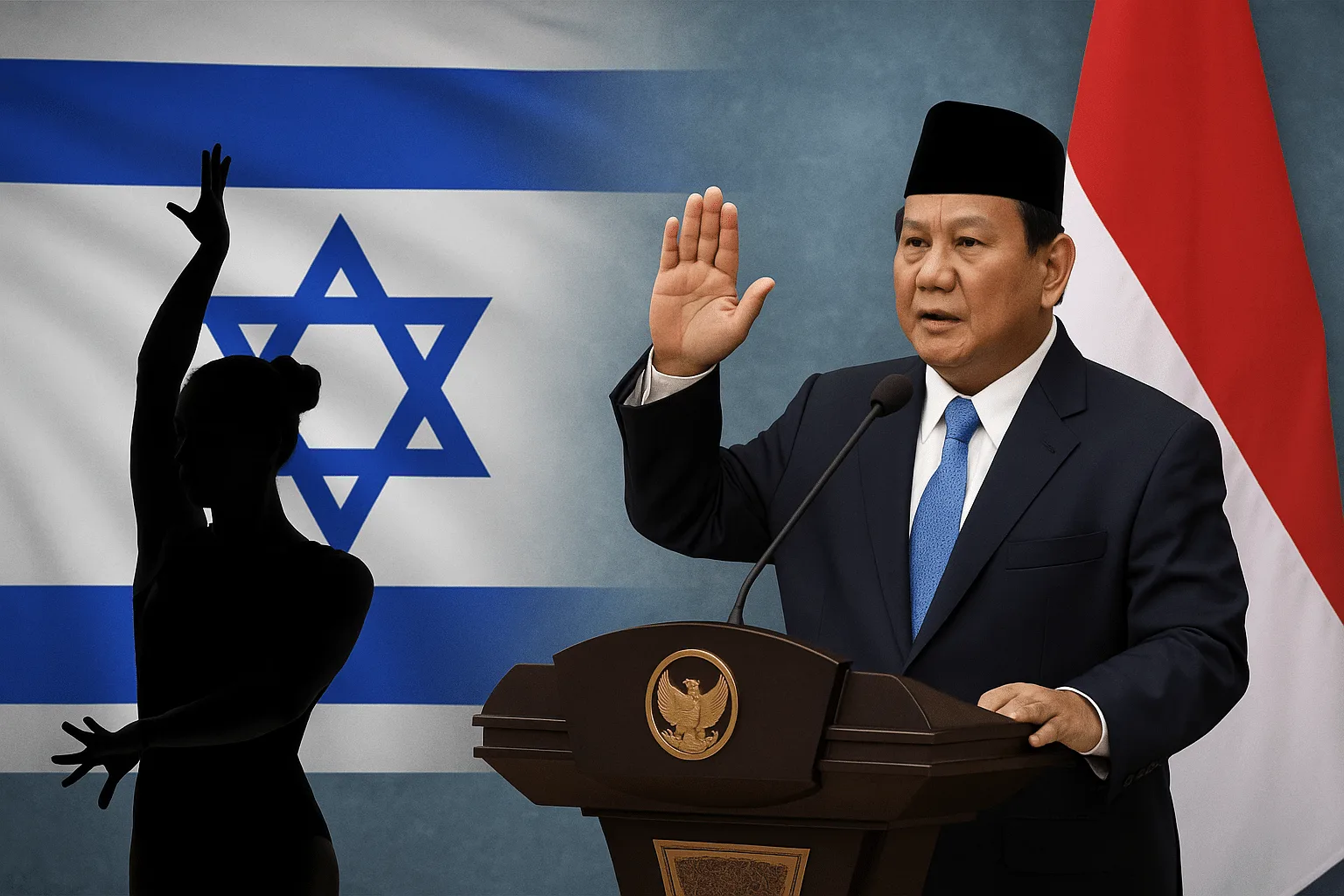
President Prabowo's Conditional Diplomacy at the UN
This discourse gained new momentum after President Prabowo Subianto at the UN General Assembly in New York (September 2025) stated Indonesia's readiness to recognize Israel with conditions. The condition is that Israel must first recognize the independence and statehood of Palestine and provide security guarantees for its people.
In his speech, Prabowo emphasized that Indonesia "urges recognition of Palestine and an end to the humanitarian tragedy in Gaza," adding, "after Israel recognizes the independence of Palestine, Indonesia will immediately recognize Israel and support Israel's security guarantees."
This statement is not merely rhetoric, but implies a potential fundamental shift in the direction of Indonesia's foreign policy, which has consistently supported the struggle of Palestine as an occupied nation in accordance with the mandate of the constitution.
Humanitarian Reality: Palestine-Israel Conflict Data
The President's statement becomes meaningful when placed in the context of the Palestine-Israel conflict that has lasted for more than seven decades. Since the 1948 war, this conflict has become a symbol of global inequality between military power and human rights.
Data from the United Nations Office for the Coordination of Humanitarian Affairs (UNOCHA) shows that since 1967, more than 5 million Palestinians have lived under Israeli military occupation with various restrictions.
UNOCHA's latest report (May-June 2025) highlights the tragic conditions on the ground:
- The rate of acute malnutrition in newborns in Gaza increased from 9% to 17%.
- More than 2,000 civilians have been killed as a result of the escalation of the conflict in the last three months alone.
This reality shows that the possibility of recognition of Israel not only touches the diplomatic realm, but also tests the nation's commitment to universal humanitarian values that are its constitutional identity.
Constitutional Analysis: Limits of Presidential Authority
Within the framework of the 1945 Constitution, every act of diplomatic recognition must be placed within a legitimate legal framework.
Approval of the DPR in International Agreements
Article 11 paragraph (1) of the 1945 Constitution states that the President, with the approval of the House of Representatives (DPR), declares war, makes peace, and enters into agreements with other countries. This means that recognition of a country is not a unilateral decision of the executive, but requires legislative legitimacy as a form of popular sovereignty.
President Prabowo's conditional statement does not necessarily violate the law, but opens up space for constitutional interpretation. Recognition of Israel, if carried out without the DPR's approval mechanism, can be considered an overreach of authority that contradicts the principle
checks and balances.
Moral Mandate of the Preamble to the 1945 Constitution
Beyond the formal aspect, the moral spirit of the constitution is a fundamental foundation. The Preamble to the 1945 Constitution affirms that “colonialism in the world must be abolished because it is not in accordance with humanity and justice.”
This sentence is a source of values that shapes the direction of Indonesia's foreign policy. Therefore, recognition of Israel, which still maintains its occupation of Palestinian territory, has the potential to violate these moral values of the constitution.
International Law Perspective and Two-State Solution
From an international law perspective, recognition of a country is based on the criteria of the Montevideo Convention 1933 (territory, population, government, and capacity to establish relations). Israel meets these criteria.
However, problems arise when its territorial legitimacy conflicts with the Palestinian people's right to independence, which has also been recognized by the UN since Resolution 181 of 1947. This is where Indonesia's unique position lies: supporting a two-state solution (
two-state solution) as a form of justice, but rejects recognition of Israel before Palestine is truly independent.
Support for a two-state solution remains an international consensus, but public support in conflict areas is declining sharply. A 2025 Gallup survey noted that only 33% of Palestinians in the West Bank and 27% of Israelis still approve of this solution. This low support is a major challenge.
Constitutional Diplomacy Path: Recommendations for Indonesia
President Prabowo's statement at the UN actually opens up conditional diplomatic space. If Israel does not meet the requirements (Palestinian independence), Indonesia remains in the status quo position. If Israel fulfills it, recognition must go through the DPR approval mechanism.
From the perspective of John Rawls' theory of justice, a just policy must side with the weakest—in this case, the Palestinian people. This is in line with the view of
constitutional morality (constitutional morality) put forward by Mahfud MD, that policies must reflect the values of the 1945 Constitution, not just formal procedures.
Therefore, Indonesia can take the path of constitutional diplomacy:
- Strengthening the Multilateral Role: Encouraging the real implementation of a two-state solution at the UN, OIC, and Non-Aligned Movement.
- Recognition as the Final Step: Making recognition of Israel the final step after Palestine is recognized as an independent state and the withdrawal of troops from the occupied territories.
- Humanitarian Diplomacy: Strengthening food, medical and education assistance in Gaza and the West Bank as real solidarity.
- DPR Involvement: Ensuring legislative involvement in every stage of diplomacy to guarantee constitutional legitimacy.
With such a strategy, Indonesia does not lose its moral position as a nation that rejects colonialism, while at the same time being able to demonstrate diplomatic maturity. Recognition of Israel becomes the result of a measured, constitutional and fair process, not a reactive step.
















Comments
0Share your perspective politely, stay relevant, and focus on the article. Comments appear after moderation.
Join the discussion
Write a clear, polite response that stays on topic.
No comments yet. Be the first to discuss.
Comments will appear after moderation.