
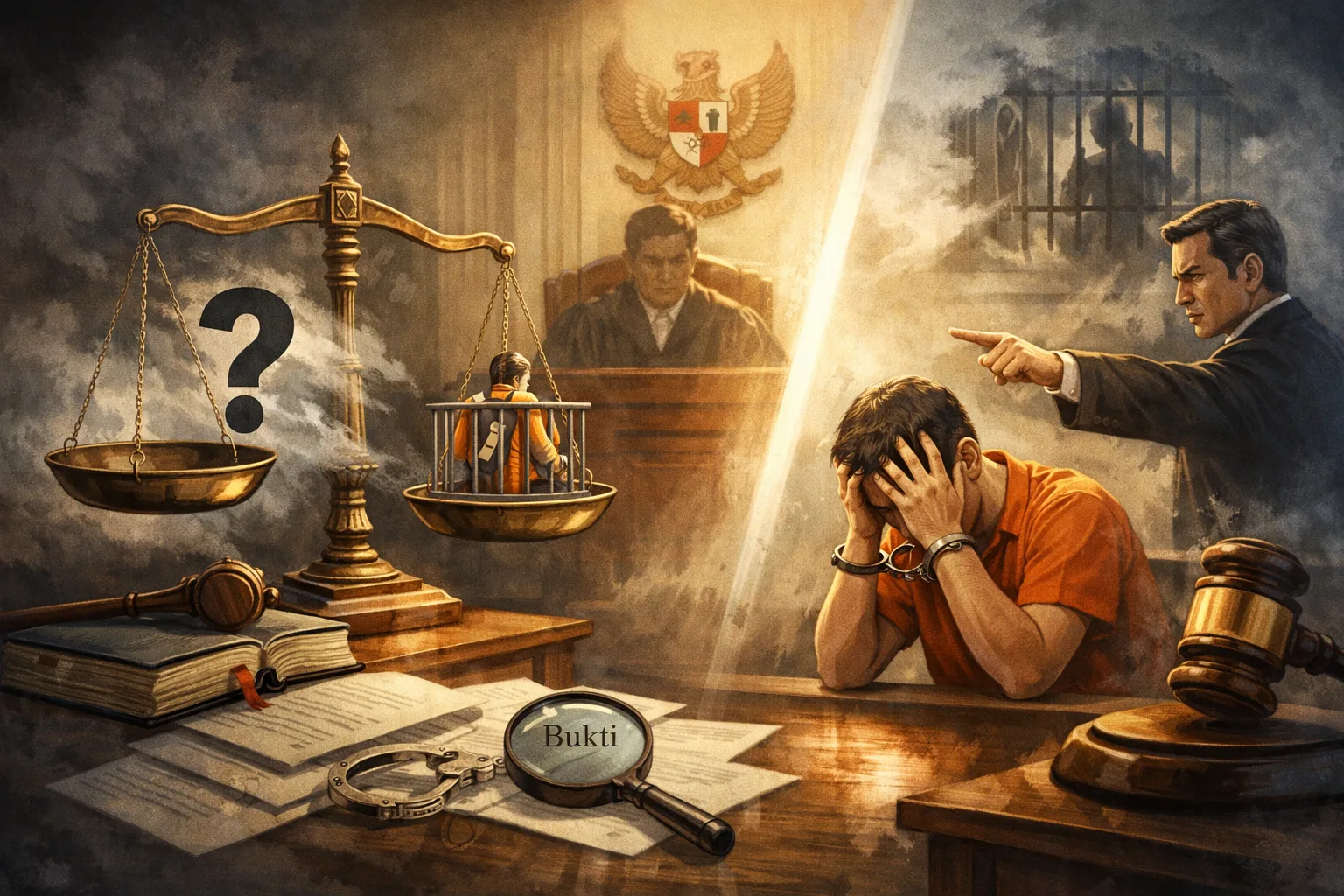
Legal Literacy - As humans who have (or are) dedicating the rest of their sanity to studying at the faculty of law, there is one eternal curse attached to our diplomas equivalent to the wet stamp ink of the rectorate: being considered asGoogle walked by extended family, neighbors, to elementary school friends who have been ten years lost contact.
This phenomenon usually occurs in sacred moments that should be full of warmth, such as family gatherings, high school reunions, or just hanging out at the guard post. When Economics graduates are asked "what is a good investment this year?" or Engineering graduates are asked "why isn't the house AC cold?", we law graduates will get questions that weigh the same as a comprehensive exam, but are expected to be answered in the duration of Instagram Story.


"Eh, Mas, if my grandfather's inherited land is seized by a neighbor who turns out to be the brother-in-law of the second wife, but the certificate is still Letter C and has not been transferred since the Dutch era, what article does that fall under? Can the person be imprisoned?"
Instantly, the nastar in the gathering jar tastes as bitter as an interlocutory decision rejected by the judge.
The Myth of Palugada Man (Anything You Want, I Have)
There is a massive and structured misunderstanding in our society that law graduates are super humans who memorize the entire contents of laws and regulations in Indonesia. In fact, let's be honest while staring at the ceiling of the room. The number of regulations in this country is more than the number of false hopes given by your crush.
Starting from the 1945 Constitution, Laws, Perpu, PP, Perpres, Permen, to Perda that take care of parking levies in the surprise market. Do you think we memorize all of that by heart? Of course not, Bestie.
People often forget—or don't know—that legal science has specializations. Like medicine. If your tooth hurts, you go to the dentist, not to an obstetrician, right? Well, it's the same in law. Some focus on Criminal (blood and prison), Civil (money and inheritance), Constitutional (elections and the Constitutional Court), or State Administration (permits and bureaucracy).
But for my aunt in the village, a Bachelor of Law is a Bachelor of Law. Period.
Imagine how awkward I am. My thesis discusses a heavy topic njelimet about "Trading in Influence" trade alias of influence in corruption. My days are spent dissecting how state officials abuse their positions for personal gain. Uh, suddenly at the dining table I was confronted with the question:
"How do I get a divorce so that the joint property doesn't fall into the hands of the mistress?"
Oh dear, Auntie. My research is about white-collar corruption, about officials who flirt and sell influence, not about household dramas like the series "Layangan Putus". But if I answer "I don't know", I'll be told that I didn't take my studies seriously. If I answer carelessly, I'll be accused of being misleading. Damned if I do, damned if I don't. Just like the fate of the little people in the face of the oligarchy.
"Which Article Applies?" Is a Trick Question
When we were in college, we were not taught to memorize the wording of articles one by one like memorizing Harry Potter spells. What we learned was legal logic, principles, and how to dissect problems (legal reasoning). We were taught to think systematically, not to be automatic answering machines. If the lecturer asks and we forget the wording of the article, we just open the book (or now open our cellphones). The important thing is that the logic works.
But try explaining the concept of "legality principle", "mens rea", or "nullum delictum" to Uncles who are emotional because their car was grazed by a public transport. They don't need theory. They need article numbers to look tough and have power to scold people.
What is even more sad is the expectation that legal answers are definitely black and white. Like mathematics 1+1=2.
"If he cheats on me, he goes to jail, right?" they asked with fiery eyes.
This is where the art (and suffering) of being a legal person lies. We have to answer with one magic word that clients hate the most but lawyers love the most: "It depends."
Yes, it depends.
Depends on whether the evidence is sufficient or not (remember, one witness is not a witness). It depends on whether it falls into the realm of pure criminal or civil law (default/breach of contract). It depends on whether the investigator is in a good mood or not. And the most bitter—but real—thing is whether the case goes viral or not.
When we try to explain that law is not just about articles, but also about evidence and legal proceedings, the other person usually stares with a disappointed look. As if the Bachelor of Laws degree behind our name is just a useless wall decoration because it cannot provide instant certainty, aka "sat-set."
Bachelor of Laws vs Legal Expert Netizens
Our suffering has increased many times over in this social media era. Now, our rivals are not only famous lawyers whose rings are as big as padlock, but also "Legal Expert Netizens."
Every time there is a viral case—whether it's cyanide coffee, the murder of a general, or a tin corruption case—suddenly everyone in the comments column becomes a criminal law expert. They throw legal terms carelessly: "This is clearly premeditated murder!", "This must be money laundering!", "Just sentence them to death!".
Then our family reads those comments, and compares them with our (pretentiously) wise and careful analysis.
"Why does the TikTok account @HukumSimpel234 say that they can be immediately detained, Mas? Why do you say we have to wait for the investigation first? Are you not update yet?"
Oh God, take my life—but wait, not yet, the laptop installments haven't been paid off yet.
I want to scream that the law in the comments column and the law in the courtroom are as different as heaven and a well. On social media, the law works based on emotions and likes. In court (ideally), the law works based on facts and laws. But explaining this takes energy equivalent to running a marathon around Gelora Bung Karno.
Pay (At Least) with Coffee
We understand that the law in this country is complicated, expensive, and sometimes doesn't make sense. It's only natural that those closest to us make us a support to just ask for directions so they don't get lost in the wilderness of rules. We are also happy to help, really. There is a special inner satisfaction when the knowledge we learned by staying up late (accompanied by instant noodles) turns out to be useful to others.
But, please understand our position.
Not to mention when we talk about the gap between theory and practice. In class, we are taught ideal law (das sollen). That everyone is equal before the law (equality before the law). But once we graduate and see the real world (das sein), what applies is sometimes not the Criminal Code (Kitab Undang-Undang Hukum Pidana), but KUH-Kasih-Uang-Habis-Perkara [Criminal Code of Love-Money-Case-Closed].
So, when you ask "what is the law for this?", and we answer hesitantly or convolutedly, it's not because we're stupid. It's because we're weighing things up: do we want to answer using pure legal theory that is free from sin, or using the reality of the law in the field that is full of mud?
Therefore, my friends, stop terrorizing us with the question "which article applies" via chat WhatsApp at 11 pm. Legal consultation is actually expensive. If you go to a fancy law firm in SCBD, the hourly rate is in dollars, and the meter runs from the moment you say "Hello".
Here, you're already asking about complicated land dispute cases, asking for instant solutions, but the payment is only with the words: "Thank you, I'll pray for your career to be successful."
Prayers are indeed effective, sir. But prayers cannot be used to pay electricity bills or buy concert tickets.
So, if tomorrow or the day after you have a legal problem, don't immediately point out the article. Invite us for coffee first, order some delicious snacks, and—most importantly—don't get angry if our answer starts with the words: "Well... it depends."
Because in the world of law, the only certainty is uncertainty itself. Regards.















Comments
0Share your perspective politely, stay relevant, and focus on the article. Comments appear after moderation.
Join the discussion
Write a clear, polite response that stays on topic.
No comments yet. Be the first to discuss.
Comments will appear after moderation.