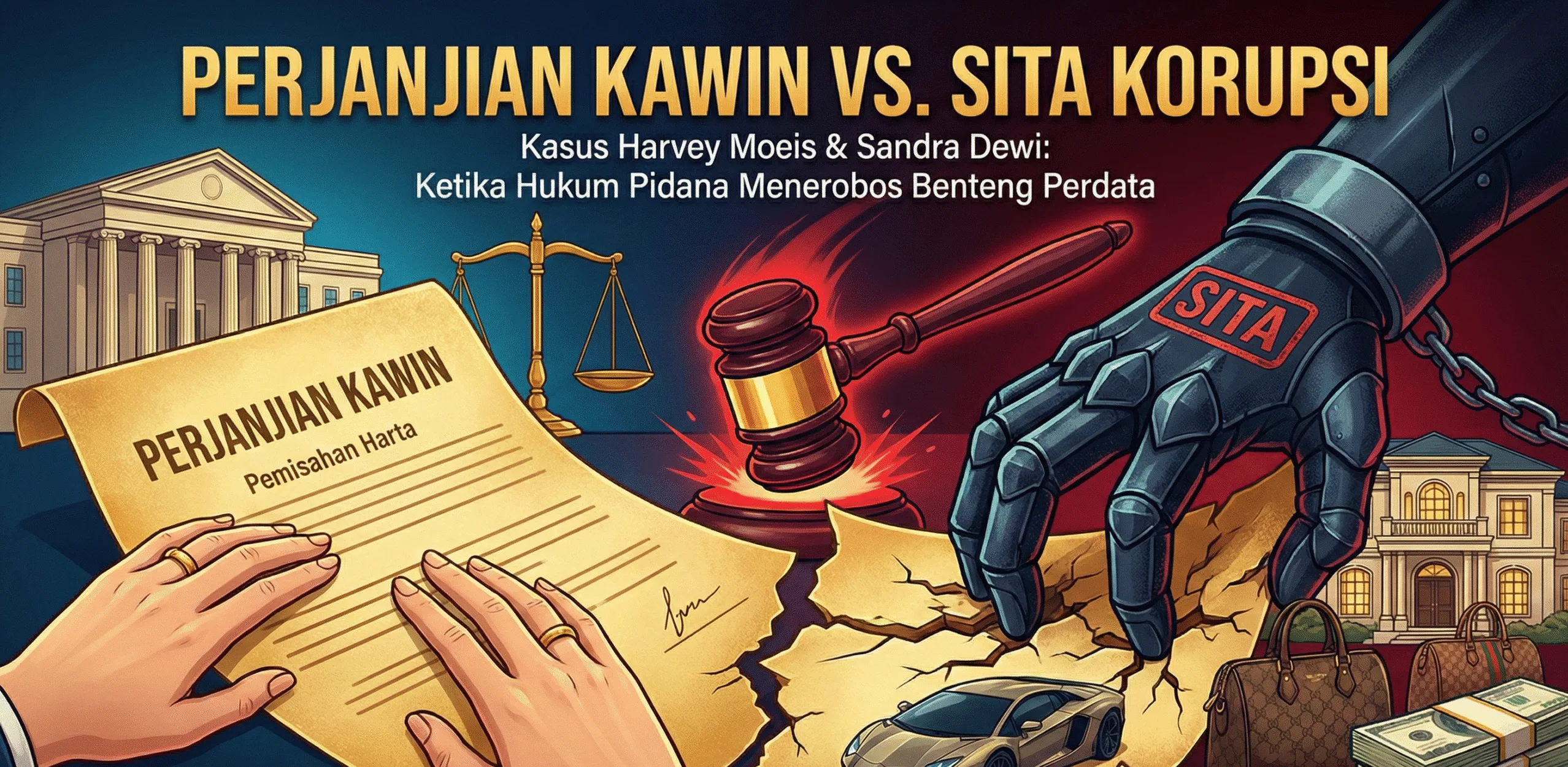
Legal Literacy - The Harvey Moeis case proves that prenuptial agreements are not a magical defense against the confiscation of corruption assets. Read the legal analysis on commingling and the dominance of criminal over civil law.
The corruption case involving Harvey Moeis, with a fantastic state loss value—as stated in the Corruption Criminal Court Decision Number 70/Pid.Sus-TPK/2024/PN Jkt—has broad implications. Not only regarding criminal liability, this case also has serious implications for asset seizure as an effort to recover state losses (asset recovery).



In the dynamics of investigation and trial, Sandra Dewi, as the wife of the convict, raised objections to the confiscation of a number of assets. She argued that these assets were her own property and the result of her own efforts, which was reinforced by the existence of a marital agreement on separation of property made in 2016.
This phenomenon sparked an interesting juridical discourse: To what extent is the "sanctity" of a marital agreement—a civil law instrument—when faced with criminal law in particular? Can this document serve as a shield to reject the confiscation of state assets?
The Legal Position of Prenuptial Agreements
Normatively, marriage agreements are regulated in Article 29 paragraphs (1)–(4) of Law Number 1 of 1974 concerning Marriage. This regulation is reinforced by Constitutional Court Decision No. 69/PUU-XIII/2015 which expands its flexibility, where agreements can now be made not only before, but also during the marriage (post-nuptial agreement).
The main objectives of a marital agreement include:
- Protecting the individual assets of each husband or wife.
- Preventing the commingling of assets during the marriage.
- Provides legal certainty regarding asset ownership and debt liabilities.
However, this civil validity faces a severe test when it enters the realm of criminal law.
The Dominance of Criminal Law in Asset Seizure
In criminal procedure law, the state has coercive authority. Article 39 paragraph (1) of the Criminal Procedure Code provides the basis for investigators to confiscate items that:
- Are suspected of originating from the proceeds of a crime;
- Are used to commit or obstruct the investigation of a crime; or
- Have a direct connection with a crime.
The crucial point is in Paragraph (2), which affirms that objects in civil dispute or bankruptcy can still be confiscated for the purpose of investigation. This means that the civil status of an item (including those regulated in a prenuptial agreement) does not automatically give it "immunity" from confiscation if it is indicated to be related to a crime.
This principle is reinforced by the follow the moneyapproach. In corruption and money laundering (TPPU) crimes, law enforcement traces the flow of funds wherever it goes. If the flow of criminal proceeds enters a spouse's account, then the asset is legitimately pursued, regardless of the existence of a separation of assets agreement.
Case Analysis: Why Did Sandra Dewi's Prenuptial Agreement "Fail"?
In the Harvey Moeis case, prosecutors and judges used material evidence parameters, not just the formality of civil documents. There are two key concepts that weaken objections to confiscation:
- Commingling of Funds (Commingling) The legal facts indicate that the assets claimed as Sandra Dewi's personal property have been commingled (commingled) with the proceeds of her husband's corruption. When the proceeds of crime enter an account containing legitimately earned money, and are then used to purchase assets, those assets lose their character as separate "personal property." Assets that have been commingled are difficult to separate definitively, and can therefore be qualified as part of the proceeds of a crime.
- Concept Beneficial Owner Investigators are also assessing whether the couple acted as beneficial owner (recipient of benefits) from the proceeds of the crime. If proven to have enjoyed the flow of funds, the argument for asset separation becomes irrelevant.
This is confirmed by Sandra Dewi's eventual withdrawal of her objection lawsuit regarding the confiscation of her luxury assets (branded bags, deposits, properties) and her decision to submit to the court's decision, which has permanent legal force. This action implicitly acknowledges that the evidence of illicit fund flows is stronger than the claim of separate property.
Conclusion
This case sets an important precedent that a marriage agreement is not an anti-confiscation "bunker" in corruption cases. The marriage agreement between Harvey Moeis and Sandra Dewi is not able to nullify the state's authority to seize assets. In the anti-money laundering regime, proof of fund flow (follow the money) holds the highest supremacy compared to the formal civil ownership status. Assets tainted by corrupt money, even if protected by a marriage agreement, will still be confiscated for the state.
List of References & Further Reading:
- Constitutional Court Decision No. 69/PUU-XIII/2015 concerning Marriage Agreements.
- Constitutional Court Decision No. 21/PUU-XII/2014 concerning Objects of Preliminary Injunction.
- Humanities Journal: "The Influence of Prenuptial Agreements on Bankruptcy".
- Administratum Journal: Study of Civil Law.
- Hukumonline: Criminal Confiscation of Debt Collateral.
- Related News: "Sandra Dewi Withdraws Lawsuit, Luxury Bags to Pakubuwono House to Be Auctioned".
- Ministry of Finance Legal Dictionary: Definition Beneficial Owner.
























Comments (0)
Write a comment