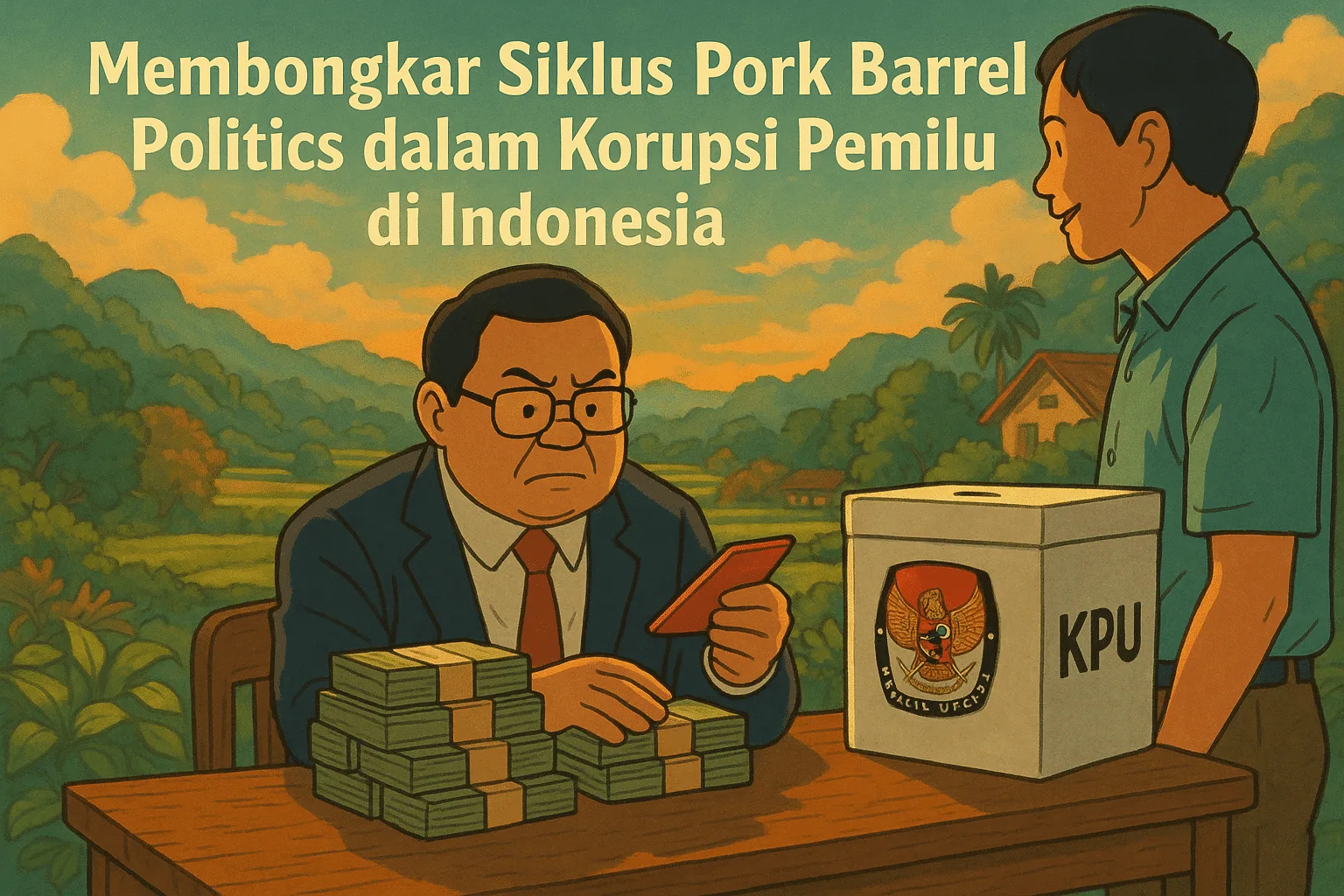
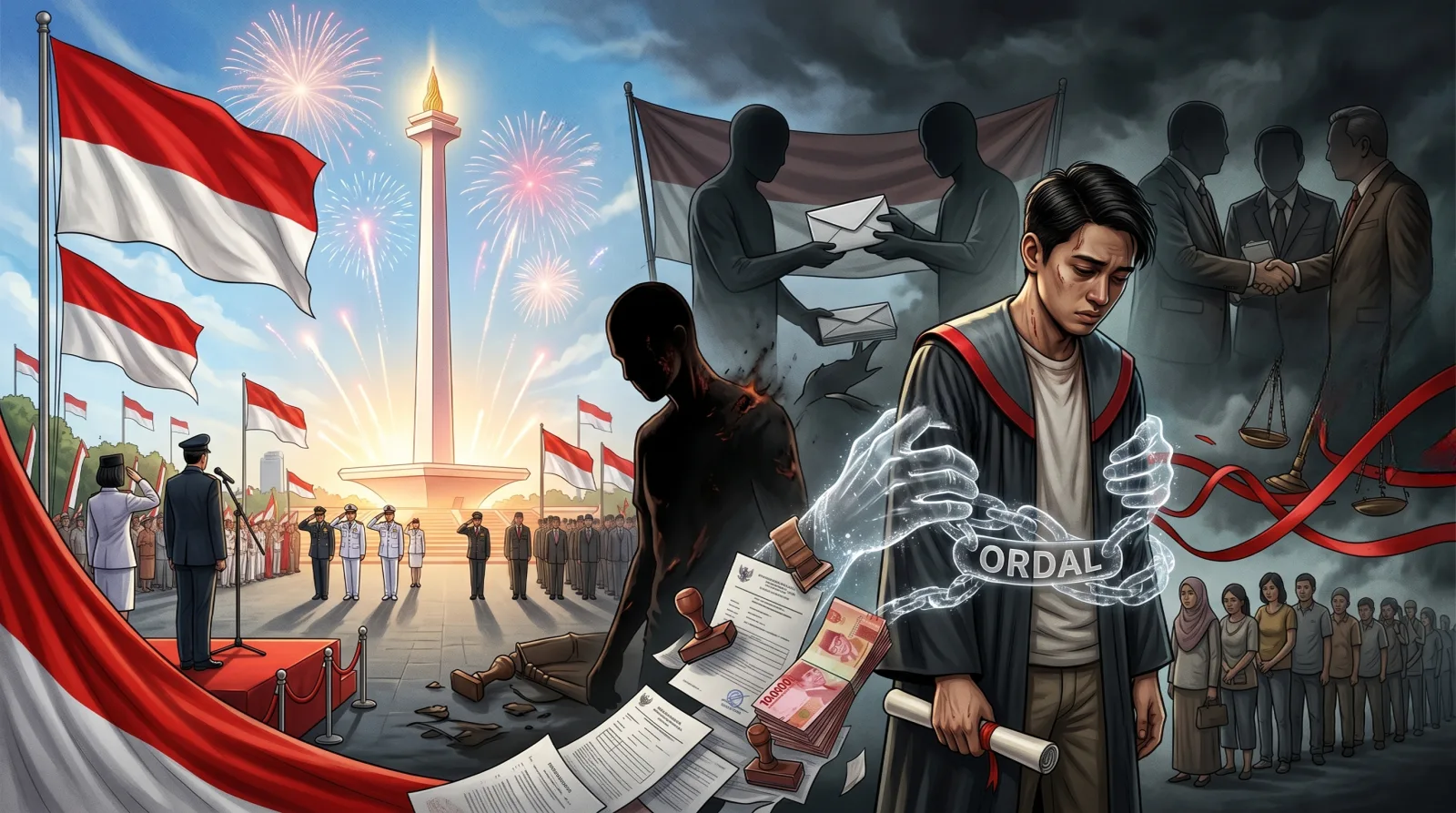
Legal Literacy - Indonesian politics, as an arena for contesting various interests, seems to be showing an increasingly bleak face, even though it is polished with a cheerful and encouraging image on the mass media veranda.
The phenomenon of pork barrel politics or familiarly referred to as pork barrel politics, is one of the issues that is currently being discussed by a number of groups in the midst of political corruption that is increasingly eroding the pillars of democracy in this country.


In our current context, pork barrel politics is associated as a form of misuse of the distribution of state funds which is carried out selectively towards a number of areas that are considered strategic in gaining support from constituents.
This strategy has become one of the ultimate weapons for politicians to maintain the leadership position they have mastered, but at the same time, this method obscures the face of democracy which ideally should be based on the principles of justice and transparency.
This is the paradox that has occurred in our political system over the past five years: in the midst of claims and glorification of the ideals of reform, corrupt practices still grip, and are even increasingly organized in a complete manner.
In Indonesia, the phenomenon of pork barrel has become part of a political culture that is difficult to refute. In almost every election contest, we can see how legislative or executive candidates use public office, budgets or state facilities for their own interests which are seemingly designed in the name of "people's welfare".
Positions and state budgets that should be managed fairly and transparently are often used for electoral interests, without considering equity and program sustainability.
This short-term dirty practice further exacerbates increasingly unequal social conditions, where assistance is more prioritized to areas that are considered to have promising potential for gaining votes, while other areas are increasingly marginalized.
Of course, such a political strategy is very detrimental to the condition of the people. They seem to be fed temporary pain relievers, with the aim of diverting their attention from the real core problems.
Poverty, which should be a social problem, in the eyes of politicians is actually the main target for vote-getters. As a result, the practice of "dawn attacks" before voting time, exchanging votes for money or basic necessities has become an acute problem in the field that is difficult to resolve.
Political Corruption and Democracy that has Plunged
The practice of pork barrel politics cannot be separated from the phenomenon of political corruption that has been eroding the body of democracy for a long time. Political corruption is a serious threat to the credibility and legitimacy of governments in various countries, including Indonesia. This phenomenon not only damages the integrity of the individuals involved, but also weakens the structure and functions of government as a whole.
Corruption in the political constellation has created a very destructive domino effect. Even more risky, the impotence of the law which is powerless in resolving the practice of political corruption, makes the perpetrators feel they have impunity.
Politicians to political parties involved in pork barrel politics are almost always immune from legal action, apart from the fact that the way they do things tends to be organized, neat and difficult to prove materially, they also have a wider range of political relations. This is what makes the flow of power circulation very difficult, and instead makes our increasingly dirty political system even murkier.
Amidst the uncertainty of the future of our democracy's quality, what happens if the practice pork barrel continues to be allowed to breed? Ideally, democracy should be a mechanism to realize social justice for all people, not an instrument for mere electoral political interests. When the authority of public office and the state budget are allocated as bargaining chips for votes, then our democracy has lost its essence.
From a broader perspective, the practice pork barrel is a form of denial of democracy which should promote openness, participation and justice, but is instead distorted by narrow political pragmatism.
Finally, the system that is formed is a way of looking at things that no longer prioritizes the quality of development or public services, but rather a system that is oriented towards power and political influence alone.
When public officials are involved in corrupt practices, the impact goes far beyond financial losses. At a deeper level, corruption erodes public trust in the government. In conditions where the government is in a legitimacy crisis, the effectiveness in enacting policies and implementing a number of programs is also affected.
In the extreme stage, the public is increasingly skeptical and even tends to disobey rules and ignore policies issued by a government that lacks legitimacy due to corrupt practices that are vulgarly displayed, because they feel there is no justice, public ethics and transparency in the decision-making process.
Uncovering the Root of the Problem
So, is there a solution to uncover the root of this problem? First, we need to return to the basic principles of democracy: justice and transparency. Elections cannot be positioned as an arena for politicians to use state money and public office for short-term interests.
Therefore, a signal of improvement and massive reform in the election system, and the ethics of public officials in managing the state budget, is an urgency that must be put forward.
Secondly, to break the culture of pork barrel politics, there needs to be a stricter monitoring system of every word and action of public officials so that there is no abuse of power in supporting one of the candidates who contributed to the election contest by using equipment provided by the state.
In addition, the main challenge in efforts to enforce the law against political corruption in Indonesia is very complex, with a number of the most prominent aspects such as non-neutral power intervention in the election contest and the selective independence of law enforcement agencies.
This political intervention often occurs in various forms of patterns, ranging from direct intervention to other more subtle ways to influence the direction of the election competition that is being held.
Strengthening the independence and sharpness of supervisory institutions, both from within the government and civil society, must be empowered so that they can monitor and oversee every election process that is free from all forms of fraud committed.
In this case, the role of the mass media also has a strategic position in monitoring the behavior of power that is not transparent, abuses its position and harms the interests of the people.
But what is more important than all of that is the collective awareness of the public that must be reawakened. Without being supported by a paradigm transformation from a society as constituents who were previously oriented towards money to being lulled by sweet promises or short-term projects, they must switch to a voter perspective that prioritizes rationality and criticism.

















Comments
0Share your perspective politely, stay relevant, and focus on the article. Comments appear after moderation.
Join the discussion
Write a clear, polite response that stays on topic.
No comments yet. Be the first to discuss.
Comments will appear after moderation.