
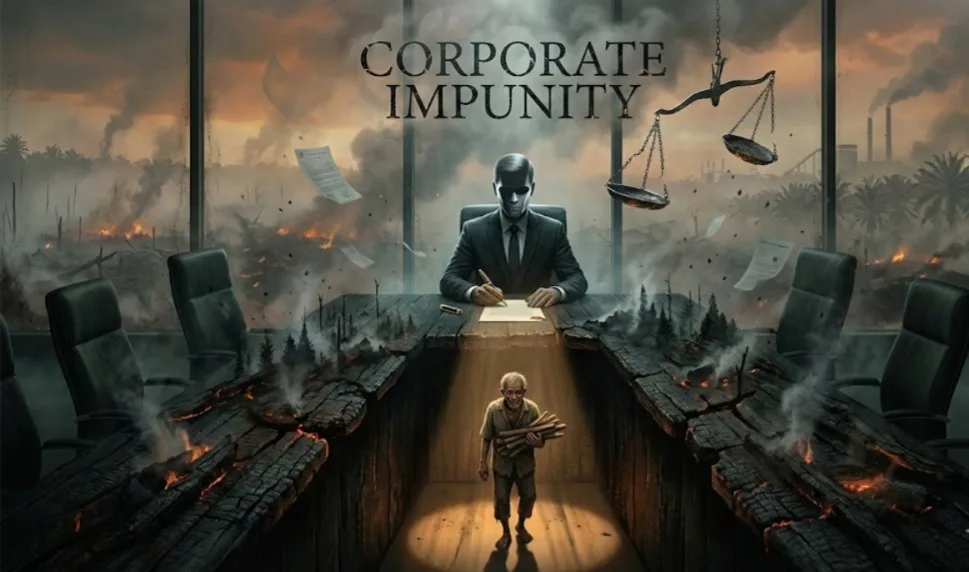
Legal Literacy - There is a smell of smoke that not only sticks in the throat, but also sticks to our ideas about law: strict on the weak, weak on the strong. When a grandmother who steals wood is processed quickly, but a large corporation that burns down a forest gets away with just a fine, we are witnessing a systemic institutional failure, not an accident of law enforcement. This phenomenon is not just about inefficiency: it demands that we re-examine the doctrines, evidentiary mechanisms, and power relations that allow corporate impunity for massive ecological damage. We live in the shadow of the irony of the Rechtsstaat, where criminal law loses its fangs when dealing with artificial legal subjects.
The Paradox of Environmental Law Enforcement in the Rule of Law
This cracked mirror of law enforcement is clearly seen in the massive forest and land fires (Karhutla) in 2015 and 2019. Although thousands of hectares of concession land were burned and caused trillions of rupiah in losses and mass URTI, very few corporate executives felt the cold prison floor (Walhi, 2020). The answer is tucked between the folds of obsolete legal doctrines. Although the Supreme Court has issued Supreme Court Regulation (PERMA) Number 13 of 2016 concerning Procedures for Handling Criminal Cases by Corporations, practice in the field shows acute hesitation. Prosecutors and judges are still held hostage by the conventional paradigm of mens rea (evil intent) that is attached to biological humans, not business entities.





















Comments
0Share your perspective politely, stay relevant, and focus on the article. Comments appear after moderation.
Join the discussion
Write a clear, polite response that stays on topic.
No comments yet. Be the first to discuss.
Comments will appear after moderation.