
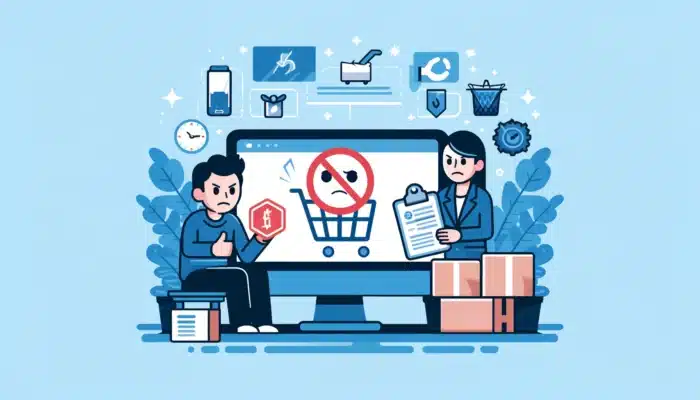
Legal Literacy - Consumer protection is specifically regulated by law. This includes when a customer from online shop receives goods that do not match the advertisement or photos displayed.
This article discusses in depth the legal protection for consumers if the goods they buy turn out to be different or not as expected.


Consumer Rights Online Shop
In this case, consumers or customer from the online store have several rights regulated in Article 4 of Law Number 8 of 1999 concerning Consumer Protection, namely:
- the right to comfort, security, and safety in consuming goods and/or services;
- the right to choose goods and/or services and to obtain these goods and/or services in accordance with the exchange value and the conditions and guarantees promised;
- the right to correct, clear, and honest information regarding the condition and guarantees of goods and/or services;
- the right to be heard their opinions and complaints about the goods and/or services used;
- the right to obtain advocacy, protection, and efforts to resolve consumer protection disputes fairly;
- the right to receive consumer guidance and education;
- the right to be treated or served correctly and honestly and without discrimination;
- the right to compensation, damages and/or replacement, if the goods and/or services received do not comply with the agreement or are not as they should be;
- rights regulated in other statutory regulations.
Prohibitions for Business Actors Online Shop
There are several things that business actors are not allowed to do, including business actors online shop. This is regulated in Article 8 of the Consumer Protection Act, namely:
(1) Business actors are prohibited from producing and/or trading goods and/or services that:
- do not meet or do not comply with the required standards and statutory regulations;
- do not comply with the net weight, net content or net, and the amount in the count as stated on the label or etiquette of the goods;
- do not comply with the size, measure, weight and amount in the count according to the actual size;
- do not comply with the conditions, guarantees, privileges or efficacy as stated on the label, etiquette or description of the goods and/or services;
- do not comply with the quality, level, composition, processing process, style, mode, or certain uses as stated on the label or description of the goods and/or services;
- do not comply with the promises stated on the label, etiquette, description, advertising or sales promotion of the goods and/or services;
- do not include the expiration date or the period of use/utilization that is best for certain goods;
- do not follow the provisions for producing halal products, as stated in the “halal” statement on the label;
- do not affix labels or make explanations of goods containing the name of the goods, size, net weight/content or net, composition, instructions for use, date of manufacture, side effects, name and address of the business actor and other information for use which according to the provisions must be affixed/made;
- do not include information and/or instructions for using goods in Indonesian in accordance with applicable laws and regulations.
(2) Business actors are prohibited from trading damaged, defective or used goods, and contaminated goods without providing complete and correct information about the goods in question.
(3) Business actors are prohibited from trading pharmaceutical and food preparations that are damaged, defective or used and contaminated, with or without providing complete and correct information.
(4) Business actors who commit violations in paragraphs (1) and (2) are prohibited from trading these goods and/or services and are obliged to withdraw them from circulation.
Consumer Protection in the ITE Law
Related to sale and purchase transactions carried out online, Article 9 of the ITE Law explains the responsibilities of business actors, namely:
“Business actors who offer products through Electronic Systems must provide complete and correct information regarding contract terms, manufacturers, and products offered.”
Then, Article 12 Paragraph (3) of the ITE Law affirms that:
“Everyone who violates the provisions as referred to in paragraph (1) is responsible for all losses and legal consequences arising.”
Business actors or sellers online shop if proven to have committed fraud, for example using a false identity or committing trickery in buying and selling online, he can be subject to criminal penalties based on Article 378 of the Criminal Code jo. Article 28 paragraph (1) of the ITE Law.

Consumer Protection if Goods Online Shop Do Not Match
Article 7 letters a, b, and g of the Consumer Protection Law states that business actors have an obligation to act in good faith in carrying out their business, provide true, clear and honest information about the condition of the goods, and provide compensation, damages, or replacement of goods to match what has been agreed upon.
Referring to the regulations above and the existence of Article 4 of Law Number 8 of 1999 concerning Consumer Protection, if customer receiving goods that do not match the order, then he is entitled to receive compensation and/or damages and/or replacement so that consumer rights can be fulfilled.
Business actors who are proven to have violated by trading goods and/or services that do not match the promises in labels, tags, information, advertisements or promotions can be criminally sanctioned based on Article 62 paragraph (1) of the Consumer Protection Law with a maximum imprisonment of 5 years or a maximum fine of Rp2 billion.
If the consumer still feels dissatisfied and wants firm action, then the consumer can also file a complaint to:
- The Police, if customer want the business actor to get criminal sanctions.
- The Consumer Dispute Resolution Agency or the Non-Governmental Consumer Protection Agency, if customer want to get financial compensation.
- Complaints to the authority institution, if customer want the business actor to be subject to administrative sanctions, for example for customer medicines can file a complaint to BPOM.
- Requesting LPKSM to submit legal standing, if customer want the business actor to stop or take certain actions.
- The Honorary Council of Professional Discipline, if customer want the professional organization to file professional disciplinary action.
In addition, if the goods received by customer do not match the photos in the advertisement, consumers from online shop can also sue the seller civilly on the grounds of default on the sale and purchase transaction made.

Default according to R. Subekti is a negligence or omission that includes 4 kinds of conditions, namely:
- Not doing what was promised to be done.
- Carrying out what was promised, but not as promised.
- Doing what was promised but late.
- Doing something that according to the agreement should not be done.
If one of these 4 conditions occurs, such as goods received by customer does not match what is contained in display store online, then customer can sue civilly on the grounds of default.
That is the explanation regarding consumer protection if the goods from online shop received are not as expected.
Visit the page Literasi Hukum Indonesia and follow Instagram @literasihukumcom for upgrade for better legal knowledge!

















Comments
0Share your perspective politely, stay relevant, and focus on the article. Comments appear after moderation.
Join the discussion
Write a clear, polite response that stays on topic.
No comments yet. Be the first to discuss.
Comments will appear after moderation.