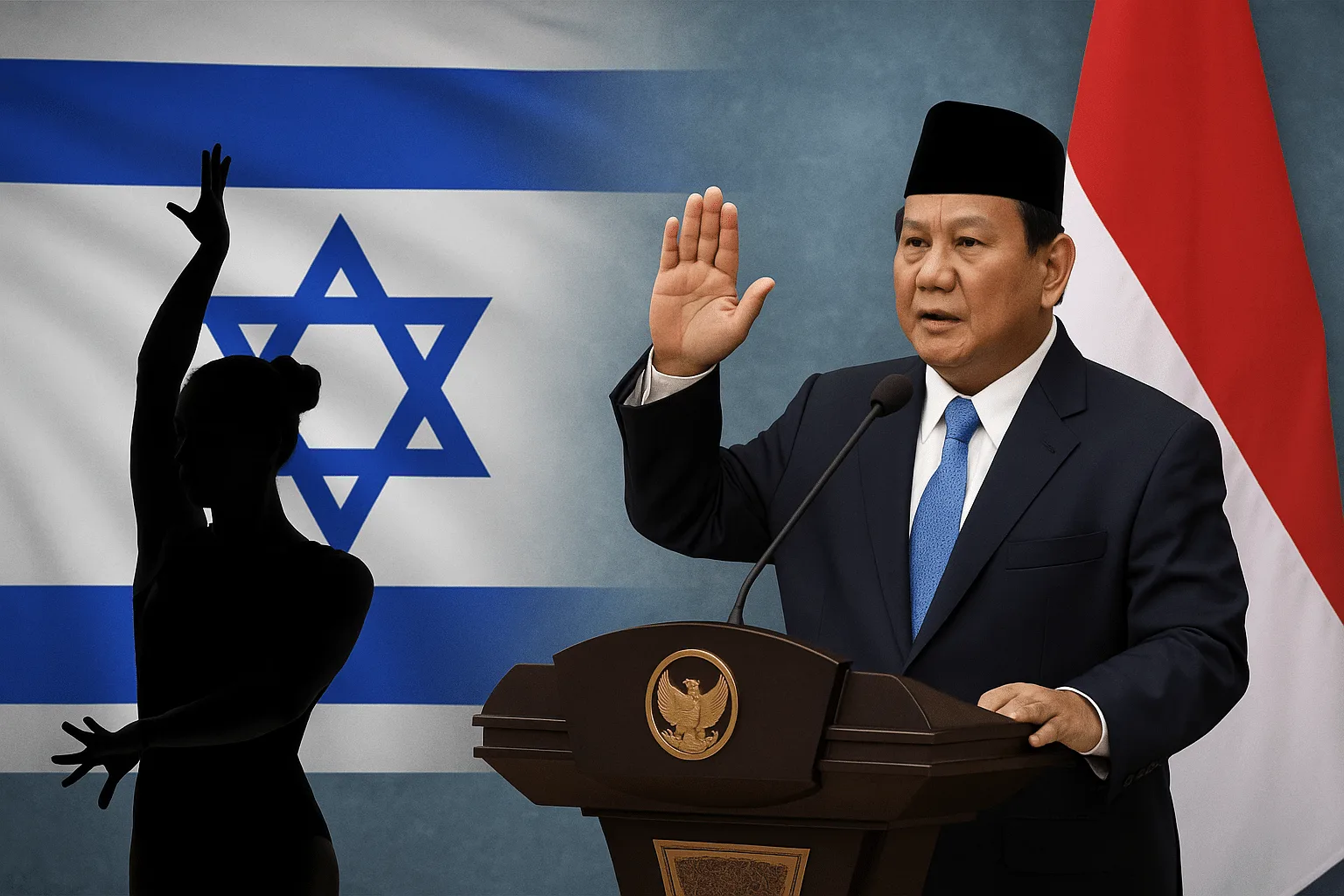
Legal Literacy - Indonesia's stance on the current Palestinian-Israeli conflict is being tested on two different but interconnected diplomatic stages: high-level political forums and practical day-to-day policies. The sharpest contrast arises when comparing President Prabowo Subianto's grand discourse on conditional recognition of Israel with the very concrete immigration policy, namely the visa refusal for Israeli gymnastics athletes for the 2025 Artistic Gymnastics World Championships in Jakarta. This discrepancy between verbal statements and actual actions raises a fundamental question: which of these two approaches is the most appropriate diplomatic strategy and aligned with the spirit of the nation's constitution?

Non-Accommodative Fact: Visa Refusal for Israeli Athletes

The latest policy shows that the government is choosing a tough stance. Indonesia has officially rejected visas for Israeli athletes who were supposed to compete in the 2025 Artistic Gymnastics World Championships in Jakarta (October 2025). This rejection is a fact confirmed by high-ranking officials, indicating that Indonesia is consistent in not separating the issue of sports from the issue of colonialism. This action is a manifestation of a non-accommodative attitude based on a constitutional mandate—a direct implementation of the mandate of the 1945 Constitution which rejects all forms of colonialism. From this perspective, the visa refusal for athletes is the right diplomatic strategy because it maintains the moral red lines and the country's basic laws. This decision shows that Indonesia is ready to bear potential international sanctions for the sake of principled consistency. More than just a moral issue, this policy closes the gap for veiled normalization.

Global Discourse: "Conditional Recognition" Tactics

On the other hand, this non-accommodative attitude is balanced by the narrative brought by President Prabowo on the global stage. In his speech at the UN forum, he reiterated the strategic statement that Indonesia is ready to recognize Israel and guarantee its security, provided that Israel first recognizes the independence and sovereignty of the State of Palestine (two-state solution). For legal academics, this statement is interesting because it touches on the issue conditional recognition. The legality of conditional recognition in Classical International Law is often debated, because recognition in theory should be declarative (only stating facts) and should not impose additional conditions.

"Conditional Recognition" as a Political Maneuver

Although its legality is debated in legal doctrine, President Prabowo's statement is a high-level political maneuver. This strategy effectively increases Indonesia's bargaining power, changing the country's status from merely an opponent to an actor holding the normalization card. The prerequisite put forward (Palestinian independence) is a condition imbued with the Indonesian constitution itself, making this offer morally and constitutionally legitimate. This conditional diplomacy places Indonesia as a principled mediator, capable of offering a final solution with clear prerequisites.

Conclusion: Real Actions Are Stronger than Hypothetical Discourse

Although President Prabowo's conditional diplomacy is a clever tactic to promote peace, it remains hypothetical. Its main condition—Palestinian independence—has not yet materialized. This is where the consistency of the gymnastics athlete visa policy in Jakarta becomes crucial. The rejection is a non-negotiable policy fact at this time. This proves that despite the discourse of conditional normalization, Indonesian foreign policy at the implementation level still prioritizes non-cooperation with Israel. This non-accommodative action sends a much clearer and stronger message in practice. Therefore, the most appropriate, effective, and aligned diplomatic strategy with the spirit of the Indonesian Constitution today is not the discourse of conditional recognition which is still a political promise. The most appropriate strategy is non-accommodative consistency which is proven through the rejection of the presence of Israeli athletes. In the end, consistency in action is the main pillar of credible foreign policy based on the mandate of the nation's founders.