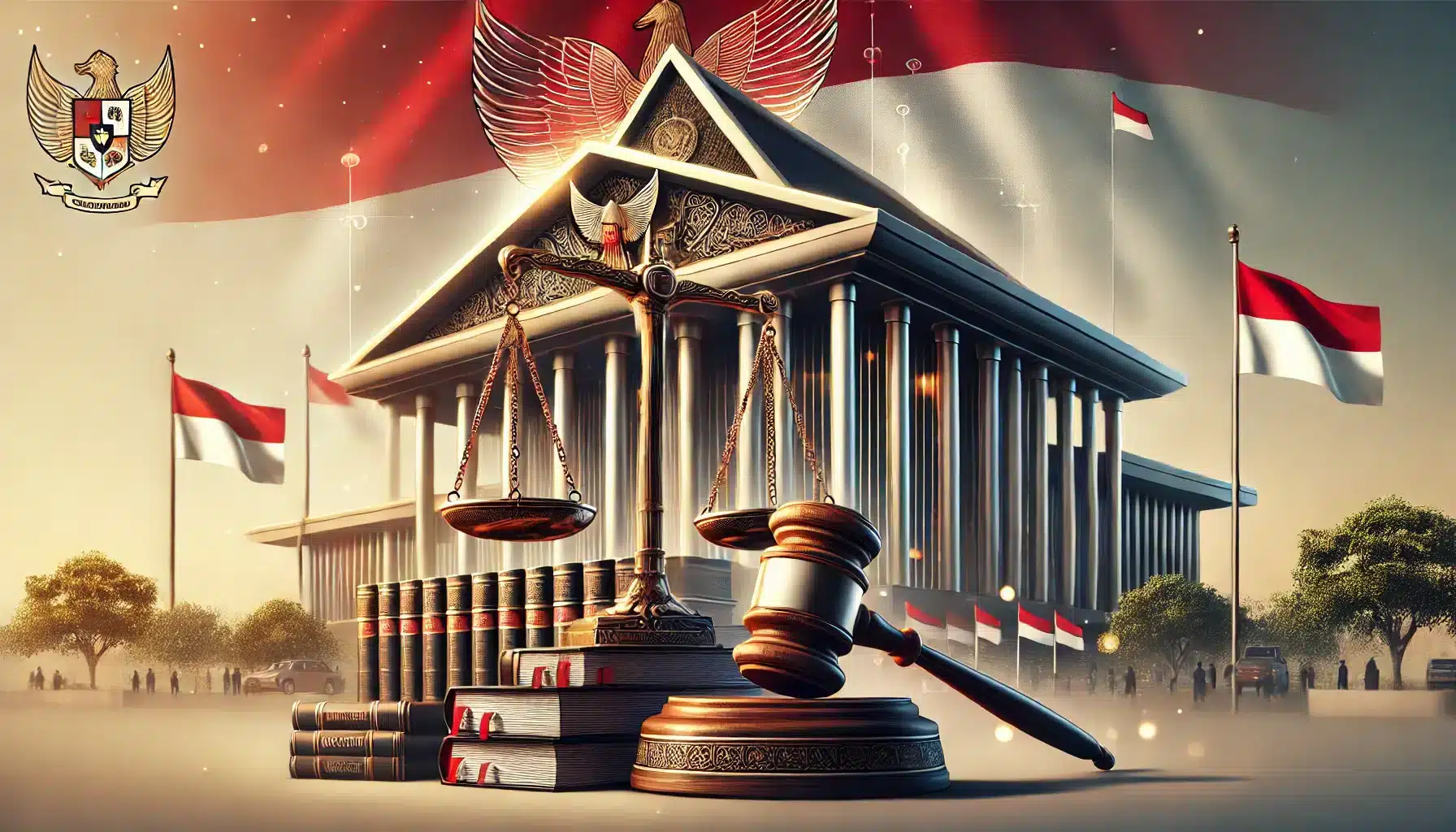
Legal Literacy - This article discusses the dynamics of the Constitutional Court (MK) in the Indonesian constitutional system, focusing on the application of judicial review involving the MK and the Supreme Court. This article also examines the authority of the MK as a constitutional judicial institution, including its role in regional head election disputes (pilkada) and the implications of important decisions that affect the constitutionality of the election regime in Indonesia, such as the 2024 Pilkada.
Constitutionality of the Constitutional Court
The dynamics of the Constitutional Court in the Indonesian constitutional installation have their own characteristics; there are several distinctive angles with the initiating country, Austria. The application of the model decentralized system or abstract bifurcation requires a rigid separation of judicial jurisdiction in terms of judicial review. In practice, judicial review in the Indonesian constitutional system is divided into two institutions, the Supreme Court and the Constitutional Court.[1] The Supreme Court is assigned the authority to examine the legality of regulations under the law, and on the other hand, the Constitutional Court is given the authority to examine the constitutionality of laws.[2]


The main authority held by the Constitutional Court is complemented by other authorities as regulated in the constitution, in casu 1945 Constitution. The mention of constitutional review as the main authority cannot be separated from Hans Kelsen's initial idea in forming the Constitutional Court as a special judicial institution that annuls laws with the constitutional touchstone – acting as a negative legislature.[3] These additional authorities include the authority to dissolve political parties, disputes over general election results (pemilu), disputes over the constitutional authority of state institutions, and the impeachment of the President and/or Vice President. All of these normative authorities are clearly stated in Article 24C paragraphs (1) and (2) of the 1945 Constitution and have not undergone any substantive changes when they were enacted into law; vide Law Number 24 of 2003 juncto Law Number 7 of 2020.
The Constitutional Court's Maneuver in Regional Head Election Disputes
As a democratic country, Indonesia provides an election system that is a form of representative democracy. The application of representative democracy is motivated by the fact that direct democracy cannot and is not ethically realized.[4] The election system in Indonesia has its own uniqueness because it does not only consist of one regime. The election regime in Indonesia is divided into general elections and regional head elections (pilkada). This separation of regimes is dynamic considering that in this case the Constitutional Court is maneuvering its stance in interpretations that have implications for changes in the scope of the meaning of elections and pilkada itself.
Article 22E of the 1945 Constitution as interpreted by the Constitutional Court in Decision Number 97/PUU-XI/2013 limits the scope of elections to only include the election of members of the House of Representatives (DPR), the Regional Representative Council (DPD), the Regional House of Representatives (DPRD), as well as the President and Vice President.[5] The pilkada regulation which is separated from the general election as regulated in Article 18 paragraph (4) of the 1945 Constitution becomes legal decidendi The Constitutional Court in interpreting the meaning of pilkada which cannot be integrated into the election regime.[6] By using systematic interpretation and original intent The Constitutional Court assesses that even though the pilkada is carried out directly like the general election, it does not necessarily mean that pilkada disputes are also handled by the Constitutional Court, which incidentally has the authority to handle election disputes.[7] The integration of pilkada into one roof with the general election is a form of extension of authority which the Constitutional Court considers to be a form of unconstitutional act.[8]
With the above construction, the Constitutional Court in its decision stated that Article 236C of Law Number 12 of 2008 – the object constitutional review – which orders the handling of regional election disputes to be transferred from the Supreme Court to the Constitutional Court does not have binding legal force. Because there is a legal vacuum and a special institution that handles regional election disputes, the Constitutional Court ruled that regional election disputes would continue to be handled by the Constitutional Court until the relevant law was formed.[9] Responding to the Decision a quo Law Number 8 of 2015 was formed, which was later amended by Law Number 10 of 2016, in casu Article 157 which accommodates the material of the decision by granting the authority to decide regional election disputes to the Constitutional Court as long as a special judicial body has not been formed.[10]
The content of article 157 paragraphs (1), (2), and (3) of Law Number 10 of 2016 – substantially the three paragraphs in the two laws a quo are the same in accommodating Decision 97/PUU-XI/2013 – tested with Decision Number 85/PUU-XX/2022. The three paragraphs were tested using the Constitutional Court's interpretation in Decision Number 55/PUU-XVII/2019 which stated that the amenders of the 1945 Constitution did not distinguish between election regimes. This fact was extracted from the debates during the amendment process of the 1945 Constitution. Furthermore, the Constitutional Court elaborated that there are several variants in the simultaneity in the implementation of elections. Among these variants is the election of the executive group; namely the President and Vice President, Governors, Regents, Mayors, and so on are carried out simultaneously and at different times the election of the legislative group is carried out; namely the DPR, DPD, and DPRD.[11] Therefore, regional elections cannot be said to be a system separate from elections and the simultaneous nature is a constitutional matter.
The three paragraphs were also tested with Article 22E paragraph (1) of the 1945 Constitution concerning elections. The implementation of elections – in casu regional elections – will be disrupted because the special court that will handle regional election disputes has not been formed based on Article 157 paragraphs (1), (2), and (3).[12] Article a quo was also tested with Article 24C paragraph (1) of the 1945 Constitution which essentially only gives the authority to resolve election disputes to the Constitutional Court. As the Constitutional Court's constitutional interpretation in Decision 55/PUU-XVII/2019 states that the regional election regime is integrated into one roof with elections, the settlement of regional election disputes should also be one roof with election disputes.[13]
Based on the legal considerations above, the Constitutional Court (MK) ruled that Article 157 paragraphs (1) and (2) of Law Number 10 of 2016 has no binding legal force. The Constitutional Court also ruled that the phrase "until the establishment of a special judicial body" in paragraph (3) has no binding legal force. The normative implication is that the Constitutional Court's authority to handle regional election disputes is no longer temporal and the establishment of a special court is not necessary. In addition, this decision also has implications for the status of the Constitutional Court. Based on Article 157 above, the position of the Constitutional Court is only as a legislative organ because it is temporary and the Constitutional Court cannot freely use this authority.[14] However, after the decision to annul Article 157 paragraphs (1), (2), and part of paragraph (3), the Constitutional Court returned to being a constitutional organ in terms of regional election disputes.
MK and the 2024 Regional Election Dispute
After holding simultaneous elections on February 14, 2024, Indonesia will hold simultaneous regional elections in 2024. The 2024 simultaneous regional elections will take place in November 2024 based on Article 201 paragraph (8) of Law Number 10 of 2016. As a derivative of the Law, a quo, the General Election Commission (KPU) issued KPU Regulation (PKPU) Number of 2024 which further regulates the schedule of the simultaneous regional elections. Based on the PKPU Attachment, voting in the 2024 regional elections will be held on November 27, 2024.[15]
The determination of the simultaneous regional election schedule as a normative consequence of the Constitutional Court's constitutional interpretation must be obeyed by all parties. As the only institution authorized to define constitutional meaning, the Constitutional Court has judicial supremacy that can bind the obedience of government officials in interpreting the constitution.[16] This supremacy is necessary to create legal certainty, especially the meaning of the constitution as interpreted by the Constitutional Court.
Despite the Constitutional Court's very central position, the Constitutional Court's decisions do not necessarily run smoothly. The formation of law and its implementation are strongly influenced by social and political forces.[17] The formation of law, in casu regional election dispute decisions, have no impact if they are not supported by social and political forces.
Social power is related to public support for the decision. Meanwhile, political power is related to the political steps of state officials in implementing the Constitutional Court's decision. As guardian of democracy, the Constitutional Court must obtain these two forces so that the regional election dispute decisions issued do not become floating decisions and seem to have no executorial power. The constitutional verse which states that the Constitutional Court's decision is final and binding must be realized and this is a shared responsibility, both from social and political forces, to uphold the constitution.
Bibliography
- Asshiddiqie, Jimly. 2020. Formal Testing of Laws in the Rule of Law State. Jakarta: Konstitusi Press.
- Buana, Mirza Satria. 2023. Comparative Constitutional Law: Philosophy, Theory, and Practice. East Jakarta: Sinar Grafika.
- Hermawan, Muhammad Ilham. 2020. The Theory of Constitutional Interpretation: Implications of Constitutional Review in the Constitutional Court. Jakarta: KENCANA.
- Huda, Ni'matul. 2021. Indonesian Constitutional Law. Depok: Rajawali Pers.
- Magnis-Suseno, Franz. 2023. Political Ethics: Basic Moral Principles of Modern Statehood. Jakarta: Gramedia Pustaka Utama.
- Martitah. 2023. The Constitutional Court from Negative Legislature to Positive Legislature. Jakarta: Konstitusi Press.
- Palguna, I Dewa Gede. 2020. The Constitutional Court and the Dynamics of Legal Politics in Indonesia. Depok: Rajawali Press.
[1] Mirza Satria Buana, Comparative Constitutional Law: Philosophy, Theory, and Practice (East Jakarta: Sinar Grafika, 2023) p. 92
[2] Jimly Asshiddiqie, Formal Testing of Laws in the Rule of Law State (Jakarta: Konstitusi Press, 2020), p. 76
[3] Buana (2023), pp. 275-276
[4] Franz Magnis-Suseno, Political Ethics: Basic Moral Principles of Modern Statehood (Jakarta: Gramedia Pustaka Utama, 2023), p. 370
[5] Decision Number 97/PUU-XI/2013, p. 54
[6] Ibid, p. 55
[7] Ibid, p. 56
[8] Ibid, p. 60
[9] Ibid, p. 62
[10] Law Number 8 of 2015 concerning Amendments to Law Number 1 of 2015 concerning the Stipulation of Government Regulations in Lieu of Law Number 1 of 2014 concerning the Election of Governors, Mayors, and Regents into Law Article 157 paragraphs (1) and (3)
[11] Decision Number 55/PUU-XVII/2019, pp. 323-324
[12] Decision Number 85-PUU-XX-2022, pp. 32-33
[13] Ibid, pp. 37-39
[14] I Dewa Gede Palguna, The Constitutional Court and the Dynamics of Legal Politics in Indonesia (Depok: Rajawali Pers, 2020), p. 75
[15] Regulation of the General Election Commission Number 2 of 2024 concerning the Stages and Schedule for the Election of Governors and Deputy Governors, Regents and Deputy Regents, and Mayors and Deputy Mayors in 2024
[16] Muhammad Ilham Hermawan, Theory of Constitutional Interpretation: Implications of Constitutional Review in the Constitutional Court (Jakarta: Kencana, 2020), p. 124
[17] Martitah, The Constitutional Court from Negative Legislature to Positive Legislature (Jakarta: Konstitutsi Press, 2023), p. 45





















Comments
0Share your perspective politely, stay relevant, and focus on the article. Comments appear after moderation.
Join the discussion
Write a clear, polite response that stays on topic.
No comments yet. Be the first to discuss.
Comments will appear after moderation.