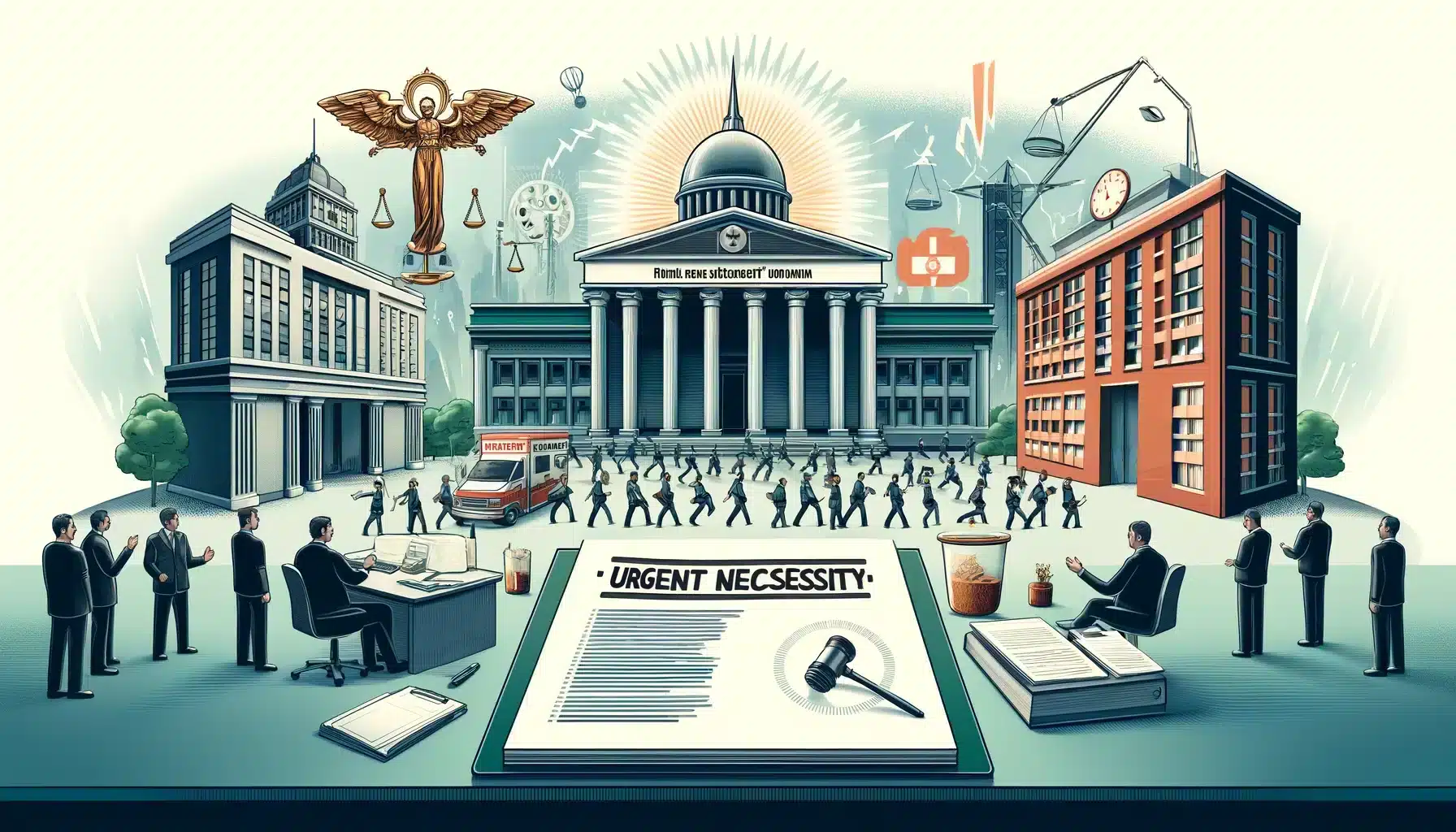
Article 12 of the 1945 Constitution refers to this state of emergency in terms of a “state of danger”. In addition, Article 22 of the 1945 Constitution refers to it as “matters of compelling urgency”. The use of different terminology has implications for differentiating the juridical implications of the two. According to Jimly, the state of danger is equivalent to the understanding of a state of emergency or state of emergency. The President can stipulate or declare a state of danger at any time because it is included in the President's authority as head of state.
Meanwhile, in Article 22 of the 1945 Constitution, the material regulated includes the President's authority in the realm of legislative power, namely the President's authority to stipulate Perpu. If examined grammatically, the phrase in Article 22 is more general than the phrase in Article 12. Article 22 which regulates compelling urgency includes a state of danger because a state of danger is compelling. Meanwhile, not all compelling urgencies are dangerous. The conclusion is that in any situation, the President can issue or stipulate a Perpu as long as it meets the requirements, even in normal circumstances.[3]


The conditions that must be met in order for a situation to be said to be a state of danger that causes compelling urgency are:
- Dangerous threat or an element of a threatening threat
- Reasonable necessity or the element of necessity that requires
- Limited time or the element of time limitation[4]
If these three elements have been fulfilled, then a state of the country can be said to be a state of danger. However, if the first element is not fulfilled, then the situation is included in the understanding of compelling urgency. In the formation of a Perpu, there is another special requirement, namely that there is no alternative other than a Perpu in overcoming the situation.[5] Thus, if there is a Perpu that does not fulfill these elements, then the Perpu is essentially contrary to Article 22 of the 1945 Constitution.



















Comments
0Share your perspective politely, stay relevant, and focus on the article. Comments appear after moderation.
Join the discussion
Write a clear, polite response that stays on topic.
No comments yet. Be the first to discuss.
Comments will appear after moderation.