

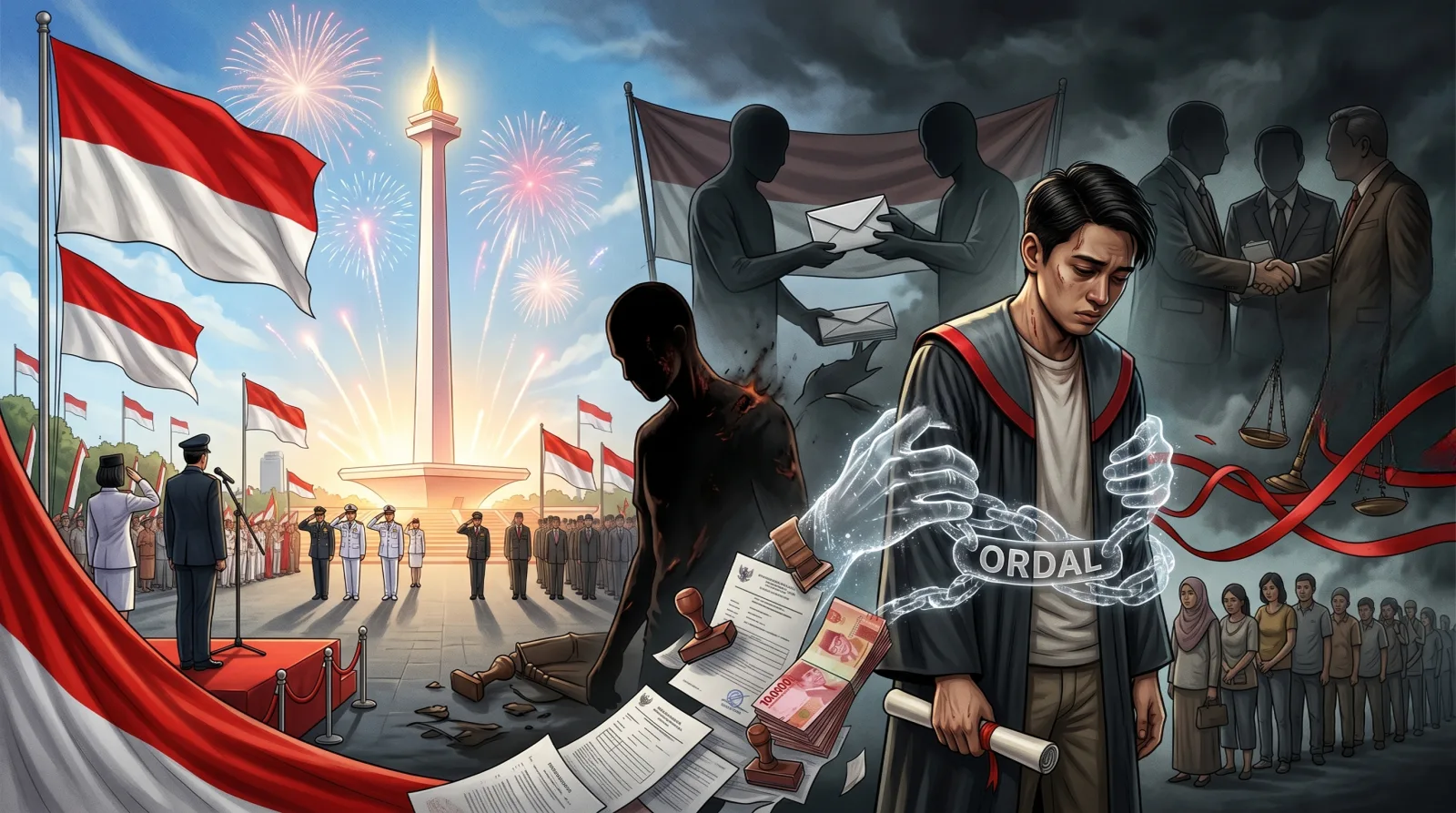
Legal Literacy - Imagine a morning in a public service office where a citizen has to wait for hours only to be told that the authorized official is in a "meeting", while behind the counter glass, piles of files that should have been completed yesterday are left to gather dust. This scene is so common, so banal, that we tend to accept it as a "risk of life" in this country. However, behind the lethargic face of bureaucracy, there is a large ulcer that in our legal discourse we call maladministration. The problem is, in our legal governance, maladministration is often only considered a "typo" or "procedural negligence" that is forgiven with a formal apology or a verbal reprimand that leaves no trace. When practices like this are accepted as normal, the state is actually teaching one dangerous thing: that negligence of power is not a mistake, but a tradition. Maladministration is not just a procedural failure, but a crime of power legalized by habit.
Maladministration as a Crime of Power in a Rule of Law
Every government action, no matter how small, is essentially an extension of power that must be subject to the law. As emphasized by Hadjon (2007: 95), every government action must be legally and morally accountable because it concerns the use of authority derived from the people's mandate. So, if we delve deeper into the recesses of legal philosophy, maladministration is actually the most real form of betrayal of the social contract. When the state fails to provide proper services, it is actually systematically violating the constitutional rights of citizens. We need to build a new legal construction: that serious maladministration is a convergence of unlawful acts by the authorities (onrechtmatige overheidsdaad), gross negligence, and violations of citizens' constitutional rights. In the perspective of state administrative law, compliance with the General Principles of Good Governance (AAUPB) is not an option (optional), but an obligation (imperative).


As Ridwan (2016: 182) asserts, AAUPB is the benchmark for the legitimacy of government actions; without it, we will only be trapped in a condition of "shameless state" a condition where violations of procedure are considered a common occurrence.
Normalization of Negligence and the Collapse of Legal Dignity
In the midst of this banality, we need to stop for a moment and ask questions that challenge the existence of our law. If maladministration that violates constitutional rights is not considered a serious crime, then what law are we actually protecting? If a small citizen is punished for stealing a pair of sandals for survival, while an official who emasculates the rights of thousands of people through a procedurally flawed decree can still walk away without any sanctions other than "administrative reprimand", where is the dignity of our law? This inequality shows that we are maintaining a system that values the formality of office more than the substance of justice. We are trapped in the narrow logic that "crime" only occurs if there is an illegal flow of funds, while the practice of killing legal certainty through maladministration is considered a residue of development that can be morally justified.
Ombudsman and the Culture of Administrative Impunity
Our lack of seriousness in viewing maladministration is clear from how our legal instruments work discriminatorily. Law Number 37 of 2008 concerning the Ombudsman of the Republic of Indonesia does provide a supervisory mandate, but the teeth of this institution are often blunt when faced with the walls of sectoral ego of ministries or institutions. The Ombudsman's recommendations, which are legally final and binding, are often considered in practice as "friendly advice" that can be ignored without consequences. This condition creates a culture of impunity. If an official makes an administrative error that causes billions of rupiah in losses to the rights of citizens, but no money goes into his personal pocket, our law tends to hesitate to punish him. In fact, the destructive impact of an administratively wrong decision is often wider and more permanent than an individual act of bribery. The administrative crime of office is the most ancient form of malpractice of power because it kills the people's hope for justice right at the door of the government office.
Official Discretion and Legal Limits of Abuse of Authority
However, in order to maintain legal clarity and avoid shallow populism, we must be able to rigidly distinguish the hierarchy of administrative errors. We need to separate between minor administrative errors that are technical-clerical, serious errors that injure service procedures, to serious maladministration (gross administrative misconduct) that consciously violates constitutional rights or abuses authority in an extreme way. It is important to emphasize that official discretion is still protected by law as a space for service innovation (freies ermessen). The legal problem arises not when an official takes discretion, but when the discretion deviates from the original purpose of granting authority (détournement de pouvoir). Discretion is a tool to achieve benefit, but it should not be a shield to legalize arbitrariness. Minor errors may be resolved with administrative improvements, but serious maladministration must be positioned as a crime of power that cannot only be redeemed with an apology.
Reformulation of Sanctions against Serious Maladministration
Therefore, it is time for us to radically redefine the governance of power. We must begin to view maladministration as an administrative crime of office that has a degree of danger equivalent to corruption. This transformation requires a paradigm shift from persuasive supervision to coercive supervision. Recommendations from the Ombudsman should no longer end up in the archive table. There must be a legal mechanism that automatically connects non-compliance with recommendations with severe administrative sanctions, including removal from office or disqualification from public office in the future. We need to implement "Sanctions of Shame" or institutional shame sanctions, where agencies that continuously commit maladministration are given a red label publicly. Of course, this mechanism must still be subject to due process of law, strict proof of negligence through independent audits, and full transparency to avoid new abuses of authority within the supervisory institution itself.
Furthermore, our biggest challenge is to tear down the walls of "blind loyalty" within the bureaucracy. Legal certainty can only be achieved if procedures are carried out with moral integrity. Often, maladministration occurs because subordinates are afraid to question orders from superiors that clearly violate procedures. This is exacerbated by the neglect of living law that develops in society. The Constitutional Court in several of its decisions, implicitly began to place the right to good public services as part of the fulfillment of human rights. Therefore, the protection of whistleblowers within the bureaucracy who dare to report administrative crimes must be strengthened by law. We need bureaucrats who are more afraid of the law than afraid of the anger of their superiors. The collective awareness that public service is a sacred trust must be re-instilled since official education. Without this moral transformation, no matter how great the regulations are, they will only become beautiful paper tigers that have no fangs to bite deviations.
Compliance with PTUN Decisions as a Test of the Rule of Law
The discourse on "Shameless State" must also touch on the role of administrative justice which has so far felt isolated. So far, the State Administrative Court (PTUN) has been more focused on canceling decisions (beschikking) than providing full restoration of citizens' rights. If a citizen wins a lawsuit in the PTUN, he often only gets a victory on paper because the execution of the decision is very dependent on the "good faith" of the official concerned. Asshiddiqie (2010: 58) states that the dignity of the law of a country is at stake in how its court decisions are respected. Executive non-compliance with the judiciary in administrative matters is a form of the highest level crime of power a constitutional rebellion that injures the principle of separation of powers and destroys legal authority in the eyes of the public. When court decisions are ignored by the authorities, then the law is actually declared dead by the state itself.
Restoring Shame in Public Service
As an offer of original ideas that are progressive but still based on sound legal principles, Indonesia needs the establishment of a "Public Service Court" or at least the strengthening of a special chamber in the Supreme Court that specifically handles lawsuits for compensation from citizens due to serious maladministration. This compensation should not only be borne by the state, but must also be jointly and severally borne by the personal assets of officials who are proven to have committed crimes of power intentionally or due to gross negligence. With the existence of personal financial risks that are proportional to the level of error, officials will have a strong incentive to comply with procedures. Of course, this policy must be limited only to cases where there is strong evidence of abuse of authority or intentional disregard of procedures that are already clear. This is the most effective way to restore "shame" to the heart of our bureaucracy. There is no more room for inefficiency that is deliberately maintained on the suffering of the people.
In closing this reflection, we must realize that a great nation is not measured by the magnificence of its physical infrastructure alone, but by how dignified it serves its simplest citizens. Maladministration that is continuously maintained is a poison that slowly but surely will paralyze our democracy. We must no longer allow this country to be managed by the mentality of "as long as it's done" by ignoring the procedural rights of citizens. The law must be present not only to punish petty thieves, but also to discipline negligent rulers. A state that tolerates maladministration is not actually failing to serve, but is the most silent form of constitutional denial.

















Comments
0Share your perspective politely, stay relevant, and focus on the article. Comments appear after moderation.
Join the discussion
Write a clear, polite response that stays on topic.
No comments yet. Be the first to discuss.
Comments will appear after moderation.