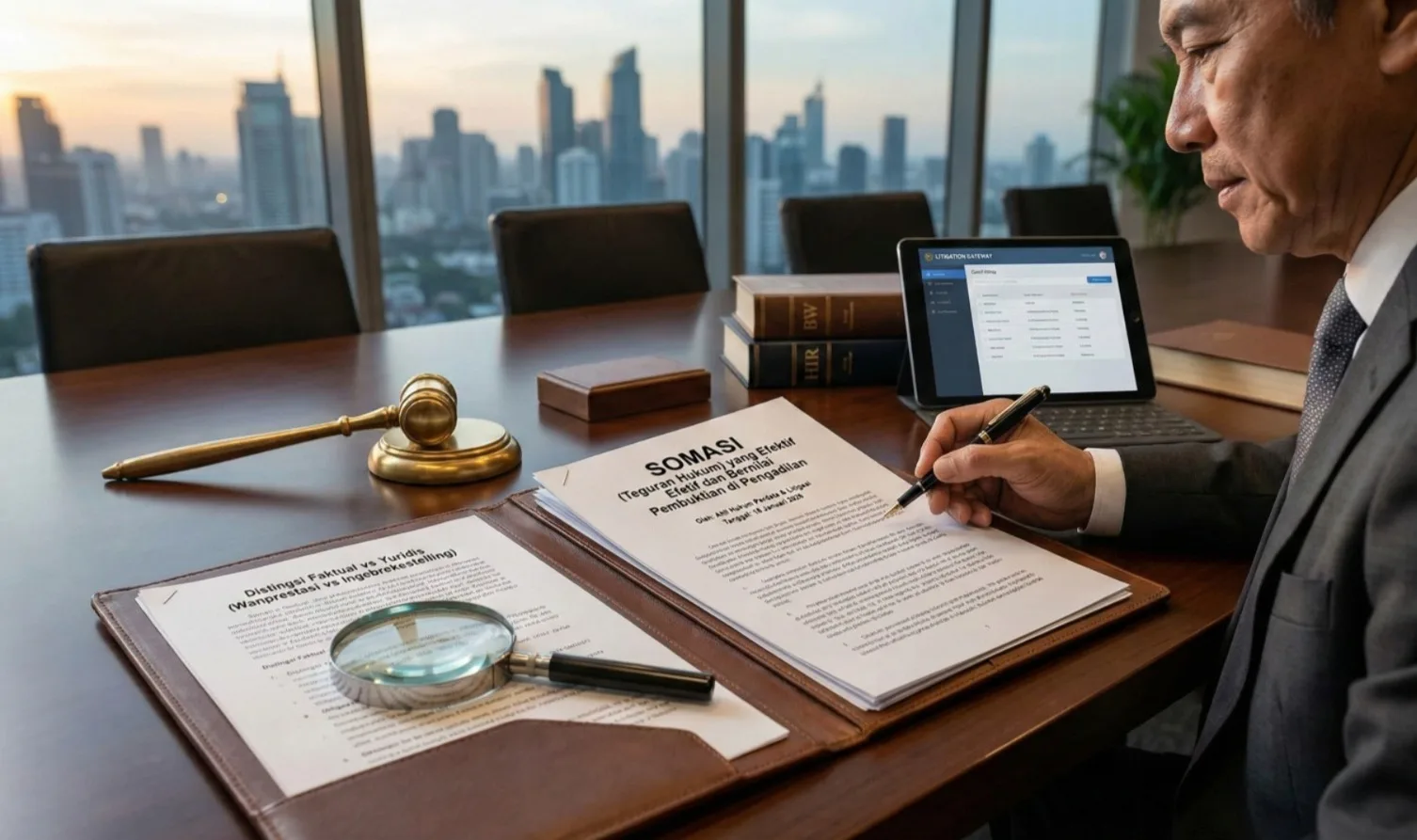
1. Introduction: The Context of Modern Litigation
In the modern civil justice landscape, the volume of default cases continues to increase, but many lawsuits fail at an early stage (exceptions). The main problem is often not the substance of the loss, but the formal defects of the preliminary procedure. A summons serves as a litigation gateway, transforming a factual dispute into a legal dispute.
A. Factual vs. Legal Distinctions (Default vs. Ingebrekestelling)
It is important to distinguish between being late (fact) and being negligent (law). The following table clarifies the differences:
| Aspect | Default (Factual) | Negligence / Verzuim (Legal) |
|---|---|---|
| Nature | State of Fact (Feitelijk) | State of Law (Rechtstoestand) |
| Trigger | Late or non-performance | Existence of a Summons (Reprimand) or Fataal Termijn Clause |
| Legal basis | Article 1234 of the Civil Code (Obligation of Performance) | Article 1238 of the Civil Code (Declaration of Default) |
| Legal consequences | Does not automatically give rise to the right to compensation | It is an absolute requirement for claims for Compensation (Article 1243 of the Civil Code) and Risk Transfer (Article 1237 of the Civil Code) |
B. Basic Theoretical Affirmation (Constitutive Nature)
In legal dogmatics, the summons is Constitutive (creates a legal state). Without a summons (except in exceptional conditions), the fact of delay does not give rise to the right to claim compensation. A formally flawed summons can cause a lawsuit to fail with a Niet Ontvankelijke Verklaard (NO) decision.
2. Basic Concepts, Doctrines, and Dualistic Position
A. Foundation of Academic Doctrine
- E. Utrecht: Defines summons as a firm wilsverklaring (declaration of will) to demand performance.
- Subekti: Affirms that a "reprimand" is an absolute requirement to establish the debtor's negligence.
- Pitlo: Emphasizes the function of ingebrekestelling as a demarcation line for when the risk shifts from the creditor to the debtor.
B. Classification of Achievements (Article 1234 BW)
- Practical Explanation: The type of achievement determines how to summon.
- Legal Basis: Article 1234 BW and Article 1242 BW.
- Implication: For the obligation to "not do something" (Article 1242 BW), a summons is not required because the violation directly gives rise to compensation.
C. Dualistic Position of Summons
- Unilateral Legal Act (Eenzijdige Rechtshandeling): Constitutive in creating a state of default (verzuim) (Article 1238 BW).
- Letter of Evidence (Bewijsmiddel): Serves to prove before a judge that a warning has been given (Article 1866 BW jo. Article 164 HIR).
3. Hierarchy of Legal Basis and Contractual Variations
The understanding of summons must be placed in the correct hierarchy of norms so that legal arguments become solid.
A. Summons Norm Hierarchy Table
| Norm Level | Legal Instrument | Function & Position |
|---|---|---|
| Primary Norm | Civil Code (BW) | Constitutive Foundation (Articles 1238, 1243 BW). Main reference if the contract is silent. |
| Lex Specialis | Contract/Agreement | Overrides general provisions of BW (Article 1338 BW). If the contract stipulates "Automatic Default", the summons becomes optional. |
| Practice Confirmation | Supreme Court Jurisprudence | Guidelines for the application of law by judges (e.g., standard of timeliness). |
B. Summons Based on Contract Clause
- Practical Explanation: Check the contract first. Is there a waiver of notice clause?
- Legal Basis: Article 1338 paragraph (1) BW (Freedom of Contract).
- Implication: If the contract stipulates "automatic late default", the summons is facultative (reinforcement of good faith). If not, return to Article 1238 BW (mandatory).
4. Obligations and Exceptions (Mandatory vs Facultative)
Understanding when a summons is absolutely necessary is key to litigation efficiency.
| Condition | Summons Status | Legal basis | Practical Explanation |
|---|---|---|---|
| No definite deadline | MANDATORY | Article 1238 BW | The debtor must be reprimanded to know when the performance must be fulfilled (due date). |
| There is a Fataal Termijn | NOT MANDATORY (Optional) | Doctrine & Jurisprudence | Performance becomes futile if it is late (e.g., wedding catering). |
| Debtor Refuses (Repudiation) | NOT MANDATORY | Doctrine of Bad Faith | The debtor's explicit rejection is considered an automatic default. |
| Obligation to "Not Do" | NOT MANDATORY | Article 1242 BW | Violation of the prohibition (e.g., leaking secrets) immediately gives rise to compensation. |
| Mora Creditoris | NOT RELEVANT | Article 1236 BW | If the creditor himself refuses payment, the debtor is not negligent. |
5. Valid and Effective Conditions: Measurability Parameter
A. Validity Indicator
B. Based on judicial practice, an effective summons must be:
- Clear (Clarity): Detailed object of the claim (Principal + Interest).
- Certain (Certainty): Deadline date/time (Article 1338 paragraph 3 of the Civil Code - Reasonableness).
- Imperative: Using command language (Bevel).
B. Legal Risks of Formally Defective Summons
What are the consequences if a summons is drawn up carelessly?
- No Deadline: The summons is considered an ordinary appeal → No Verzuim arises (Article 1238 of the Civil Code).
- Wrong Address/Subject: Error in Persona → Summons is invalid → Lawsuit NO.
- Vague Claim: Obscuur Libel → The judge cannot grant the petitum for damages.
6. Letter Drafting Techniques: Standard Anatomy Block
A. Mandatory Structure
- HEADING: Official Letterhead, Reference Number, Subject (Explicit: SUMMONS).
- IDENTITY & LEGAL BASIS: Reference to Agreement/Invoice.
- DEFAULT FACTS: Description of failure to fulfill.
- ORDER (PETITUM): Using imperative phrases.
- BILLING DETAILS & DEADLINE: Measurable table.
- CONSEQUENCES & RESERVATION OF RIGHTS: Statement of default and transfer of risk.
B. Examples of Imperative Phrases (According to Type of Performance)
In order to fulfill the element of "Order" (Article 1238 of the Civil Code), use the following variants:
- For Money Debt: "We ORDER you to settle all payment obligations of Rp [...] no later than..."
- For Service/Construction Work: "We INSTRUCT you to immediately restart work in the field and pursue negative deviation progress..."
- For Asset Eviction: "We REPRIMAND and ORDER you to vacate and hand over the physical object of the dispute in an empty state..."
7. Number and Stages of Demand Letters
Practical vs. Normative Perspective
It is important to understand that the Civil Code does not regulate the number of demand letters.
- Normative: 1 Demand Letter is sufficient if it is firm (Article 1238 of the Civil Code).
- Litigation Practice: 2-3 Demand Letters are recommended for complex cases (land/construction) to prove maximum good faith before a judge.
8. Delivery and Proof Methods (Litigation-Proof)
The delivery method determines the strength of proof in court. Here is a comparison:
| Delivery Method | Validity Status | Evidentiary Strength | Main Risks |
|---|---|---|---|
| Registered Mail | Valid (Law 38/2009) | High (Legal Presumption of Receipt) | Requires longer delivery time. |
| Private Courier | Valid (Fact) | Medium (Needs supporting evidence) | Private courier receipts are sometimes only considered proof of delivery, not official proof of receipt. |
| Official Email | Valid (ITE Law) | Medium-High (If there are server logs) | Vulnerable to spam or denied as "unreadable". |
| Valid (ITE Law) | Low-Medium | Vulnerable to screenshot manipulation, read receipt turned off. |
Recommendation: Use a combination of Registered Post (Mandatory) + Email/WA (Supporting).
9. Application Case Study
To strengthen understanding, here are the application scenarios:
- Case A: Overdue Cash Debt
- Fact: Debt of Rp 100 million, promise to pay 1 Jan.
- Action: Send a Demand Letter 1 time (3-day limit). If not paid → Immediately Sue for Default. One demand letter is sufficient because the achievement is simple.
- Case B: Stalled Project (Construction)
- Fact: Contractor is slow, progress deviation -20%.
- Action: Demand I (Reprimand for 7 days of repair), Demand II (Termination warning), Demand III (Contract termination). It needs to be gradual because there is mobilization of tools/workers.
- Case C: Repudiation (Rejection)
- Fact: The debtor replied to WA: "I will not pay a single cent!"
- Action: No further summons is needed. Save the rejection as proof of automatic Verzuim. Immediately register the lawsuit.
10. Draft Letter Template (Professional Standard)
This template includes a "No Negotiation" clause and risk mitigation.
LAW FIRM / CREDITOR LETTERHEAD
Number : [No. Ref]
Attachment: 1 (One) File [SKK & Calculation Details]
Subject: SUMMONS / DEFAULT STATEMENT (INGEBREKESTELLING)
To:
Mr. [Debtor's Name]
at [Address According to Contract]
Dear Sir/Madam,
Acting for and on behalf of our client [Client's Name], based on the Special Power of Attorney dated [Date of SKK] (Attached), we convey the following:
I. LEGAL RELATIONSHIP BASIS
- That you are bound by Agreement No. [...] dated [...] ("Agreement").
- Referring to Article [..] of the Agreement regarding Legal Domicile, this letter is sent to the agreed address.
II. DEFAULT FACTS
3. That the payment obligation has fallen due on [...].
4. That until this letter is published, you have not fulfilled this obligation.
III. ORDER AND DETAILS OF CLAIMS
Based on Article 1238 of the Civil Code, we ORDER you to pay:
| Component | Value (Rp) | Basis of Calculation |
| Principal Debt | Rp 100,000,000 | Invoice No. ... |
| Accrued Interest | Rp 5,000,000 | 6% p.a (Article 1250 BW) |
| Late Payment Fee | Rp 2,000,000 | Article ... of the Agreement |
| TOTAL | Rp 107,000,000 |
Payment must be received effectively no later than 3 (three) calendar days from the date of this letter (3:00 PM WIB), to the account:
Bank [Bank Name] No. [Account Number] a.n. [Account Holder Name]
Negotiation Closing Clause (Optional): This letter constitutes a final warning. All previous mediation or verbal communication processes are deemed to have ended without agreement. All of your obligations must be fulfilled without delay.
IV. CONSEQUENCES & RESERVATION OF RIGHTS
- The passage of time results in you being considered in default (in verzuim).
- The risk passes to you (Article 1237 paragraph 2 of the Civil Code).
- We reserve the right to pursue Civil Lawsuits.
- Any manipulation of assets may risk criminal penalties as long as it fulfills the elements of Article 372/378 of the Criminal Code.
Sincerely,
Legal Counsel
[Signature & Stamp]
(Advocate's Name, S.H.)
11. Practical Checklist (Anticipation of Exceptions)
Use this checklist to mitigate the risk of counterattacks (Exceptions) from the opponent:
A. Formal Compliance:
- [ ] The basis of the legal relationship (contract) is valid.
- [ ] Performance is due & Details are accurate.
- [ ] Anticipate Premature Exceptions: Ensure the summons deadline has expired before registering a lawsuit.
- [ ] Anticipate Obscuur Libel Exceptions: Ensure the details of Principal, Interest, and Fines are clearly separated.
- [ ] Anticipate Error in Persona Exceptions: Ensure the debtor's name matches the ID card/Deed.
B. Delivery Stage:
- [ ] Send to the contract domicile address (Mandatory).
- [ ] Archive proof of delivery (Postal Receipt/Digital Log).
12. Legal Consistency Test (Final Self-Audit)
| Test Parameter | Status | Risk Analysis |
|---|---|---|
| Norm Consistency | ✅ VALID | In accordance with BW, HIR, UU ITE, and UU Pos. The hierarchy of norms is maintained. |
| Contract Integration | ✅ SAFE | Checking penalty and domicile clauses in the contract before preparing a summons, avoiding petitum inconsistencies. |
| Civil Risk | ✅ SAFE | The deadline is based on the principle of appropriateness, minimizing the risk of being considered unlawful act. |
| Criminal Risk | ✅ SAFE | Criminal warnings are informative and conditional, avoiding extortion accusations. |
| Evidentiary Integrity | ✅ STRONG | The use of post tracking as a legal presumption strengthens the evidentiary position. |






















Write a comment