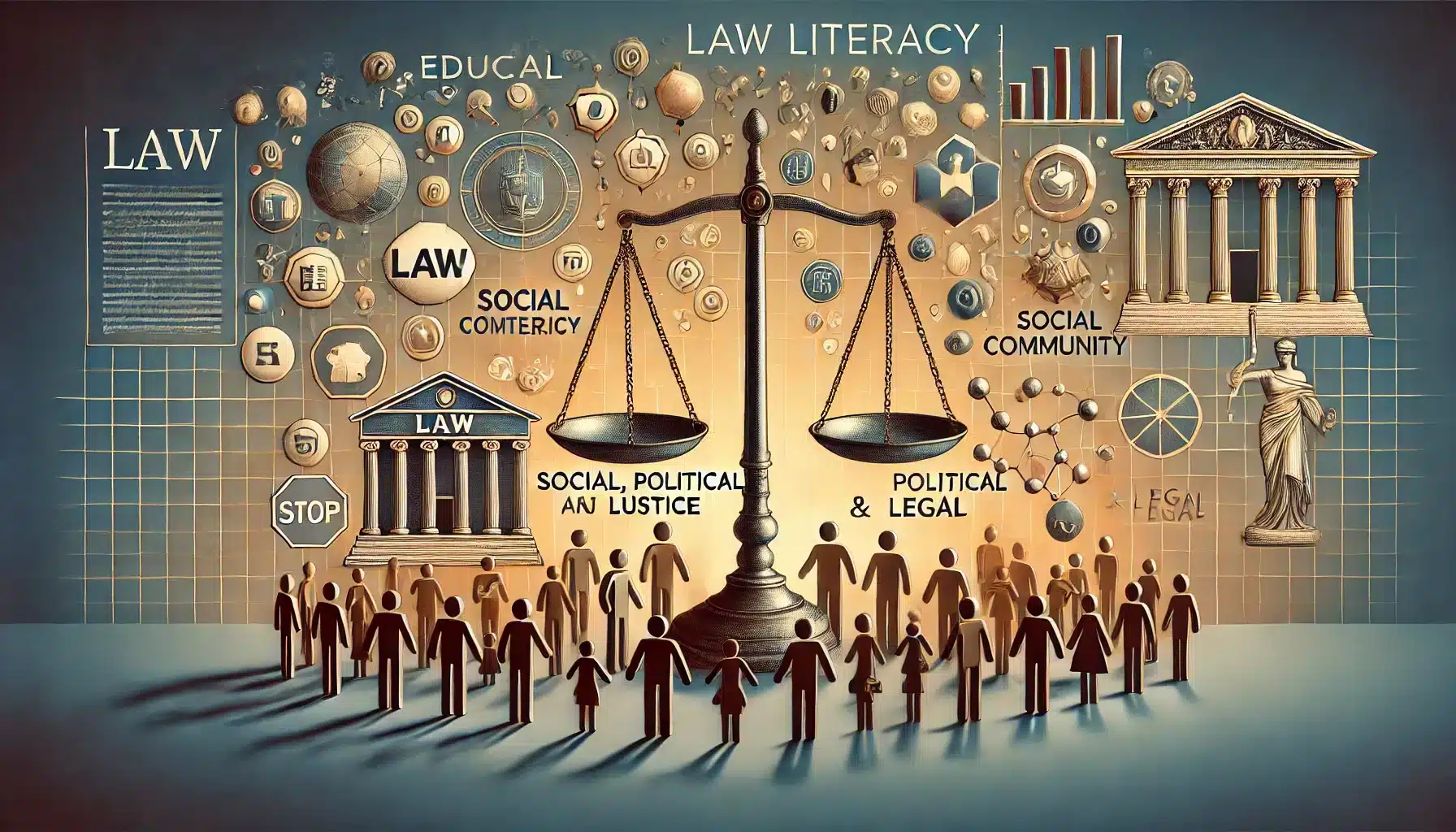
Legal Literacy - This paper aims to elaborate on the relationship between social, political, and legal aspects, which are fundamental in legal studies. The scope of explanation includes definitions, history, and the thoughts of preceding philosophers, including interpretations based on the author's views.

Definition and History

Starting with the basic definition, social is a collection of individuals and human groups engaged in activities referred to as social phenomena. Politics is the effort of individuals or groups to achieve specific interests, often culminating in a power struggle. Meanwhile, law can be defined as the rules of the game or agreements arising from political activities within social interactions.

Essentially, politics and law are products of social interaction. Therefore, these three aspects—social, political, and legal—fall under the category of social sciences. Nevertheless, the advancement of science allows each to have its own specialization. To facilitate understanding, these three concepts can be summarized as follows:

  • Social = community or collection of individuals
  • Politics = interests and power
  • Law = agreements and rules of the game

Referring to Aristotle's thought in his book entitled Politics, power is essentially the same in every social group. Most of the arguments in this book highlight class conflict, the concept of the state as the largest community, and the ideal actions of individuals in society. Aristotle also discusses social reality and how ideal actions should be taken by individuals. A concrete example of this thought is the explanation of the history of the formation of city-states which illustrates the human tendency to socialize and engage in politics as political animal or political creature.

From the above thoughts, it can be understood that social entities basically desire order and regularity. However, this ideal value is often difficult to realize because of the basic nature of humans who have conflicting egos or interests. On the other hand, humans also have a tendency to depend on each other. To achieve this order, law emerges as a standard, ethics, or social norm. The simplest form of this law is custom or culture. The separation of science between social, political, and legal is necessary because the three are interrelated and often overlap in discussion and application.

Checks and Balances within Social Groups

In society, there are various competing interests and needs, so it is necessary to have limitations to fulfill each interest fairly. This is where the law is present as a tool that is made and implemented in a certain area of sovereignty or social control. This law arises from a sense of justice and the ideal order desired by the society. Over a period of time, this law can develop into a habit or culture.

Advertisement
Read without ads.
Join Membership

If we discuss politics as a tool to seize power and law as a tool to enforce power, there is a mechanism that regulates these two processes so as not to cause excessive conflict. The main objective of this arrangement is to maintain order or stability, especially when there is a change of power. This concept is known as check and balance, or control and balance.

Check and balance cannot be separated from the evolution and development of political and legal history in a social entity, such as a country. There are two main objectives in this concept:

  1. Ius Constitutum: Rules that have been established to prevent or encourage a certain action to be carried out immediately.
  2. Ius Constituendum: The hope for a desired condition in the future, which has not yet been realized.

Dichotomy and Determinants Between Politics and Law Based on Organ Theory

Politics and law fundamentally have a relationship that is both confrontational (dichotomy) and mutually influential (determinant). For example, according to research by Dr. Miro Cerar, the ontological boundaries or philosophical classification between law and politics are divided into two main views:

  1. Monistic Ontology: The view that law and politics are the same or similar concepts.
  2. Dualistic Ontology: The view that sees the difference between law and politics as a result of pluralistic or diverse human perceptions.

This explanation refers to the organ or influence theory of a community group, whether through general social phenomena, law, or politics. Dr. Miro Cerar argues that politics and law not only have a relationship of conflict or consensus, but more often highlight the main characteristic of maintaining that balance itself. This causes political and legal processes to be limited in certain stages to create a clear and structured process.

Advertisement
Read without ads.
Join Membership

In short, in political science, social phenomena cannot directly influence extreme changes in existing law and politics. This is due to social characteristics that function to maintain check and balance in a social system, both in politics and law, as well as the processes that exist between the two.

Conclusion

From the discussion above, it can be concluded that the relationship between social, political, and legal aspects is complex but very important to understand as a basis for legal learning. Social as a phenomenon of human interaction, politics as a tool to achieve power, and law as a rule that governs social life, are all interconnected and mutually influential.

The concept of check and balance is key in maintaining stability among the three. With a good understanding of the roles and functions of each, we can better understand why law is not just a rule, but also the result of social and political compromises involving various interests.

References:

  1. Aristotle, Politics. https://iep.utm.edu/aristotle-politics/#H4
  2. Cerar, M. (2009). "The relationship between law and politics," Ann. Surv. Int'l & Comp. L., 15, 19. https://digitalcommons.law.ggu.edu/cgi/viewcontent.cgi?article=1126&context=annlsurvey