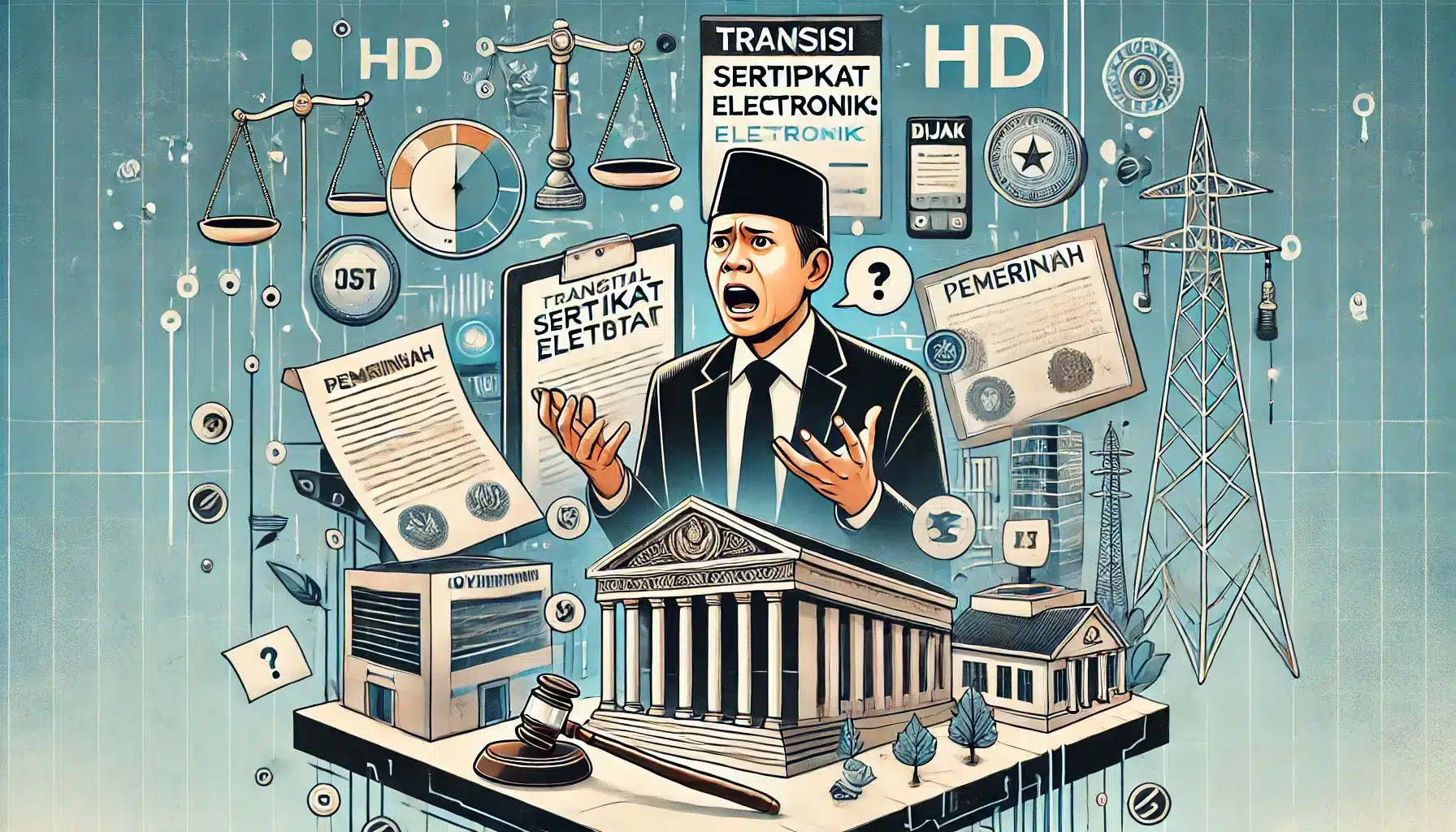
Legal Literacy - Currently, in the context of land affairs in Indonesia, there are two forms of land title certificates: analog certificates and electronic certificates. Analog certificates are certificates that are generally found among the public and are in the form of a book, consisting of stitched data sheets, containing physical and juridical data on land rights objects. Meanwhile, electronic land certificates are only in the form of a single sheet called a secure paper sheet with special specifications provided by the Ministry of Agrarian Affairs and Spatial Planning/National Land Agency (ATR/BPN).
The Indonesian government has taken a strategic step by initiating the transition of land title certificates from physical analog form to electronic form. This policy was initially regulated in Regulation of the Minister of Agrarian Affairs and Spatial Planning/Head of the National Land Agency (Permen ATR/BPN) Number 1 of 2021 concerning Electronic Certificates. However, the regulation has been revoked and declared invalid by the Regulation of the Minister of Agrarian Affairs and Spatial Planning/Head of the National Land Agency of the Republic of Indonesia Number 3 of 2023 concerning the Issuance of Electronic Documents in Land Registration Activities. This regulatory change marks a further step in the government's efforts to ensure that this land digitization policy can be implemented more effectively and comprehensively.


The transition of land title certificates to electronic form offers many advantages, such as reduced bureaucracy, increased service speed, and reduced risk of certificate forgery. However, the success of this policy depends heavily on how the government manages the transition. One aspect that needs serious attention is the ease of the transition process for the public. This process must be designed to be simple and easily accessible to all levels of society, including those in remote areas or those unfamiliar with digital technology.
Transparency and fairness in transition costs are also crucial issues. The government must provide clarity regarding the cost structure that must be paid by the public in order to transition land title certificates from analog to electronic form. Cost equality must be guaranteed so as not to burden the public, especially those with economic limitations. The government needs to ensure that there are no burdensome additional costs imposed on the public in this process. Information regarding these costs must be socialized clearly and transparently so as not to cause confusion or misunderstanding.
In the context of implementation, it is known that the Land Office that has been designated as a pilot project to organize the issuance of Electronic Certificates is obliged to carry out its responsibilities fully in providing services to the community. Each office that becomes a pilot must be ready to provide the best service and ensure that the transition process runs smoothly without significant obstacles for the community.
The initial target of this electronic certificate policy is to be applied first to state or government assets. However, it has recently been discovered that several cities and regencies have carried out electronic certification for assets owned by individuals or legal entities. It needs to be ensured that this implementation is carried out with full caution and thorough preparation so as not to cause difficulties for the people who are the subject of the policy.
The public must also understand that for now, there are two provisions regarding applications for land rights registration for the first time and maintenance of land registration data (such as buying and selling, grants, etc.). First, if the land certificate has not been issued electronically, the land book and analog certificate will be stamped "no longer valid" and issued in the form of an electronic land title certificate. Second, if the land certificate is already in electronic form, then for that edition it will be declared invalid and a new edition of the electronic certificate will be issued.
Notaries, PPATs, Banks, or land rights holders also need to understand the Recording Sheet. This sheet is separate from the electronic land certificate sheet and is used as an information sheet regarding notes that occur on the land title certificate. For example, a recording sheet for a lease agreement, a sale and purchase binding agreement, recording of mortgage rights, etc. The Land Office is expected to carry out massive socialization so that the public knows the types and products that will be owned after the media transfer from analog certificates to electronic certificates.
The Land Office must also provide the public with an understanding of the guidelines for reading data and information contained in the electronic land certificate. The data listed on the certificate is very limited, considering that it is only one sheet, compared to the previous analog certificate which was in the form of a book or stitched sheets. A good understanding of how to read electronic certificates will help the public feel more comfortable and confident in the security and accuracy of the recorded data.
The transition process from analog certificates to electronic certificates will go through a data validation stage to ensure the accuracy of electronic measurement letters and electronic land books. The activities carried out by the land office are then divided into two. First, certificates that have been validated and can be transferred into electronic land certificates. Second, certificates that require boundary arrangement, which means that measurements and reviews of existing boundaries at the location must be carried out by the land office. This is important to socialize well and correctly, because not all people understand the consequences that occur that their land must go through a boundary arrangement process. Clarity regarding the time and costs arising from the boundary arrangement must also be provided.
Based on information available on the Sentuh Tanahku application, the measurement process to determine land area is conveyed within 12 working days. In terms of costs, there needs to be socialization of what cost components arise as a result of the boundary arrangement. Article 84 of Government Regulation Number 18 of 2021 concerning Management Rights, Land Rights, Condominium Units, and Land Registration only explains that the implementation of land registration can be carried out electronically, so it is not yet an obligation. The following article also states that the implementation of land registration electronically is carried out in stages, taking into account the readiness of the electronic system built by the ministry.
From a legal perspective, the regulations governing this transition must comply with the principles of legality and legal certainty. Regulations must be designed in such a way that they do not give rise to diverse interpretations and potential disputes in the future. Personal data protection must also be a top priority, given that land title certificates contain sensitive information that must be protected from potential misuse.
The government also needs to increase public digital literacy to support this transition. Education and training on the use of technology and electronic administration processes must be encouraged, so that the public can adapt to this change. With mature policies and transparent implementation, this transition will not only increase the efficiency of land administration but will also be an important part of efforts to create more transparent, efficient and modern governance. As a nation that continues to develop, the adoption of technology in land rights management is a necessity to move towards a better future.
Let's jointly oversee this electronic land certificate transition. Synergy between the government, the public and various stakeholders is very important to ensure that this process runs smoothly and does not cause difficulties for the public. With good cooperation, we can create a more efficient, secure and transparent land system for the future of Indonesia.






















Comments
0Share your perspective politely, stay relevant, and focus on the article. Comments appear after moderation.
Join the discussion
Write a clear, polite response that stays on topic.
No comments yet. Be the first to discuss.
Comments will appear after moderation.