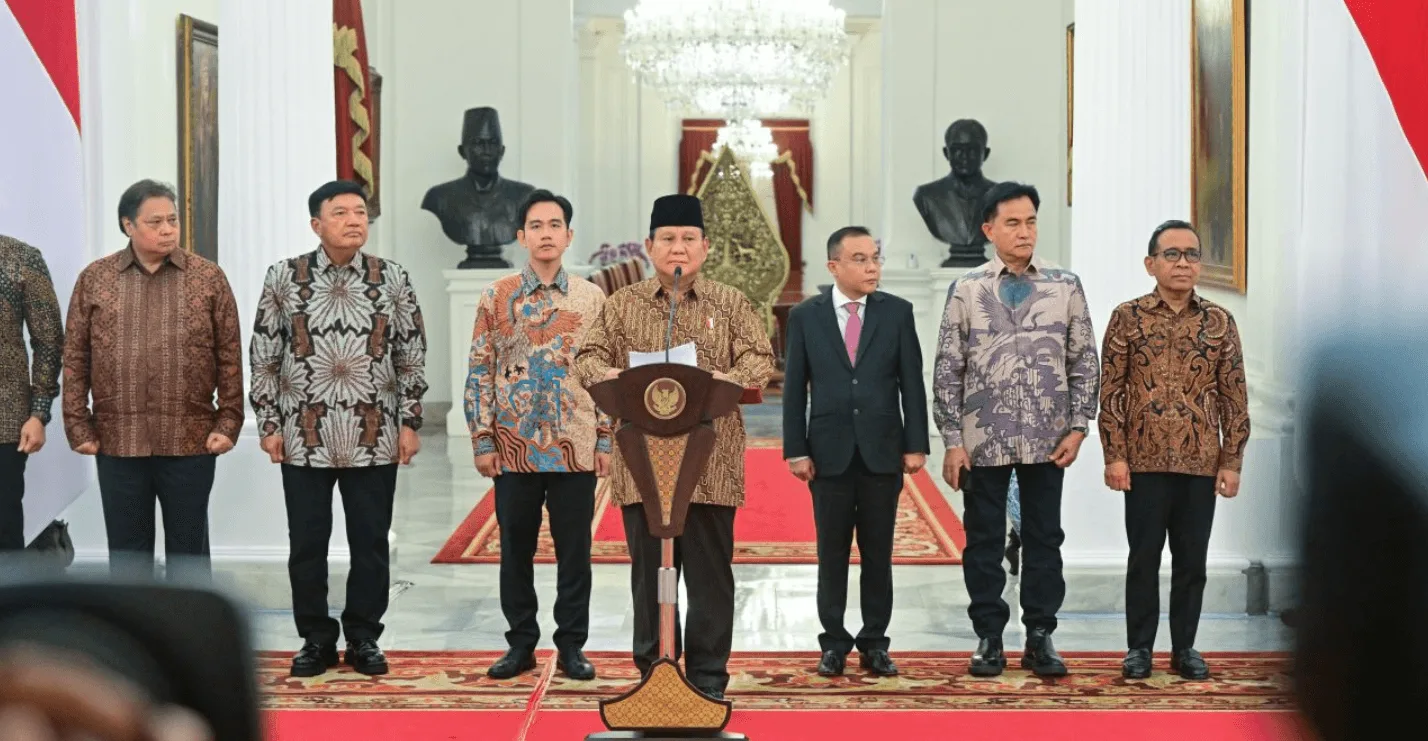
An interesting point when the announcement of the Prabowo – Gibran government cabinet was made is its very jumbo or, more precisely, obesity composition. The interpretation of obesity is not without reason because if you look at the number of structural positions, it is indeed very large. No less than 108 people were appointed by Prabowo to assist him for the next five years, consisting of 7 Coordinating Ministers, 41 Ministers, 55 Deputy Ministers and other officials at the level of Minister.
Of course, the appointment raises questions, whether the selection is based on quality or just a distribution of positions. In fact, in order to provide a place for his success team when running in the Presidential election contest, Prabowo broke up many Coordinating Ministries and Ministries. For example, the Coordinating Ministry for Law, Human Rights, Immigration and Corrections, which is held by Yusril Ihza Mahendra, who is none other than the head of the Prabowo – Gibran legal team in yesterday's presidential election.



The Coordinating Ministry led by Yusril is present as a breakdown of the Coordinating Ministry for Political, Legal and Security Affairs (Polhukam) because the Political and Security fields are excluded into a separate Coordinating Ministry under the coordination of Budi Gunawan, who is a former head of the State Intelligence Agency (BIN). In addition, there is a new Coordinating Ministry nomenclature, namely the Coordinating Ministry for Food, coordinated by Zulkifli Hasan, the Coordinating Ministry for Community Empowerment led by Muhaimin Iskandar (Cak Imin) and lastly the Coordinating Ministry for Infrastructure and Regional Development chaired by Agus Harimurti Yudhoyono.
In addition, at the technical Ministry level, there are also several divisions. The Ministry of Law and Human Rights (Kemenkumham), for example, is divided into three, namely the Ministry of Law held by Supratman Andi Agtas, then the Ministry of Human Rights held by Natalius Pigai and then the Ministry of Immigration and Corrections held by the former Deputy Chief of Police, Commissioner General Agus Indriyanto. Then there is the Ministry of Public Works and Public Housing (PUPR) which is divided into two, namely the Ministry of Public Works led by Dodi Hanggodo and the Ministry of Public Housing under the command of Maruar Sirait.
The Ministry of Tourism and Creative Economy (Menparekraf) is also divided into two, namely the Ministry of Tourism held by Widyanti Putri and the Ministry of Creative Economy or Head of the Creative Economy Agency held by Teuku Rifki Harsya. There is also the Ministry of Cooperatives and Micro, Small and Medium Enterprises (Kemenkop UKM) which is also divided into two Ministries, namely the Ministry of Cooperatives chaired by the chairman of Projo as well as the former Minister of Communication and Information (Kominfo), Budi Arie and the Ministry of SMEs led by Maman Abdurrahman. There are also several other Ministries that have also experienced divisions and cannot be mentioned and explained one by one.
In addition to the splitting in the technical Ministry sector, Prabowo also appointed several special envoys who did not exist during the Jokowi-Ma'ruf Amin era. These include the Special Envoy for Food Security, held by Muhammad Mardiono, the Chairman of PPP. The Special Envoy for Religious Harmony was held by Gus Miftah before he eventually resigned due to the controversy of insulting an iced tea seller. There is also Rafi Ahmad who was assigned as a special envoy for Youth Development and Artists as well as several other special envoys that cannot all be mentioned due to their large number.
The very obese cabinet composition raises a big question regarding work efficiency and coordination lines. This is because it will concern the alignment of related Ministry regulations which will take a long time. During the early period of Jokowi's administration, it took approximately two and a half years to fix the regulations in the Ministry of Environment and Forestry, which were previously separated between the Ministry of Environment and the Ministry of Forestry during Susilo Bambang Yudhoyono's era, so the process of aligning the regulations took quite a long time.
Looking at the large number of Coordinating Ministries and Ministries, as well as the emergence of several new nomenclatures, the process of aligning regulations at the ministerial level will certainly take a long time and leave a level of work efficiency for the institution or ministry in question. For example, the Ministry of Law and Human Rights, which was split into three, requires regulatory alignment to avoid overlapping regulations. In this case, it is necessary to separate and sort out the rules that must be done before the three ministries can work optimally.
Considering that one of the obstacles to the efficiency of rules or regulations in the service implementation process is the overlapping rules at the ministerial level, which often creates complicated bureaucratic flows. Of course, the complexity of the bureaucratic flow makes services to the community slow and convoluted.
In conclusion, this obese cabinet composition needs stricter emphasis and control. Don't let the large number of cabinets result in some ministries not working. It may still be too early to conduct an evaluation, but it is already apparent that some Ministries have not shown their performance. One definite reason is the need for adjustments and division of labor so that several new Ministry nomenclatures can work, but from here it can already be concluded that the formation of this bloated cabinet will be inefficient.
From a political pragmatism standpoint, the formation of this jumbo and obese cabinet is a form of gratitude to those who assisted Prabowo – Gibran in the recent Presidential Election contest, whether to coalition political parties, individuals, or specific groups that require position transactions. Prabowo – Gibran clearly have a significant task in proving themselves to the public, especially regarding the quality of their assistants. Moreover, Prabowo once stated that there would be no ministers appointed through patronage and that anyone who does not work properly would be replaced. Let us wait and see if that statement is true or just mere rhetoric. Do not be fierce only towards the public but lenient towards those closest to you.












Comments (0)
Write a comment