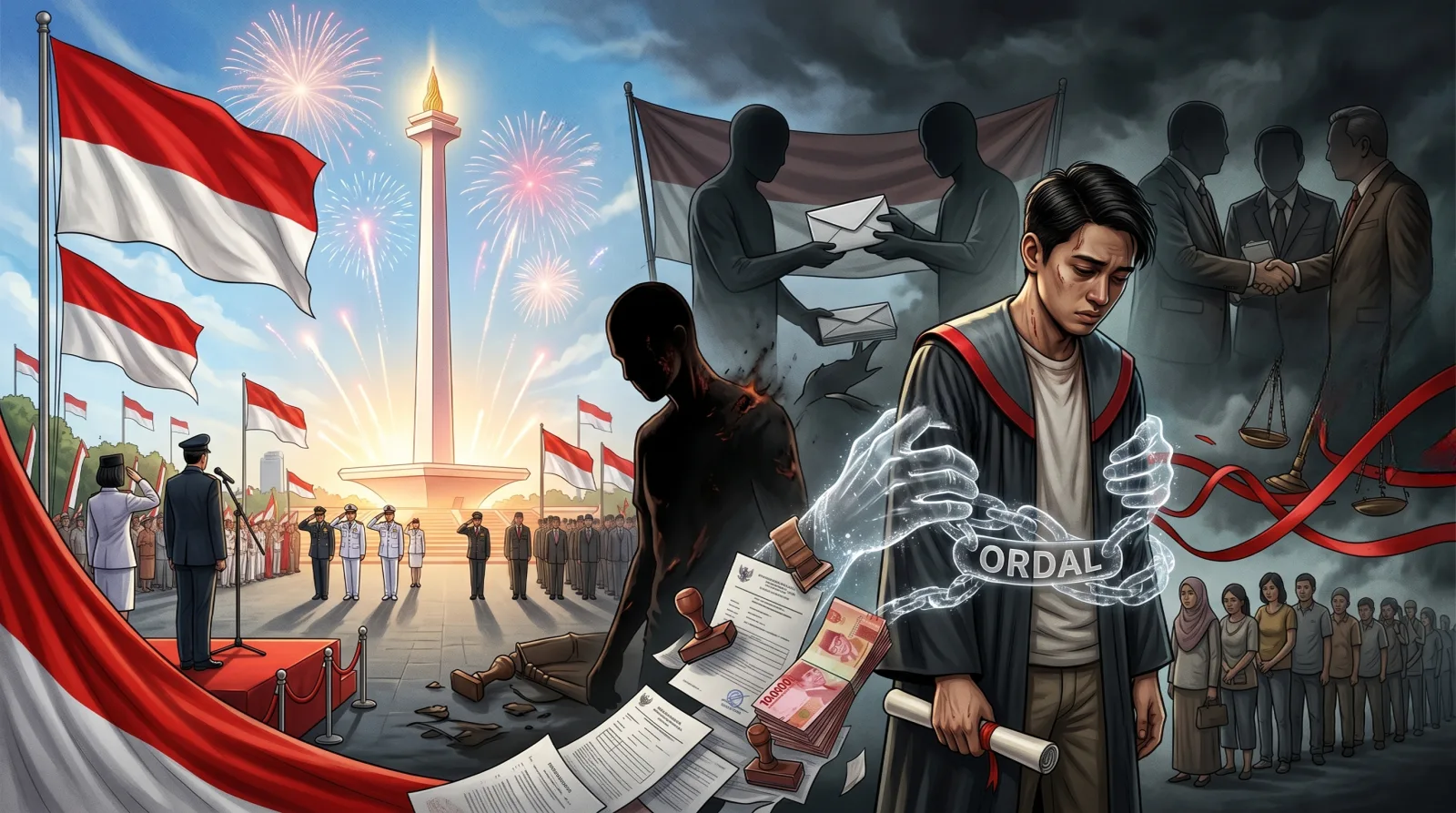
Legal Literacy - Following in the footsteps of the Indonesian National Army (TNI) through the Revision of Law Number 3 of 2025. One of the contents is to expand the opportunities for active TNI soldiers to fill positions in 16 ministries/institutions, although accompanied by a restriction mechanism, in addition to adding new tasks such as assisting in overcoming cyber threats, protecting Indonesian citizens abroad, and dealing with drug abuse.
The Indonesian National Police (Polri) also issued Indonesian National Police Regulation Number 10 of 2025 concerning Members of the Indonesian National Police Who Carry Out Duties Outside the Organizational Structure of the Indonesian National Police. based on Indonesian National Police Regulation Number 10 of 2025, members of the National Police can fill managerial and non-managerial positions in 17 ministries and institutions outside the Police structure, such as in OJK, KPK, BNN, BIN, to Kemenkumham and ESDM.
Dwifungsi ABRI (Dual Function of the Armed Forces)
The placement of TNI soldiers and Polri members in ministries/institutions is reminiscent of the New Order era of Dwifungsi ABRI. In that era, the Police together with the TNI AD, TNI AU and TNI AL were in one institution, the Indonesian Armed Forces (ABRI). Dwifungsi ABRI (socio-political and security functions) is the doctrine of the dual role of the Indonesian military (Indonesian Armed Forces), where ABRI serves as a security defense force (Hankam) as well as a socio-political force, which allows military officers to occupy positions in the government and legislature to participate in national development. This concept was initiated by A.H. Nasution to create stability, although in practice there are often deviations.
ABRI members are spread across almost every stratum of executive positions, from Ministers, Governors, high state institutions such as the DPA (Supreme Advisory Council) and others. Even in the DPR legislative institution, the ABRI Faction in the DPR during the New Order era was a military representative appointed directly by the President (Soeharto) through an appointment mechanism, not elections, as part of the Dwifungsi ABRI (socio-political and security functions) policy, and they got permanent seats in parliament (up to 100 seats), not elected by the people. Through this dual role, the military is allowed to hold positions in the government, ABRI officers sit in political and government positions such as various legislative and executive institutions and in the government bureaucracy.
Indeed, it must be admitted that, from the positive side, ABRI is considered capable of maintaining security stability and supporting national development because it is directly involved in the field. Military communication skills with the people are expected to channel aspirations and encourage development. However, the negative impact is greater, military domination, ABRI fills important positions such as ministers, regents, governors, ambassadors, to leaders of BUMN, reducing the role of civilians, Lack of Transparency & Democracy, Great political power triggers KKN practices and abuse of authority for personal or group interests, Human Rights Violations: The relationship between civilians and the military becomes disharmonious due to military domination, and Freedom of expression is very limited because it is considered subversive
Comments
0Share your perspective politely, stay relevant, and focus on the article. Comments appear after moderation.
Join the discussion
Write a clear, polite response that stays on topic.
No comments yet. Be the first to discuss.
Comments will appear after moderation.