

Legal Literacy - This article discusses the position of adopted children in Batak Karo customary inheritance law, outlining the principles that distinguish between the inheritance rights of biological children and adopted children. By delving deeper into the patrilineal kinship system typical of the Batak Karo, the author elaborates on how inheritance rights and the social position of women differ, as well as the deliberation process that is the main forum in the distribution of inheritance. This article also examines ancestral property and acquired property in the context of inheritance, providing important insights into the treatment of adopted children and daughters in the customary legal tradition.
Introduction
Inheritance law is the law that regulates the transfer of ownership rights over the inheritance of the testator after the testator dies, which determines who is entitled to be an heir and determines how much each heir's share is. Batak Karo customary law has its own rules and principles in regulating the position of adopted children in terms of Batak Karo Customary Inheritance Rights.


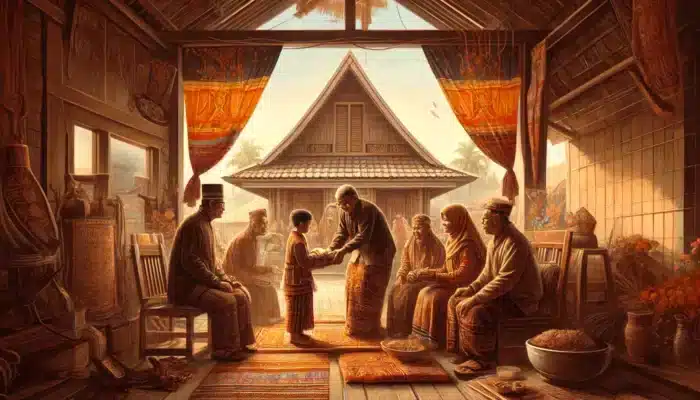
The position of children in Batak Karo customary inheritance law
In Batak Karo customary law, the position of adopted children in terms of inheritance rights may differ from that of children. In Batak Karo customary inheritance law, it is based on a patrilineal kinship system which is based on the father's line, so the distribution of inheritance rights is also distinguished, between sons as family successors and daughters. When a Batak Karo woman gets married, she will enter her husband's clan/tribe (customs), therefore Batak Karo women are not entitled to inheritance rights. In Inheritance Law Batak Karo Customs between male and female descendants in the main provisions only sons inherit their father's inheritance, while daughters receive inheritance in the form of grants, namely gifts to parents while they are still alive.
It has become common knowledge that clans/tribes (customs) who are worried about facing the reality of not having descendants generally adopt children to avoid this.
In Batak Karo customary inheritance law, the object is all inheritance from the father in the form of: Houses, Agricultural/Plantation Fields, Empty Land, Livestock, Cars and Valuables.
The position of daughters in Batak Karo customary inheritance law does not get the right to inherit, is generally considered to have an unequal degree compared to sons, this is inseparable from the customs or norms that apply in daily life, but the position of women is no different in the family. In the inheritance rights of Batak Karo customary law, women also get it, although not as much as what is obtained by sons, but if the sons do not give rights, the daughters may not demand it.















Comments
0Share your perspective politely, stay relevant, and focus on the article. Comments appear after moderation.
Join the discussion
Write a clear, polite response that stays on topic.
No comments yet. Be the first to discuss.
Comments will appear after moderation.