

In Indonesia, Sebastian Pompe (2014) noted serious intervention by the authorities in the courts. In past practice, President Soekarno's intervention was carried out openly. The intervention was carried out by including the Chief Justice of the Supreme Court, Wirjono Prodjodikoro, as a member of the Cabinet with the status of Minister in 1960. Clearly, the independence of the court was lost from that moment on. Once, in the Cosmos case involving a smuggler, Soekarno wanted this case to be tried as a subversive case in order to impose the death penalty. Therefore, he asked Wirjono to instruct the judge handling the case, Sri Widoyati, to impose the death penalty. Widoyati refused but was continuously persuaded. Subtly, Widoyati asked Wirjono to hand over the president's letter regarding the request to her. Widoyati thought it was impossible for Soekarno to be so bold as to ask her to impose the death penalty. Surprisingly, the next day, Wirjono met Widoyati and actually handed over the letter (2014:96).
Likewise, strong pressure from the Soeharto Government was found when the court handled cases involving the interests of (individuals in) power. This happened, for example, when the court tried the case of Haris Murtopo (son of Ali Murtopo, one of the strongmen of the New Order). Haris was tried after shooting his school friend to death. The court acquitted Haris on the grounds that Haris was acting in self-defense. Even though there was strong evidence that the Chief Justice of the Supreme Court, Seno Adjie, summoned the judge who was trying Haris Murtopo and directly dictated the verdict of Haris's acquittal (2014: 186-187).


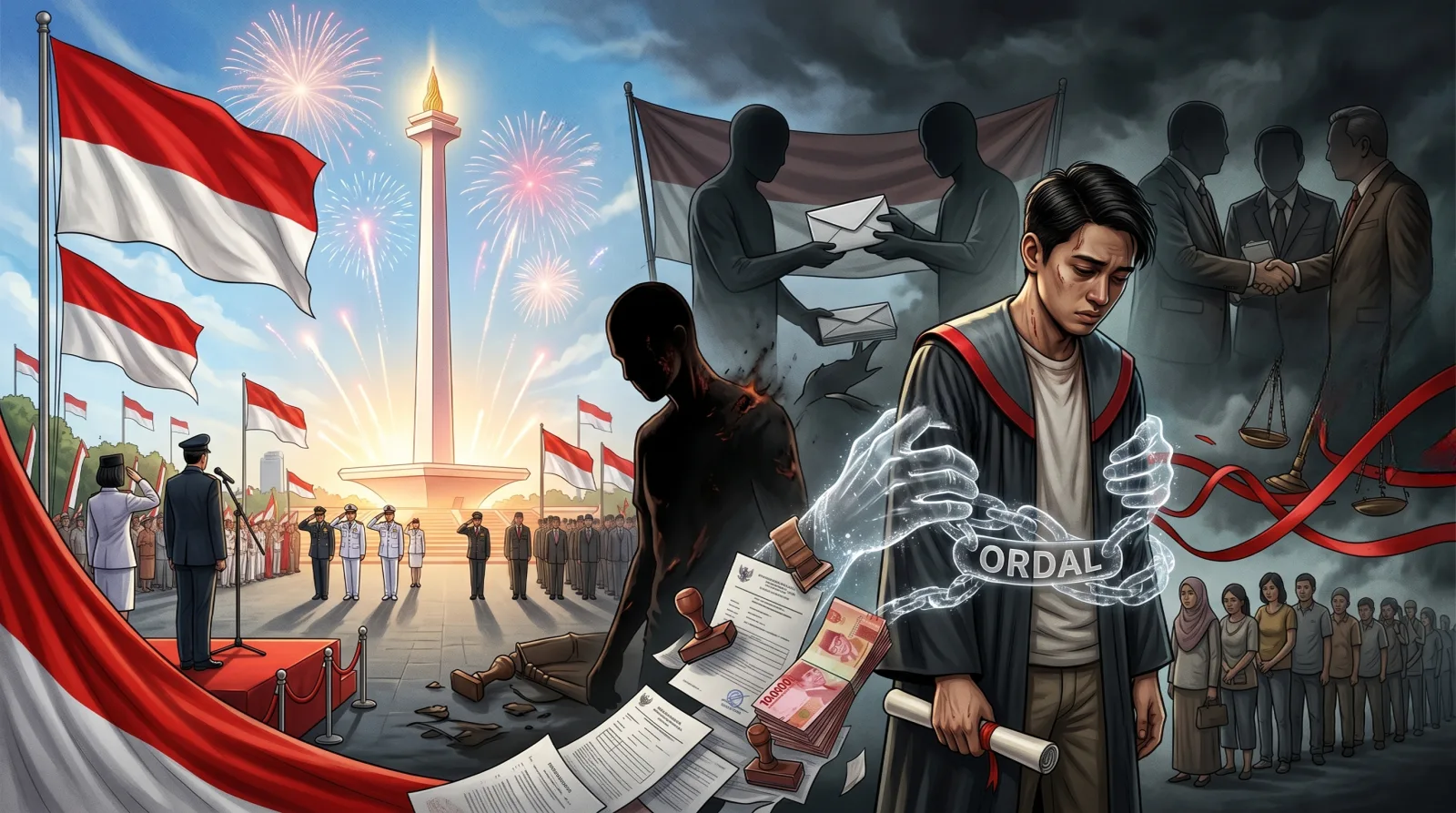
It is depicted that the attacks targeted court judges, including tough judges, even though they ultimately lost and surrendered. Tough judges surrendered and chose to resign. Judges whose integrity was eroded survived by bowing powerlessly to the dictates of the authorities. The court was very weak against the erosion of its independence. The erosion could take the form of temptation and material enticements, whether in the form of money, goods, power, popularity, or other things. It can also be in the form of threats and fear of the consequences of the decisions to be taken, both to the safety of oneself, family, or career.
Trapped in ‘Juristocracy’
Regarding the doubt that the court is the “least dangerous” branch of power, I would argue that the court, at certain anomalous points, is very dangerous to democracy. This will happen when the court feels in a very strong and ‘ultra-independent’ position. If impatient and unable to restrain itself, the court is trapped playing the main actor of ‘juristocracy’, not democracy. ‘Juristocracy’ by the originator of this term, Ran Hirschl (2005), is defined as the trend of important decision-making by judges in courts, especially in constitutional courts that have the authority to interpret the constitution, also too aggressively influencing the course of government and state policy.
There is an interesting example related to the Constitutional Court which is always understood to play a role in creating a democratic-constitutional system of government, especially through the authority of judicial review. In reality, in a number of countries, the Constitutional Court has failed to carry out its role. This failure, according to Donald L. Horowitz (2006: 126-127), is caused by several things, one of which is the Constitutional Court acting too far in dictating policies that are the authority of the legislative and executive. This was once experienced by the Constitutional Court (MK) of Hungary.
Horowitz said that the Constitutional Court of Hungary has become extraordinarily aggressive, including imposing affirmative obligations on the other two branches of power. Without constitutional provisions, the Constitutional Court of Hungary interfered in parliamentary policy matters. In fact, the Constitutional Court of Hungary once asked parliament to pass legal rules regarding procedural law or parliamentary rules of procedure. The Constitutional Court of Hungary also once stated that parliament, which failed to pass a certain law, had acted “unconstitutionally by omission”. It was recorded that on 260 occasions between 1990 and 1995, the Constitutional Court of Hungary, through its decisions, determined how laws should be made, what should be regulated in the law, and when the deadline for the law should be completed. The Constitutional Court of Hungary has decided on matters that are the authority of other branches of power in detail, even to the issue of the budget. The hyper-activism of the Constitutional Court of Hungary immediately triggered a serious political reaction from parliament. This kind of condition is what Fajar Laksono (2019:234) calls creating an institutional relationship between the Constitutional Court and the lawmakers in a confrontational, not cooperative, manner.
The court's push towards 'juristocracy' is growing as the state is experiencing hyperregulations or legal obesity. This is because this condition will have an impact on the increasing role of the court in determining the validity of each regulation and state policy through the mechanism of judicial review. This pushes the court into areas that are not part of its degree and authority. It is possible that the court becomes more like a 'mini-parliament' or even becomes a silhouette and sketch of the government. Another thing is that when the symptoms of 'juristocracy' are tolerated, the court may be tempted to use its decisions as a 'weapon' to influence the policies of other branches of power that benefit the judges in particular, or the court institutionally. This means that decisions are no longer purely based on solid and convincing legal considerations, but rather because of certain motives outside of law enforcement and justice. For Miller (2004; 272), this kind of thing is a threat to democracy. Because it is inappropriate to elevate the court as an institution that is not representative and not accountable above the representative institution in the making of a public policy. Moreover, in the area of judicial power, the principle of judicial restraint is known. Judges and courts should restrain themselves on matters that are not within their competence.
***
We often hear the expression: history will repeat itself. This means that history actually reveals the face of our future. So, even if it is not desired, the opportunity for the dark history of judicial independence to happen again is always there. A vaccine or antibody against that paradox has not been found. Most legal scholars make normative recommendations: independence is an absolute, period. In order to decide fairly, in order to contribute to democracy, judges and courts must do this, must not do that, or must avoid this and that. There is no recipe that really has a high possibility of being easily practiced so that independence really exists and is maintained. Or, maybe, judicial independence is just a myth, which is easy to tell, but never exists in reality.
Therefore, what can be written here may add to the length of the normative recommendation. We have a written constitution to safeguard democracy. It contains guarantees of the independence of the judiciary. However, all of that can work well when supported by unwritten rules of the game or norms of virtue that are mutually agreed upon. To that end, two fundamental norms for the continuation of democracy, as stated by Levitsky and Zibblat, namely mutual tolerance and institutional self-restraint (2019:83), are compatible for realizing judicial independence. In his writing, Ronli Sifris (2008) mentions that judicial independence is a core component of democracy. So, it fits!
Tolerance refers to the respect of all parties, all branches of power, for each other's existence, functions, and authorities. Differences of opinion may occur, but tolerance is an agreement to disagree. Therefore, institutional self-restraint is necessary. This means that all parties, all branches of power, avoid actions that appear to be in accordance with the law, but in reality, straddle the law.
Full Paper:


















Comments
0Share your perspective politely, stay relevant, and focus on the article. Comments appear after moderation.
Join the discussion
Write a clear, polite response that stays on topic.
No comments yet. Be the first to discuss.
Comments will appear after moderation.