
The Press and Mass Media as Pillars of Democracy
Etymologically, democracy comes from the Greek words“demos”and“kratos”. Demos means people or the public, while kratos means government.
In terms of definition, democracy is a system of government that grants rights and freedoms to its citizens to express their opinions and participate in government decision-making.


Democracy can be viewed from two perspectives. First, democracy is seen in reality based on everyday life. Second, democracy is seen as it is portrayed by the mass media.
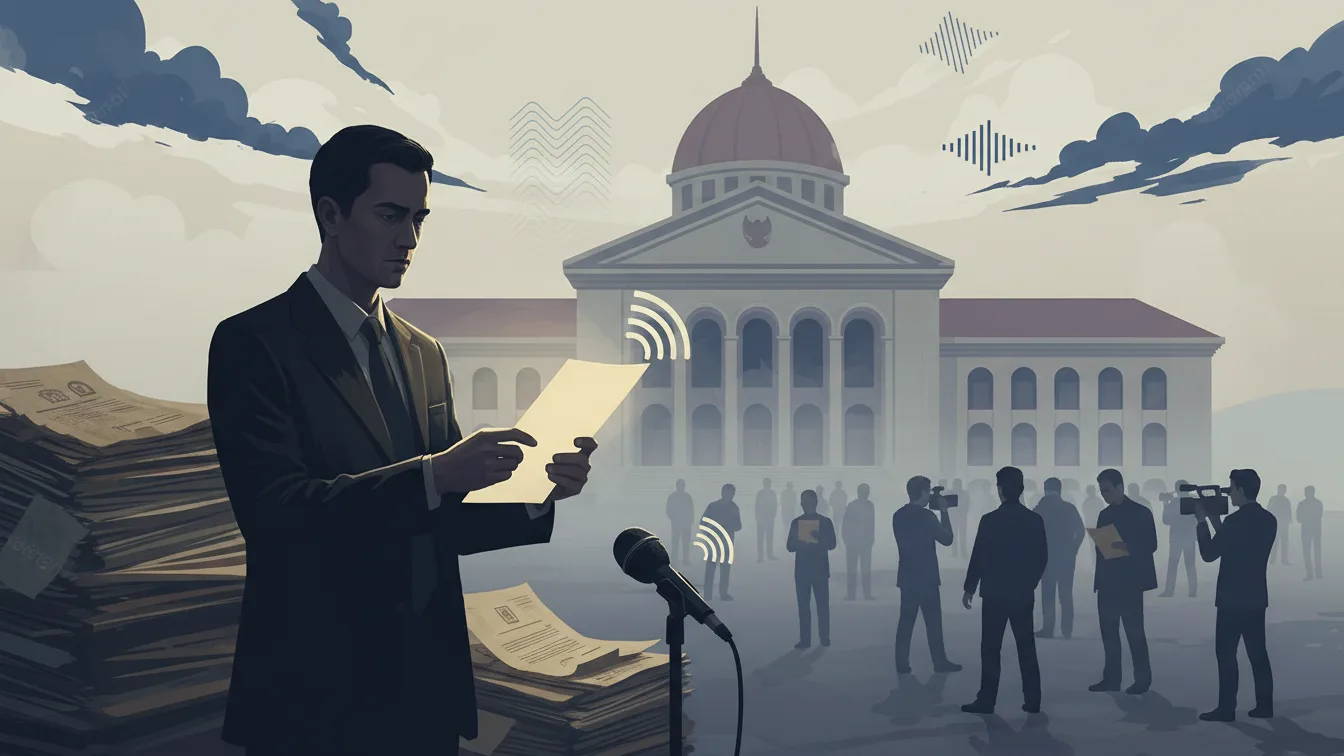
Democratization in a country will not be maximized if it only relies on the role of parliament. Therefore, the existence of the press and mass media is very necessary as a means of communication between the government and the people, as well as the people with the people.
The dissemination of information through mass media is in line with the principle of democracy, namely the concept of comprehensive and open transformation. In this case, freedom of the press is needed to support the upholding of democracy, justice, and truth.
The fourth pillar of democracy was first coined by Edmund Burke at the end of the 18th century. The term indicates that the political power held by the press is equivalent to the other three pillars in British life, namely God, the Church, and the House of Commons.
If this concept is associated with the democratic system in Indonesia, the power of the press is considered equivalent to other pillars of democracy, namely the executive, legislative, and judicial branches.
The power of the press here refers to the power to oversee the running of the government and channel the aspirations of the people. Not only that, the press and mass media also play a role in encouraging people to express their voices.
Moreover, in election moments, especially presidential elections, press institutions and mass media have an important role in influencing people's thoughts. Various media ranging from newspapers, television, radio, to news portals online massively broadcast the course of the presidential candidates' campaigns.
Through these broadcasts, the public is expected to be moved to determine their choices according to their respective preferences and minimize abstentions.
As the fourth pillar of democracy, the press and mass media require freedom and independence in carrying out their functions.
Article 4 of Law Number 40 of 1999 concerning the Press states that the independence of the press is guaranteed as a human right of citizens. A press institution is also not subject to censorship, banning, and prohibition of broadcasting. The independence of the press is also realized with the guarantee from the government to seek, obtain, and disseminate ideas and information.
Democracy in the form of freedom to convey information is sometimes also misused by press institutions and mass media.
During the election period, a number of journalists and press institutions certainly face various existential problems as a result of media company owners becoming party leaders or even participating as legislative candidates in the election moment.
During these times, sales of print media copies and media ratings online may increase. Campaign-related advertisements have the potential to increase the company's wealth. It is also possible that press institutions and mass media have political orientations that support the company owners.
In fact, the main commitment of the press and mass media is the public interest. However, in reality, the truth that should be conveyed by them is often contaminated with hoax news.
The Ministry of Communication and Informatics (Kemenkominfo) released that every year there are thousands of hoax spreaders in Indonesia. These various sites not only contain falsehoods, but also spread hatred, prejudice related to ethnicity, religion, race, and group (SARA), slander, and provocation of distrust to public bodies.
The press and mass media, which are expected to provide direction and correct information to the public, have instead become a forum for voicing political attitudes, partiality, hatred, and hostility. Not infrequently, the public also has difficulty distinguishing between true and hoax information.
Therefore, public participation is needed to oversee and minimize the spread of hoaxes so that the role of press institutions and mass media does not deviate from its function as the fourth pillar of democracy.
















Comments
0Share your perspective politely, stay relevant, and focus on the article. Comments appear after moderation.
Join the discussion
Write a clear, polite response that stays on topic.
No comments yet. Be the first to discuss.
Comments will appear after moderation.