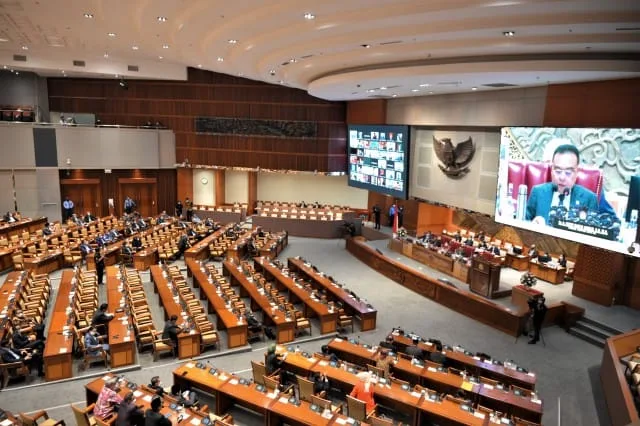
Legal Literacy - The House of Representatives as an institution that represents the aspirations of the people towards the government (executive) should act and behave in accordance with the wishes of the people. The House of Representatives should be a natural “opposition” to the government, not “friends” with the government. If the House of Representatives is on the same side as the government, then who acts as the supervisor of the government? Shouldn't the House of Representatives be a filter on all government policies? If the House of Representatives and the government are in the same camp, then the policies and laws that are born may not be based on the interests of the people, but the interests of a handful of rulers.

Political Reality in Indonesia

The political phenomenon that occurs in Indonesia is that when a political party enters the ruling government (coalition), the members of that political party, whether they are serving in the executive or legislative, or are just members, will support and defend any policies issued by the government (in this case, the president). For example, in 2019 when there was a competition for RI 1 between Prabowo Subianto and Joko Widodo, we could all see how heated the debate was between members of the Gerindra party and members of the PDIP party in the media, both television and social media. It is not uncommon for insults, slander and so on to occur between the two camps.

However, after Prabowo joined Jokowi's government and was assigned to hold the position of Minister of Defense, suddenly the politicians of the Gerindra party were no longer “fierce” towards Jokowi's government, both on social media and in parliament. They (Gerindra) even turned into supporters of Jokowi's policies, we can see this in various media when the sources come from the Gerindra party.

The event above is just an example that politicians (especially members of the House of Representatives) do not act and behave based on the interests of the people, but the interests of political parties. When political parties are outside the government, they become the opposition; when they enter the government, they suddenly coalesce and agree with government policies.

Political parties in Indonesia have lost their identity, the position of political parties in Indonesia is only based on which camp they are in, based on whether the political party is outside or inside the government. If the political party is inside the government, then it becomes pro-government and its policies. Likewise, if a political party is outside the government, then it becomes against the government. The implication is that members of the House of Representatives will be in line with their party's attitude. If not, the risk of dismissal or PAW will await.

Advertisement
Read without ads.
Join Membership

Members of the Indonesian House of Representatives, as individuals elected by the people, should act and behave based on the aspirations and interests of the people, not based on the positions and interests of their parties. If this is not possible, or too ideal to be true, then the rule of law must accommodate the registration of candidates for members of the Indonesian House of Representatives through independent channels, so that members of the Indonesian House of Representatives are free from elements of the interests of their supporting parties.

As another example, we can witness in the 2024 Presidential Election, when PKS nominated Anies Baswedan, who we all know is a representation of the anti-government in power or anti- status quo, PKS cadres who became candidates for members of the Indonesian House of Representatives also echoed changes and were against the policies of the government in power. Constituents (voters) of members of the Indonesian House of Representatives from the PKS party certainly chose PKS cadres to represent them in parliament to represent the opposition to the government. However, what happened in the end was that PKS joined (coalition) with the elected President, who we all know is an extension of the previous government. The votes collected by PKS legislative candidates originating from anti- status quo aspirations were not heeded at all. Members of the Indonesian House of Representatives who were elected from PKS, whose constituents hoped they would be the mouthpiece of the opposition to the government, instead joined the government, abandoning the voices of their constituents.

In this example, we are not talking about right or wrong, the above event is just an example that there is no such thing as the interests of the people as often echoed by politicians. In reality, they only act based on their own and their party's interests. The people are only used as stepping stones for them to be elected as representatives of the people, when they are already "inside", they act based on the interests of the party and forget the people.

Advertisement
Read without ads.
Join Membership

We can see the results of this inconsistency of members of the Indonesian House of Representatives in various surveys of the level of public trust in the institution. The Indonesian House of Representatives always occupies the bottom ranks. Like the survey released by the Indikator Survey Institute in January 2024, out of 11 existing institutions, the Indonesian House of Representatives is in the second lowest rank, namely rank 10, and political parties are in the lowest position.

Members of the Indonesian House of Representatives as individuals elected by the people, should act and behave based on the interests of their constituents. Members of the Indonesian House of Representatives are not representatives of political parties, but representatives of the people. The people are the holders of the highest power, in accordance with the 1945 Constitution of the Republic of Indonesia Article 1 paragraph (2). The Indonesian House of Representatives as a representative institution of the people should act and behave based on the interests of the people, not other interests.