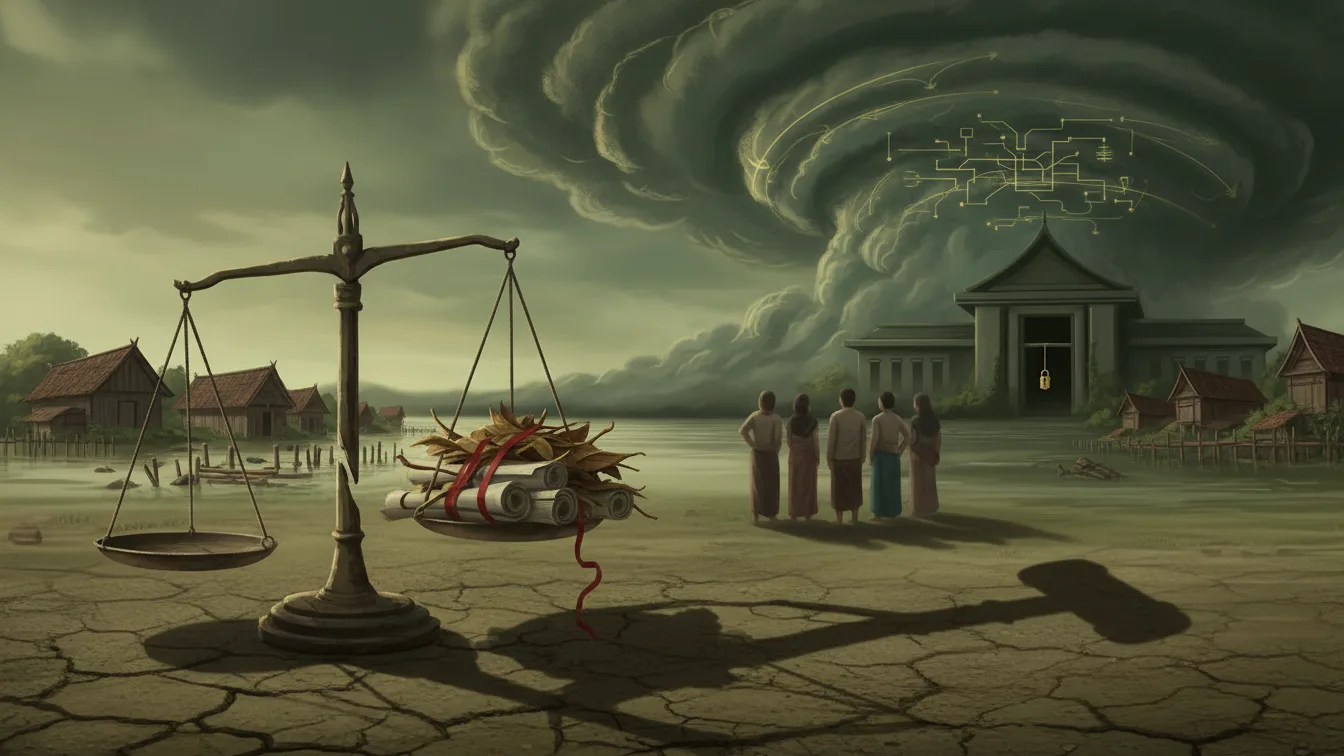
Legal Literacy - At a time when the climate crisis has forced thousands of people to lose their homes, living spaces, and even social identities, policies are instead presented in a cold language, namely management. This contrast feels so bitter when we see the reality on the ground. The tragedy of Tropical Cyclone Seroja in NTT in 2021, for example, which killed at least 181 people, and Cyclone Senyar in Sumatra at the end of 2025, which claimed more than 1,100 lives, are proof that this crisis is not just statistics, but a threat to life. However, instead of responding with the urgency of justice, the draft Bill on Climate Change Management (PPI) is trapped in a dry administrative labyrinth.
The Problem of the Terminology "Management" that Covers Up the Crisis
The use of the terminology "management" in the title of this Bill indicates the absence of a crisis paradigm in the eyes of the state. Climate change is positioned only as a technical environmental issue, not a multidimensional crisis that threatens people's safety and human rights.
In Article 3 of the draft, the objectives stated are only to "prevent the impact of environmental damage" and "realize sustainable development". There is no explicit mention of a national emergency that requires immediate action. In fact, a crisis that is only "managed" without recognizing its emergency is a crisis that is being prepared…













Comments
0Share your perspective politely, stay relevant, and focus on the article. Comments appear after moderation.
Join the discussion
Write a clear, polite response that stays on topic.
No comments yet. Be the first to discuss.
Comments will appear after moderation.