
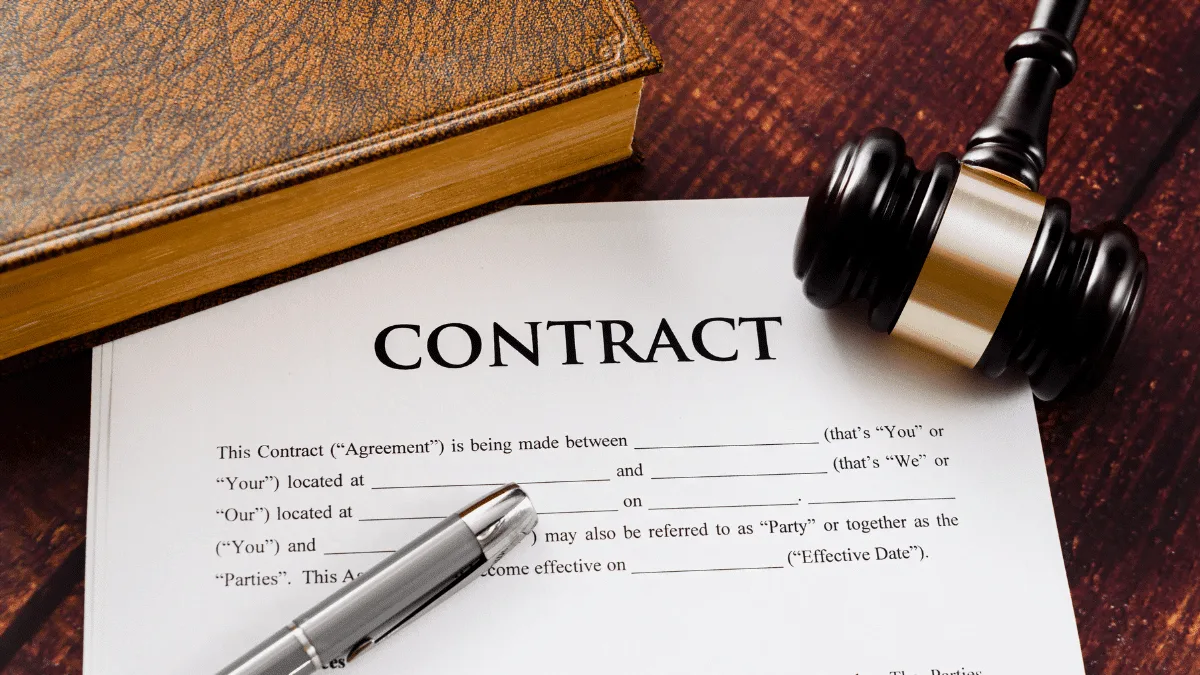
Types of Standard Agreements
- An adhesion contract is an agreement presented by one party to another, where the weaker party only has the option to accept or reject the agreement in its entirety.
- A standard agreement is an agreement made by a particular institution and intended for parties who wish to carry out certain transactions.
- Company regulations are agreements made by the company to regulate the relationship between the company and its employees.
Characteristics of Standard Agreements
- Made unilaterally
- Offered to consumers en masse
- The contents are printed and cannot be changed
- Consumers only have the option to accept or reject the agreement in its entirety
The Validity of Standard Agreements
Although it can potentially create problems regarding protection for the maker of the agreement, standard agreements are still permissible and valid as long as they meet the legal requirements of an agreement as previously mentioned. Then what about standard agreements that contain exoneration clauses?
Understanding Exoneration Clauses
An exoneration clause is a clause in an agreement that aims to release or limit the liability of one party for an event or loss that may occur. This clause is often referred to as a liability release clause or a disclaimer clause.


Rijken states that an exoneration clause is a part of an agreement that aims to release one party from the obligation to provide compensation for a breach of contract. This compensation can be in the form of partial or full losses experienced by the other party.[3]
In simple terms, this exoneration clause is defined as a clause excluding obligations or transferring responsibility in an agreement.
Examples of Exoneration Clauses
- Exoneration clause on parking tickets stating that the manager parking is not responsible for the loss of goods inside the vehicle.
- Exoneration clause in a lease agreement stating that the lessee is responsible for all damage that occurs to the leased goods.
The Validity of Agreements Containing Exoneration Clauses
In Law No. 8 of 1999 concerning Consumer Protection, an exoneration clause is considered as one type of standard clause that is not permitted. Even though the agreement has been agreed upon by both parties, the agreement is invalid if it contains an exoneration clause.[4]
According to Article 1 number 10 of the Consumer Protection Law, a standard clause is a regulation or condition that has been determined in advance by the business actor and is stated in a document or agreement that binds the consumer.
Sutan Remy Sjahdeni in his book states that a Standard Agreement is an agreement that has been prepared with standard terms by one party without giving the other party the opportunity to negotiate.
A standard clause becomes invalid when there is an imbalance between the parties because a valid agreement must be based on the agreement of both parties and bind them as law. Violation of this principle can invalidate the agreement. Therefore, standard clauses containing exoneration clauses are prohibited.
Despite the principle of freedom of contract, agreements must meet the legal requirements as stipulated in Article 1320 of the Civil Code, including having a lawful cause. Article 1337 of the Civil Code states that an agreement is invalid if it is contrary to the law or morality.
Thus, standard agreements containing exoneration clauses are invalid because they violate statutory provisions.
The Impact of Agreements Containing Exoneration Clauses
Agreements that use exoneration clauses can be null and void. Exoneration clauses constitute a transfer of responsibility from business actors regarding consumer protection.
Exoneration clauses can cause the rights and obligations of the parties to become unbalanced. Exoneration clauses in insurance policies constitute a limitation or elimination of the insurer's liability for losses suffered by the insured.
In loan agreements on P2P Lending-based Fintech, exoneration clauses can cause the agreement to be null and void because they are contrary to Article 1337 of the Civil Code.
In the UUPK, agreements containing exoneration clauses can be null and void if they violate Article 18 paragraph (1). In the Civil Code, agreements containing exoneration clauses can be null and void if they do not meet the legal requirements of the agreement.
[1] Article 1320 of the Civil Code
[2] Article 1338 of the Civil Code
[3] Ahmadi Miru. Contract Law, Contract Drafting. (Jakarta: PT Raja Grafindo Perkasa, 2007), p. 40
[4] Bernadetha Aurelia Oktavira, S.H., “The Law on Including Exoneration Clauses in Agreements” Hukum Online.



















Comments
0Share your perspective politely, stay relevant, and focus on the article. Comments appear after moderation.
Join the discussion
Write a clear, polite response that stays on topic.
No comments yet. Be the first to discuss.
Comments will appear after moderation.