
4. Remaining Unpaid Salary and Overtime
This is the most basic: wages for the days you have worked in the last month, including any overtime recorded but not yet compensated, must be paid in full. The company has no right to withhold salary as a "penalty" for resignation, even if you did not follow the one month notice procedure.
Article 52 of Government Regulation 35/2021 jo. Article 88 of Law Number 13 of 2003 concerning Manpower confirms that wages are workers' rights that cannot be unilaterally suspended by the employer.


What you're not entitled to when you resign
Honesty is part of legal literacy. There are two major rights that are forfeited when you choose to resign:
Severance pay and long service pay (UPMK) employees who are laid off by the company are only entitled, not those who resign voluntarily. This is regulated in Article 43 paragraph (1) of PP 35/2021 very strictly. Severance pay can reach two to nine times the monthly wage depending on the length of service - this is a large number, and ignorance is often exploited by companies that want to make efficiency by pressuring employees to resign "voluntarily" in order to avoid severance pay obligations.
This pattern has long been in the spotlight of the Industrial Relations Court. If you feel pushed, pressured, or conditioned to resign - not of your own free will - then legally it can be categorized as a disguised termination that opens up the right to severance pay. The proof is not easy, but the legal path is open.
Proper Resign Procedures (and the Consequences if Not Followed)
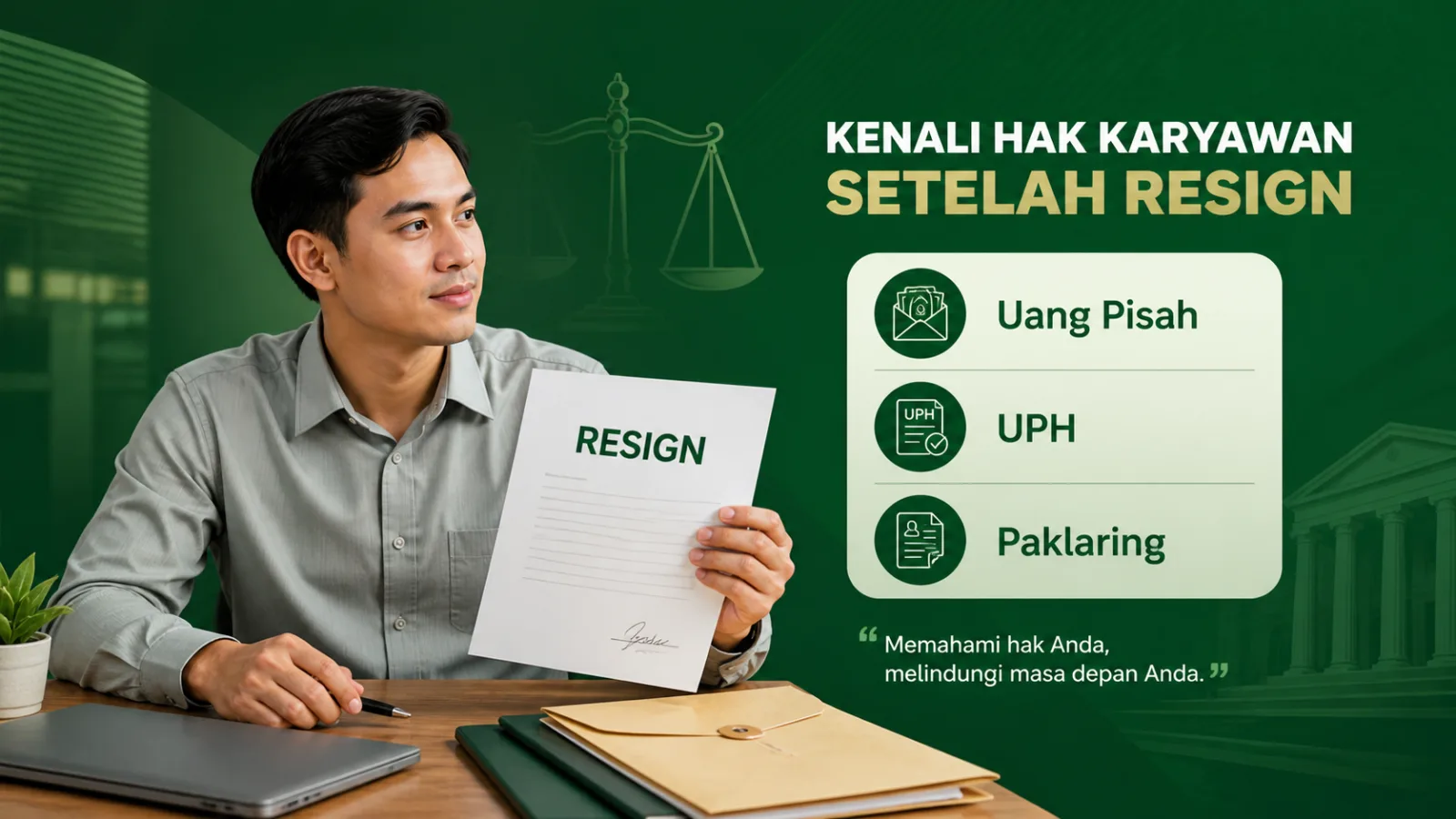
Article 154A paragraph (1) letter i of the Job Creation Law stipulates three conditions for a resignation to be considered valid and the employee is entitled to separation pay and UPH:
First, submit petition resignation in writing no later than 30 days before the resignation start date-this is known as one month notice. Second, not under service bonds. Third, continue to carry out obligations until the resignation start date.
If you don't follow the one-month notice, the risks are not criminal-remember, non-compliance with resignation procedures is civil and administrative, not criminal. The risks are financial and reputational: the company may refuse to pay separation pay (because the conditions are not met), not provide paklaring, or put your name on a blacklist circulating among similar companies.
However, the salary you have received during your employment - including the last month - must still be paid. Withholding your salary because you did not follow the resignation procedure is illegal.
Contract Employees (PKWT): The Rules Are Different
For contract or fixed-term employees, there are additional rules that are important to understand before you make the decision to resign.
Based on Article 62 of Law Number 13 of 2003 on Manpower, if one party terminates the employment relationship before the end of the contract period, the terminating party is obliged to pay compensation to the other party in the amount of the worker's wages until the contract expires. This means: if you are a contract employee with 6 months left on your contract and choose to resign, you are potentially obliged to pay compensation of six months' wages to the company.
On the other hand, PKWT employees who resign are also still entitled to compensation based on PP 35/2021, which is calculated proportionally based on the length of service. This applies even if you resign before the contract expires-the company and the employee both have rights and obligations that run concurrently.
JHT BPJS Employment: Don't Let It Settle
This is often forgotten in the resignation frenzy. After resigning, your Old Age Security (JHT) balance at BPJS Ketenagakerjaan can be fully disbursed after a one-month waiting period from the date of official resignation, based on Government Regulation Number 60 of 2015.
Requirements for disbursement: resignation letter from the company, paklaring, KTP, KK, and account book. Disbursement can be done directly at the BPJS Ketenagakerjaan office, or online through the JMO application (Social Security Mobile).
What is often not realized is that the JHT balance will not be forfeited even if it is not cashed out-it remains in your account. But putting it off means letting your funds sit idle, while you may need liquidity during a job transition.
If Your Rights Are Not Fulfilled: Three Available Paths
Knowing your rights is the first step. Knowing how to collect them is an equally important second step.
Bipartite is the first route: direct negotiation between you and the company (through the HRD or supervisor). This must be done first according to Law No. 2/2004 on Industrial Relations Dispute Resolution. Document all communications-messages, emails, letters-as evidence that you have tried to settle amicably.
If bipartite fails within 30 days, report to the Manpower Office (Disnaker) local mediation is the second step. Disnaker will facilitate tripartite mediation-you, the company, and a mediator from Disnaker. In many cases, pressure from the Disnaker mediator is enough to encourage the company to fulfill its obligations.
If mediation is not fruitful, lawsuit to the Industrial Relations Court (PHI) is the last resort. PHI handles labor disputes with relatively faster procedures than regular civil courts. For cases with small claims, you can file on your own without having to hire a lawyer-although assistance from a labor union or LBH is helpful.
Documents you should prepare in advance: employment contract or company regulations, signed resignation letter, last pay slip, leave records, and proof of correspondence related to financial rights.
Why many employees don't know this
This ignorance is no accident. Indonesia's education system does not include labor law in the general curriculum. New employee orientation usually only explains obligations to the company, not rights from the company. And when someone decides to resign, their emotional state is often not conducive to a thorough reading of the law.
On the other hand, there are structural incentives for companies not to proactively inform about these rights. The less they demand, the less they have to spend on operations. Not an evil-but not a good thing either.
Legal sociologist Satjipto Rahardjo once referred to this phenomenon as part of the legal gapthere is a gap between the laws that are written on paper and the laws that people actually feel and use. Rights that are not known are rights that cannot be exercised - and rights that are not exercised never really exist in real life.
Employment law literacy is not a luxury. For millions of Indonesian workers who daily consider whether to stay or move, this information is the difference between losing millions of rupiah or not.
Before You Send Your Resignation Letter
There are three things worth doing before submitting a resignation:
Read your employment contractit's important to be aware of the clauses in your contract, especially the clauses on resignation, separation pay, and applicable rights. If your contract is vague or doesn't have a separation pay clause, it doesn't mean you're not entitled - just that the amount should be negotiated.
Calculate your remaining leave and document it. Note how many days of leave have not been taken and make sure this number is not "lost" in the resignation administration process.
Make sure your paklaring will be issued. This doesn't need to be asked aggressively, but it does need to be confirmed in writing-ask the HRD to state when the paklaring will be ready, and keep the answer.
Resigning is the right of every employee. No company can prohibit resignation-it is protected by law. What is not protected is the ignorance of the rights that follow. And that's something we can fix, starting from now.
Legal Basis
- Republic of Indonesia. Law Number 13 of 2003 on Manpower. State Gazette of the Republic of Indonesia Year 2003 Number 39, Supplement to State Gazette of the Republic of Indonesia Number 4279.
- Republic of Indonesia. Law Number 11 of 2020 concerning Job Creationin particular, Article 81 number 45 which contains a new Article 154A paragraph (1) letter i of the Labor Law.
- Republic of Indonesia. Law Number 6 of 2023 on Stipulating Government Regulation in Lieu of Law Number 2 of 2022 on Job Creation into Law.
- Republic of Indonesia. Law Number 2 of 2004 on Settlement of Industrial Relations Disputes. State Gazette of the Republic of Indonesia Year 2004 Number 6.
- Republic of Indonesia. Government Regulation Number 35 of 2021 concerning Fixed-Term Employment Agreements, Outsourcing, Working Time and Rest Time, and Termination of Work Relationships. In particular Article 36 letter i, Article 40 paragraph (4), Article 43 paragraph (1), Article 50, and Article 52.
- Republic of Indonesia. Government Regulation Number 46 of 2015 concerning the Implementation of the Old Age Security Program as amended by Government Regulation Number 60 of 2015.
Reference
- Rahardjo, Satjipto. The Other Side of the Law in Indonesia. Jakarta: Kompas Publisher, 2003.
- Asikin, Zainal, and Amiruddin. Introduction to Legal Research Methods. Jakarta: PT RajaGrafindo Persada, 2012.
- "Employee Rights Resign 2026: How to Calculate Separation Pay & UPH." Desanaob.idfebruary 18, 2026.
- "Resign Without One Month Notice, This is the Law." Online Legal Clinic, 2024.
- "Resigned Employee Rights." Catapa.com, 2024.
- "Employee Resignation Rights: Severance Pay, UPH, & Paklaring." Dealls.comaugust 2025.
- "Understand Your Financial Rights Before Deciding to Resign." JDIH Sukoharjo, 2026.
- National Law Development Agency (BPHN). Legal Consultation: Employee Resignation Rights. literasihukum.bphn.go.id, 2025.
Disclaimer. This article has been prepared for legal education purposes and is general in nature. Each employment situation has a different context depending on the contents of the applicable employment agreement, company regulations, and collective bargaining agreements. Readers facing concrete disputes are advised to consult with the nearest labor advocate or Legal Aid Institution, or report to the local Manpower Office.






















Comments
0Share your perspective politely, stay relevant, and focus on the article. Comments appear after moderation.
Join the discussion
Write a clear, polite response that stays on topic.
No comments yet. Be the first to discuss.
Comments will appear after moderation.