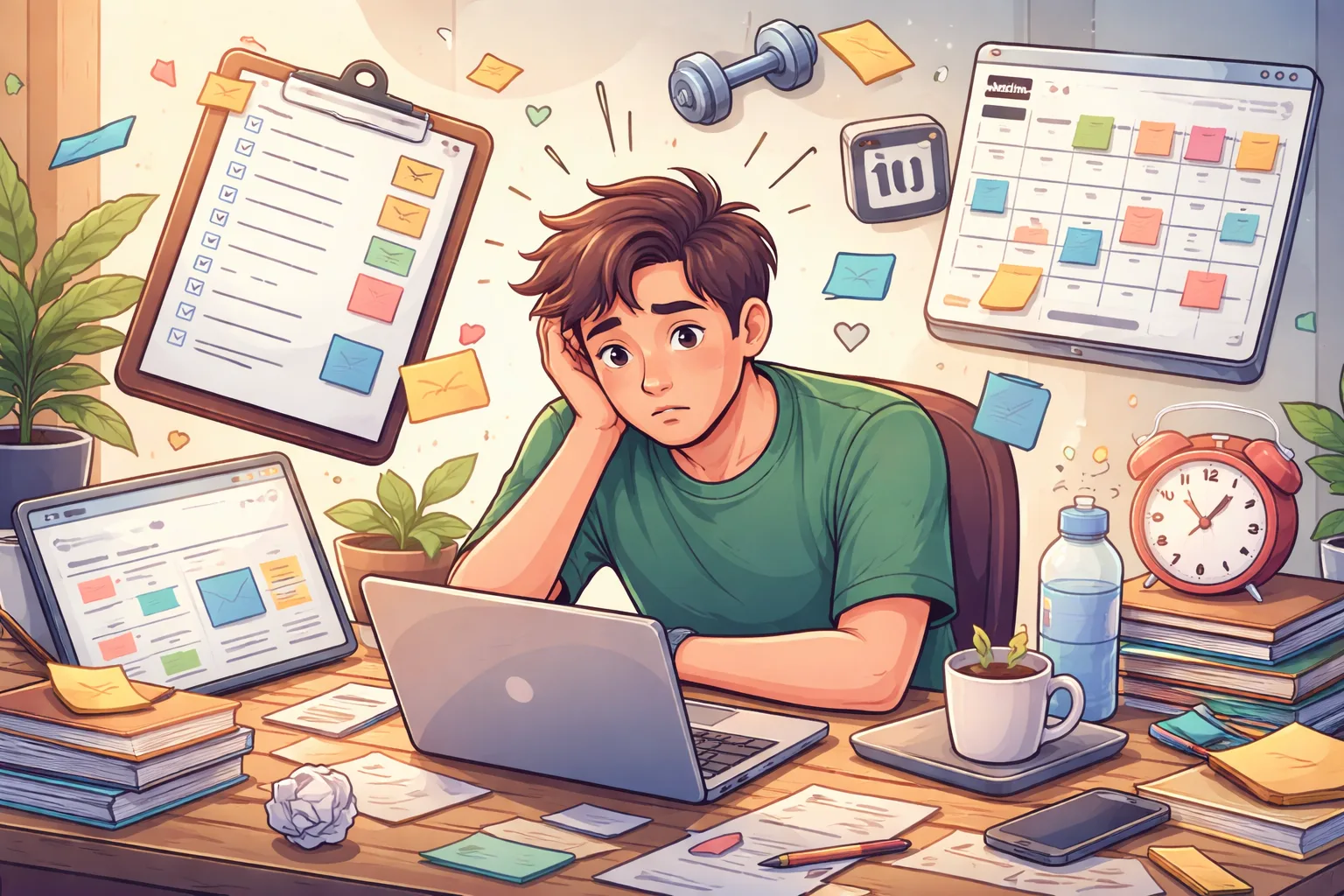
Notion and Templates: When We Think Life Can Be Solved Like PowerPoint
At some point, to-do list manual feels less convincing. We need something more “professional”. Enter Notion, Trello, Asana, ClickUp, and the whole family of applications whose names sound like startup that are venture capital funded.
Then people started collecting templates.


There is templates “Second Brain”, there is templates “Life OS”, there is templates “Personal KPI”, there is templates “Weekly Review CEO style”, some even create a dashboard of life complete with a graph of mood daily.
I'm not laughing. I understand the temptation. Seeing dashboard life is indeed satisfying. It feels like you have control. Like you can control the universe. Like God, but the freemium.
version. The problem is: life doesn't have a neat “filter” button.
In Notion, you can create categories: work, health, relationships, finance. In the real world, all those categories are mixed up like instant noodles brewed with troubled hot water.
You can write “Self-care: 20 minutes of meditation.” But the real world might respond with: “Self-care: dealing with neighbors renovating from 7 am.”
You can set “Deep work 2 hours.” But the real world might send a COD package containing something you forgot you ordered, and then you have to explain to yourself why you bought a head massager at 2 am last week.
Hustle Culture Sells Hope, But Delivers Exhaustion
One of the root problems is: we live in an era that worships busyness.
In the office, people proudly say “I'm so busy.” In gatherings, people proudly say “I don't have time.” On social media, people proudly show off colorful calendars like a rainbow that failed to be happy.
Busyness is made a status. The busier you are, the more important you are considered. As if a person's value can be measured by the number of meetings and notifications.
In fact, often “being busy” is not a sign of being productive, but a sign of not having control over one's own time.
Sometimes we don't work to live, but live to work. We arrange our days like Tetris: we panic at the slightest gap, even though Tetris is a game that always ends in defeat.
Then magical suggestions appear: “Create a morning routine.” “Set priorities.” “Stop procrastinating.”
As if the problem lies in our character, not in the system that makes us work harder for things that used to be easier to obtain.
In the end, productivity is no longer a tool to make life easier. It turns into a competition without a finish.
line. You can run fast, but still feel inadequate. Because there is always someone who runs while creating content, while investing, while building startup, while growing hydroponics on their apartment balcony.
Scheduled “Healing”: Even Rest Must Have an Output
The funniest and saddest part is when the culture of productivity successfully colonizes the concept of rest.
Now, people go on vacation not to rest, but to “healing.”
And healing it's not just about taking a nap or daydreaming. Healing must have proof. At least a story. If possible, a carousel.
What's worse: healing also includes to-do list.
-
Saturday: healing going to a coffee shop
-
Sunday: healing going to nature
-
Monday: returning to work with a fresher version of yourself (supposedly)
In the end, even rest feels like a project. If you don't come back from vacation with good photos and a caption reflective caption, you feel like your vacation was a failure.
In fact, the most honest definition of rest is sometimes simple: sleeping without an alarm and waking up without guilt.
But that is difficult to do when in your head there is an imaginary notification: “You have not been productive today.”
We Often Misdiagnose: The Problem Is Not That You Are Lazy, But That You Are Tired
There are moments when people feel like procrastinators. Then they look for solutions: motivational videos, books self-help, time management courses. They hope there is one trick that can magically make their life as orderly as a minimarket cashier's desk.
In fact, the problem may not be procrastination. It could be fatigue.
Fatigue comes in various forms: physical, mental, social. And the worst is fatigue that doesn't feel like fatigue, but feels like “why am I not mood ya”.
Then we blame ourselves. We consider ourselves undisciplined. We consider ourselves not strong enough.
In fact, it could be that our body and mind are saying: “Please, stop for a moment.”
Unfortunately, the culture of productivity does not like the word “stop”. Because stopping is like a loss. Like not producing. Like having no value.
In fact, if a machine is forced to run continuously, the end result is not productive. The end result is a breakdown. And if it breaks down, you can't write to-do list anything. All there is is a list: “find a psychologist” and “try to live slowly.”
Meetings That Could Be Emails: The Most Draining Form of False Productivity
Let's talk about something more concrete: the workplace.
Many people feel unproductive even though they are active all day long. But the activities are like this:
-
Meeting to discuss meetings
-
Follow up to ensure follow up
-
Alignment to make sure everyone is aligned (even though they still disagree)
-
Long discussions for decisions that ultimately end in “just try it first”
This is cosmetic productivity. Like skincare 12 steps but still not enough sleep. There is effort, but the results are not proportional.
And because activities like that take up time, people then pursue productivity outside of working hours: waking up earlier, going to bed later, adding side hustle.
In the end, our lives are like a 24-hour shop but with only one cashier: ourselves.
Tips for Being Less Productive (To Live a More Sane Life)
This is the part that productivity gurus usually don't sell, because it doesn't sell well. But I still want to write it, as a small form of resistance that won't overthrow anything, but at least overthrow excessive expectations of oneself.
1) It's okay to have a to-do list, but don't make it a bible To-do list It should help you remember, not judge you. If it's not finished, it's information, not a moral verdict. Try to distinguish between what "must be completed" and what is "good to be completed." Don't categorize everything as an emergency like an ambulance siren.
2) Stop measuring self-worth from daily output You are not a printing machine deliverable. You are allowed to have a day where you just survive: eat, shower, work just enough, then sleep. Sometimes that's a great achievement, especially if you're going through the day with burdens that others don't see.
3) Provide truly empty time Empty time doesn't mean "time to do other things." Empty time means you can daydream. You can be temporarily useless. Ironically, good ideas often come when we don't force ourselves to be useful.
4) Reduce "aids" if they cause trouble If you spend 2 hours tidying up dashboard productivity but the work doesn't move forward, maybe you're not organizing work, but elegantly procrastinating. An application is a tool. If the tool takes more energy than the work, then the tool has turned into a hobby.
5) Accept that life is indeed not neat There are days when your plans are ruined by trivial things: heavy rain, motorcycle breakdown, the boss suddenly asks for revisions, or family needs help. It doesn't mean you've failed to manage your time. It could be that you are living a normal life.
Being Productive Doesn't Mean Being Full, But It Means Being Precise
We often think that being productive is the same as being "full." Full schedule. Full of activities. Full head.
In fact, healthy productivity often feels like this: there is space.
Space to take a breath. Space to do something without economic purpose. Space to chat without feeling guilty. Space to be a human who doesn't always have a five-year plan.
Because in the end, life is not a competition of who is the busiest. Life is like a long journey on a public transport that sometimes idles, sometimes gets stuck in traffic, sometimes the driver is reckless, and we are just passengers trying not to fall when the public transport brakes suddenly.
And if in the middle of the journey you feel tired, you don't need to install templates new. Sometimes you just need to get off for a moment, drink warm tea, and remember the simplest thing we often forget:
We are not projects, but humans.












Comments
0Share your perspective politely, stay relevant, and focus on the article. Comments appear after moderation.
Join the discussion
Write a clear, polite response that stays on topic.
No comments yet. Be the first to discuss.
Comments will appear after moderation.