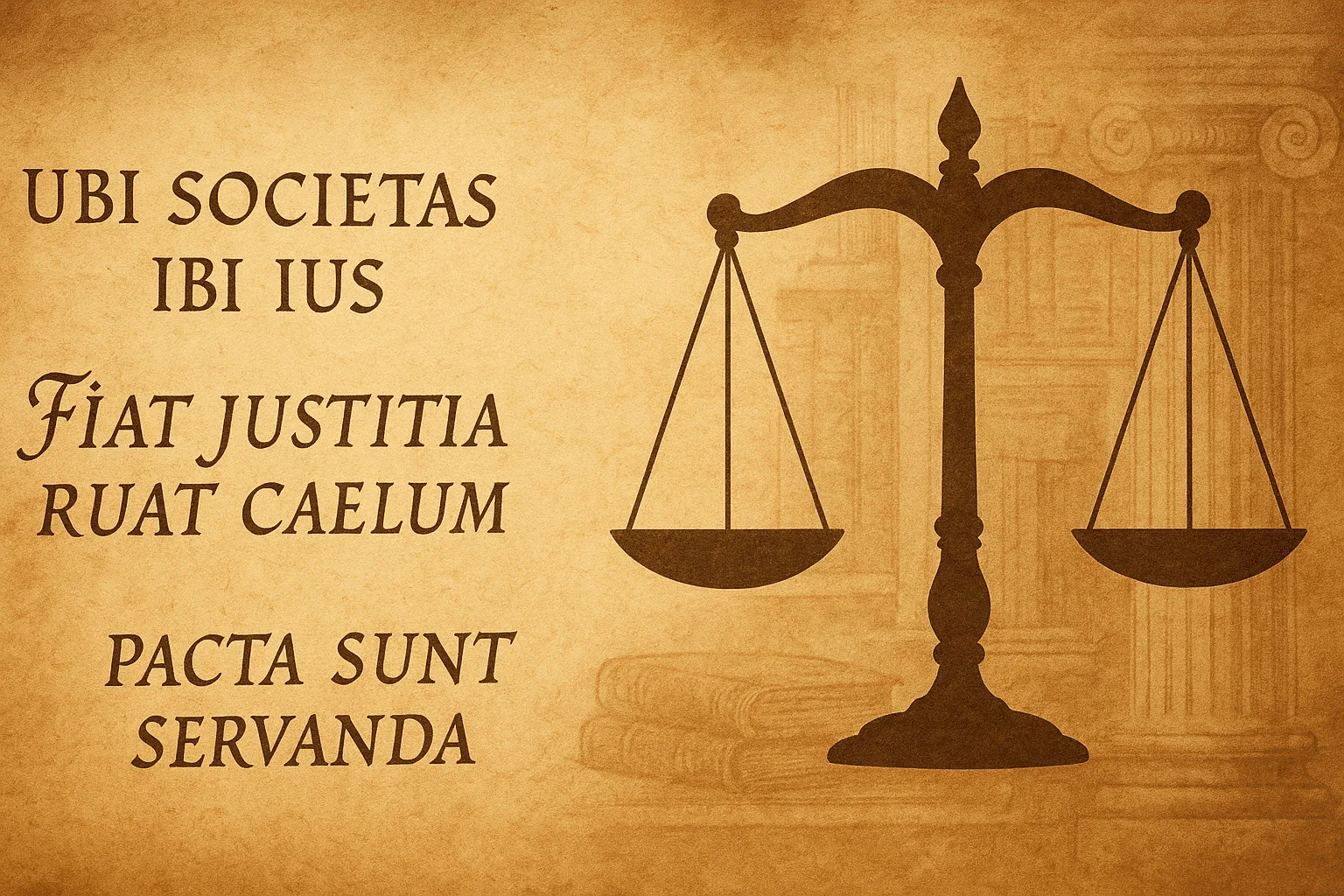
Legal Literacy - In the midst of a dense and technical jungle of laws and regulations, there is a golden thread of wisdom that weaves the entire legal structure: adagium. Far from being just ancient sayings, adagiums are intellectual DNA, the essence of juridical thought that has been distilled over the centuries. For a jurist, understanding adagiums is not just about adding to the repertoire of Latin quotations, but about delving into the anima legis—the soul of the law itself—to find the essence of justice (ius) behind the written rules (lex).
Tracing the Roots and Dissecting the Essence of Adagiums
The roots of legal adagiums are firmly planted in the land of Roman civilization. Philosophers and jurists such as Cicero with his adagium Ubi Societas Ibi Ius and Ulpianus with his three legal precepts (tria praecepta iuris) laid the foundation. This legacy was codified in the Corpus Juris Civilis during the time of Emperor Justinian, which later became the "holy book" for the development of law in Europe.


In the Middle Ages, in the first universities such as Bologna, scholars known as Glossators and later Commentators dedicated their lives to studying, interpreting, and annotating these Roman legal texts. Through this process, the legal principles contained within them were crystallized into short, concise sentences—adages—for easy memorization, understanding, and inheritance.
It is important to distinguish it from other concepts:
-
Legal Principle: This is the abstract "heart" or basic idea behind a legal system (e.g., the principle of freedom of contract).
-
Adage: This is the "voice" or sentence formulation of that principle (Pacta Sunt Servanda is the voice of the principle of freedom of contract).
-
Doctrine: This is the opinion of leading legal scholars that is recognized and often used as a source of law. Adages are often part of doctrine.
Functional Dimensions of Adages in Legal Architecture
The strength of adages lies in their philosophical and historical authority. Their function is multidimensional in the architecture of legal science.
-
Philosophical Function (Ratio Legis): Adages reveal the spirit and fundamental reasons (
ratio legis) of a norm, providing a moral and ethical foundation for why the law should be enforced. -
Interpretive Function (Interpretation Guide): When there is ambiguity or a legal vacuum, adages become a compass for judges to make legal discoveries (rechtsvinding), guiding them from literal interpretation to a fairer and more purposeful interpretation of the law (teleological).
-
Argumentative Function (Legal Instrument): In legal debates, adages serve as argumentum ad auctoritatem which is powerful. Citing them in judgments, pleadings, or scholarly works demonstrates depth of analysis and connects particular cases with universal legal truths.
-
Educational and Didactic Function: Adages are excellent teaching aids. They simplify complex legal concepts into easily digestible postulates, making them the first gateway for law students to understand fundamental principles.
Constellation of Adages: A Map of Universal Legal Wisdom
For a more structured understanding, here are some essential adages grouped by thematic area:
A. Fundamental Principles on the Existence of Law and Justice
-
Ubi Societas, Ibi Ius: "Where there is society, there is law." The foundation of the sociology of law which affirms law as an inherent social product.
-
Honeste Vivere, Alterum Non Laedere, Suum Cuique Tribuere: "Live honorably, do not harm others, and give to each person what is their due." Three basic legal commands from Ulpianus that encompass the entire purpose of law.
B. Principles on the Enforcement of Justice and Procedure
-
Fiat Justitia Ruat Caelum: "Let justice be done, though the heavens fall." The principle of steadfastness in upholding the supremacy of justice without compromise.
-
Audi et Alteram Partem (or Audiatur et Altera Pars): "Listen to the other side as well." A main pillar of fair legal process (due process of law), which requires judges to hear arguments from both sides before making a decision.
-
Nemo Judex Idoneus in Propria Causa: "No one can be a proper judge in their own case." The principle of impartiality and prohibition of conflicts of interest to guarantee judicial objectivity.
-
Presumption of Innocence: Rooted in Ei Incumbit Probatio Qui Dicit, Non Qui Negat (The burden of proof lies on the accuser). Protects the dignity of individuals from state arbitrariness.
C. Principles in Private Law (Civil and Contract)
-
Pacta Sunt Servanda: "Every agreement must be obeyed." The heart of contract law (Article 1338 of the Civil Code) and international law (Vienna Convention 1969 on the Law of Treaties).
-
Cujus Est Dominium, Ejus Est Periculum: "The risk of ownership is borne by the owner." A basic principle in property law regarding who bears the risk for an item.
-
Bona Fides (Good Faith): Although more of a principle, it is often expressed in the context that all legal actions must be based on honesty and good intentions.
D. Principles of Interpretation and Application of Law
-
Lex Specialis Derogat Legi Generali: "A specific rule of law overrides a general rule of law."
-
Lex Superior Derogat Legi Inferiori: "A higher rule of law overrides a lower rule of law."
-
Lex Posterior Derogat Legi Priori: "A new rule of law overrides an old rule of law." All three are fundamental principles for resolving conflicts between regulations (lex scripta).
-
Lex Dura, Sed Tamen Scripta: "The law is harsh, but it is written." A representation of the positivism flow that prioritizes legal certainty above all else.
-
Ignorantia Juris Non Excusat: "Ignorance of the law is not an excuse." Everyone is considered to know the law after the regulations are enacted.
Dialectics and Challenges in the Application of Adages
A mature jurist understands that adages are not magic spells that can be applied blindly. Often, there is a dialectic or conflict between one adage and another. This is where the art of jurisprudence lies (ars aequi et boni).
-
Dialectic of Justice vs. Certainty: Fiat Justitia Ruat Caelum (let justice be done though the heavens fall) often faces Lex Dura, Sed Tamen Scripta (the written law is harsh). Judges must weigh when to prioritize substantive justice and when to submit to legal certainty.
-
Dialectic of Absolute Justice vs. Utility: Application of Fiat Justitia which is too rigid can lead to Summum Ius, Summa Iniuria ("The highest justice can become the highest injustice"). This requires judges not only to be "mouthpieces of the law" (bouche de la loi) but also to use discretion to see the impact and benefits of their decisions.
Legal wisdom does not lie in the ability to memorize adages, but in the ability to choose and reconcile the adages that are most relevant to the context of the case. in concreto.
Conclusion: Adages as a Symphony of Legal Wisdom
From its roots in ancient Rome, through the preservation of medieval scholars, to its irreplaceable role in modern courtrooms, legal adages prove themselves to be a timeless symphony of wisdom. It is a bridge between text and context, between rule and justice, between past and future.
For those of us involved in the legal world, adages are a constant reminder that law is more than just a profession; it is an art and a calling to organize civilization. By understanding it comprehensively, we not only become better legal technicians, but also become wiser guardians of wisdom.














Comments
0Share your perspective politely, stay relevant, and focus on the article. Comments appear after moderation.
Join the discussion
Write a clear, polite response that stays on topic.
No comments yet. Be the first to discuss.
Comments will appear after moderation.