
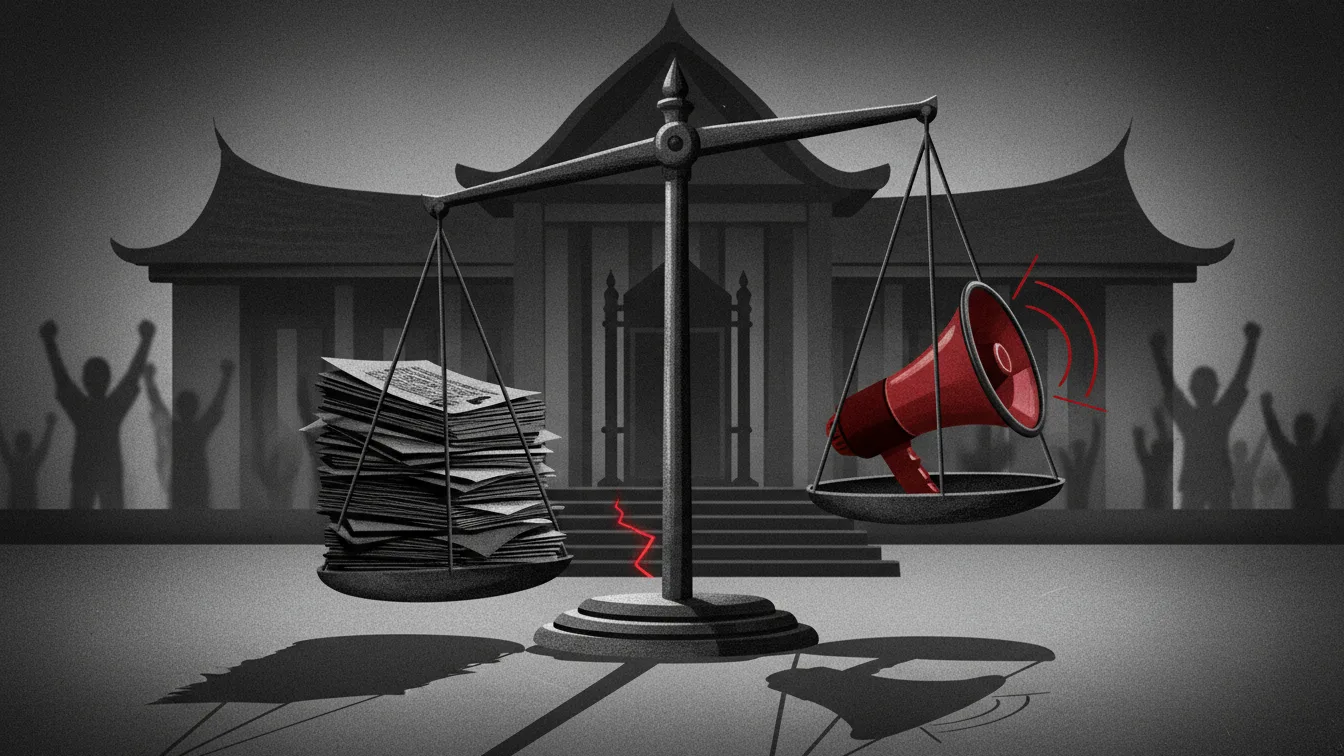
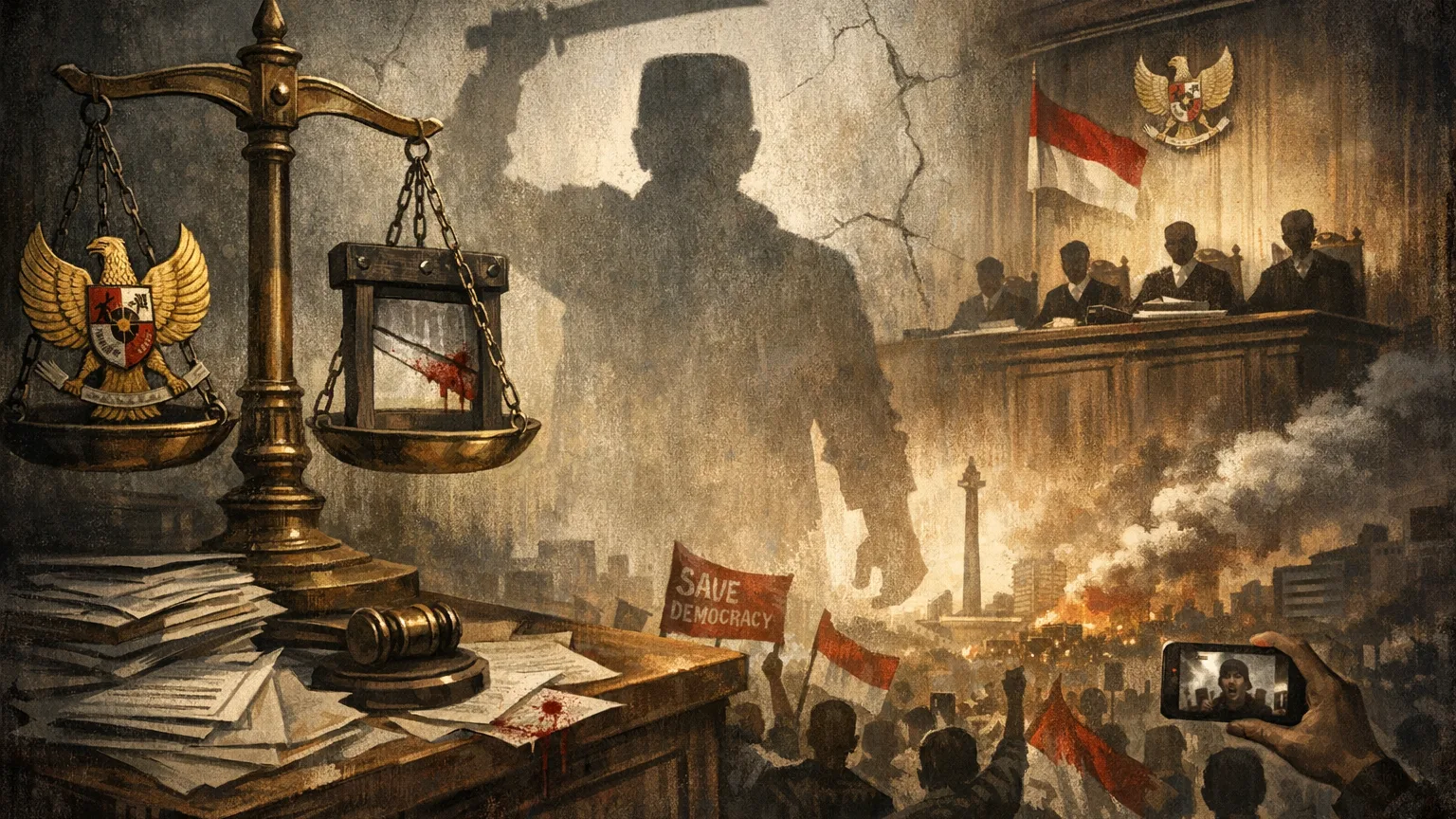
A similar logical fallacy in law is also increasingly evident and ironic in the case of Laras Faizati. She was named a suspect on charges of inciting a demonstration that was later deemed to have caused a fire. This case demonstrates a broken chain of thought in our law enforcement process, particularly concerning the concept of causality or cause-and-effect relationship.
In criminal law, to blame someone for a consequence (e.g., a fire), there must be strict proof that the person's actions were the direct and sole cause of that consequence. Accusing a call to demonstrate as the cause of a fire is a hasty conclusion and ignores many other variables that occurred in the field.


We must be able to clearly separate between "demonstration" as an entity of political rights, and "criminal acts of destruction" or "arson" as an entity of crime. The two are completely different and should not be confused. When a fire occurs in the midst of or after a demonstration, the authorities should conduct a thorough investigation based on forensic evidence: what triggered the fire? Who lit it? Was it an accident, or were there provocateurs who deliberately infiltrated to damage the image of the demonstration? Scapegoating the initiators or those who merely spread the call to demonstrate for criminal acts committed by other individuals in the field is a very dangerous simplification of the problem. It is the same as blaming the road builder because someone had a traffic accident on that road.
Furthermore, if this kind of law enforcement practice continues to be allowed and justified, it will give rise to what is known in the sociology of law as a chilling effect. The public, students, and activists will be afraid to voice injustice, criticize government policies, or simply gather to express their aspirations.
They will be haunted by the fear that if they organize a peaceful protest, they could be thrown in jail simply because a third party irresponsibly commits destruction at the same location. If this chilling effect spreads, the check and balances function of society towards the government will die, and the essence of a democratic state itself will fade and disappear.
The law was created to provide justice and certainty, not to find fault in order to silence critical voices. Law enforcers are required to work professionally and precisely. If acts of violence, destruction, or arson occur in a demonstration, then the legal subjects who actually committed the physical acts must be pursued, arrested, and prosecuted. Criminal responsibility in our legal system is individual and cannot be simply transferred to field coordinators or people who distribute action invitation posters on social media, unless it is proven in a real and undeniable way that the person specifically ordered the masses to burn and destroy. As long as the invitation distributed is an invitation to take to the streets, express opinions, and protest in accordance with legal corridors, the state is obliged to protect it.
In the end, categorizing a call to demonstrate as a crime of incitement is a major setback in our way of governing and legislating. The Delpedro Marhaen case, which resulted in an acquittal, should serve as jurisprudence and a valuable lesson for law enforcement officials not to arbitrarily use catch-all articles to ensnare pro-democracy activists.
Meanwhile, cases such as that experienced by Laras Faizati must be re-evaluated by prioritizing the correct logic of causality. Demonstrations are a constitutional right that is absolutely protected by Article 28E paragraph (3) of the 1945 Constitution. Criminalizing a call to exercise a constitutional right is the same as fighting the constitution itself. Therefore, the narrative that equates a call to demonstrate with a crime must be stopped immediately in order to maintain legal sanity and uphold the pillars of democracy in Indonesia.

















Comments
0Share your perspective politely, stay relevant, and focus on the article. Comments appear after moderation.
Join the discussion
Write a clear, polite response that stays on topic.
No comments yet. Be the first to discuss.
Comments will appear after moderation.