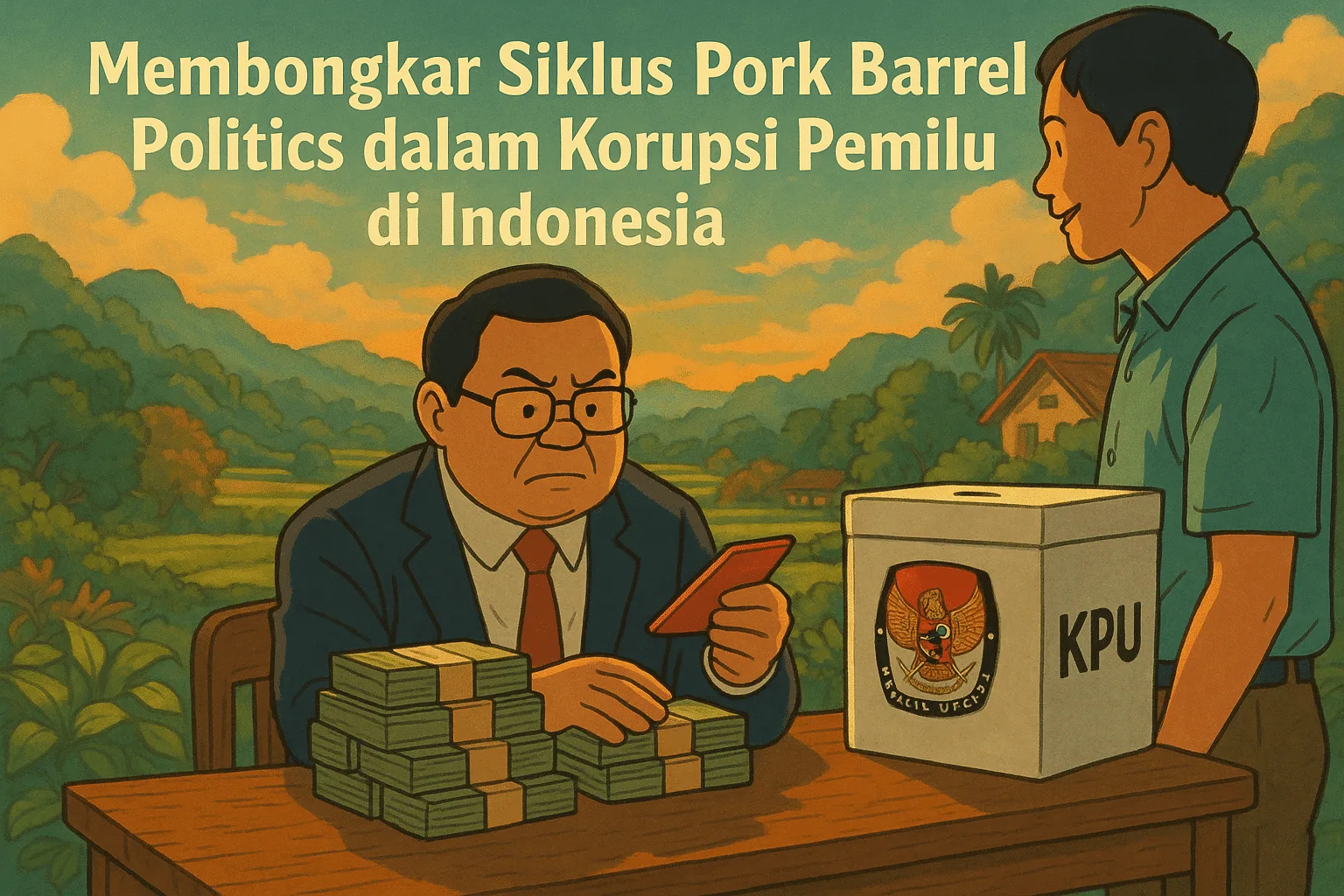
Political Corruption and Democracy that has Plunged
The practice of pork barrel politics cannot be separated from the phenomenon of political corruption that has been eroding the body of democracy for a long time. Political corruption is a serious threat to the credibility and legitimacy of governments in various countries, including Indonesia. This phenomenon not only damages the integrity of the individuals involved, but also weakens the structure and functions of government as a whole.
Corruption in the political constellation has created a very destructive domino effect. Even more risky, the impotence of the law which is powerless in resolving the practice of political corruption, makes the perpetrators feel they have impunity.


Politicians to political parties involved in pork barrel politics are almost always immune from legal action, apart from the fact that the way they do things tends to be organized, neat and difficult to prove materially, they also have a wider range of political relations. This is what makes the flow of power circulation very difficult, and instead makes our increasingly dirty political system even murkier.
Amidst the uncertainty of the future of our democracy's quality, what happens if the practice pork barrel continues to be allowed to breed? Ideally, democracy should be a mechanism to realize social justice for all people, not an instrument for mere electoral political interests. When the authority of public office and the state budget are allocated as bargaining chips for votes, then our democracy has lost its essence.
From a broader perspective, the practice pork barrel is a form of denial of democracy which should promote openness, participation and justice, but is instead distorted by narrow political pragmatism.
Finally, the system that is formed is a way of looking at things that no longer prioritizes the quality of development or public services, but rather a system that is oriented towards power and political influence alone.
When public officials are involved in corrupt practices, the impact goes far beyond financial losses. At a deeper level, corruption erodes public trust in the government. In conditions where the government is in a legitimacy crisis, the effectiveness in enacting policies and implementing a number of programs is also affected.
In the extreme stage, the public is increasingly skeptical and even tends to disobey rules and ignore policies issued by a government that lacks legitimacy due to corrupt practices that are vulgarly displayed, because they feel there is no justice, public ethics and transparency in the decision-making process.

















Comments
0Share your perspective politely, stay relevant, and focus on the article. Comments appear after moderation.
Join the discussion
Write a clear, polite response that stays on topic.
No comments yet. Be the first to discuss.
Comments will appear after moderation.