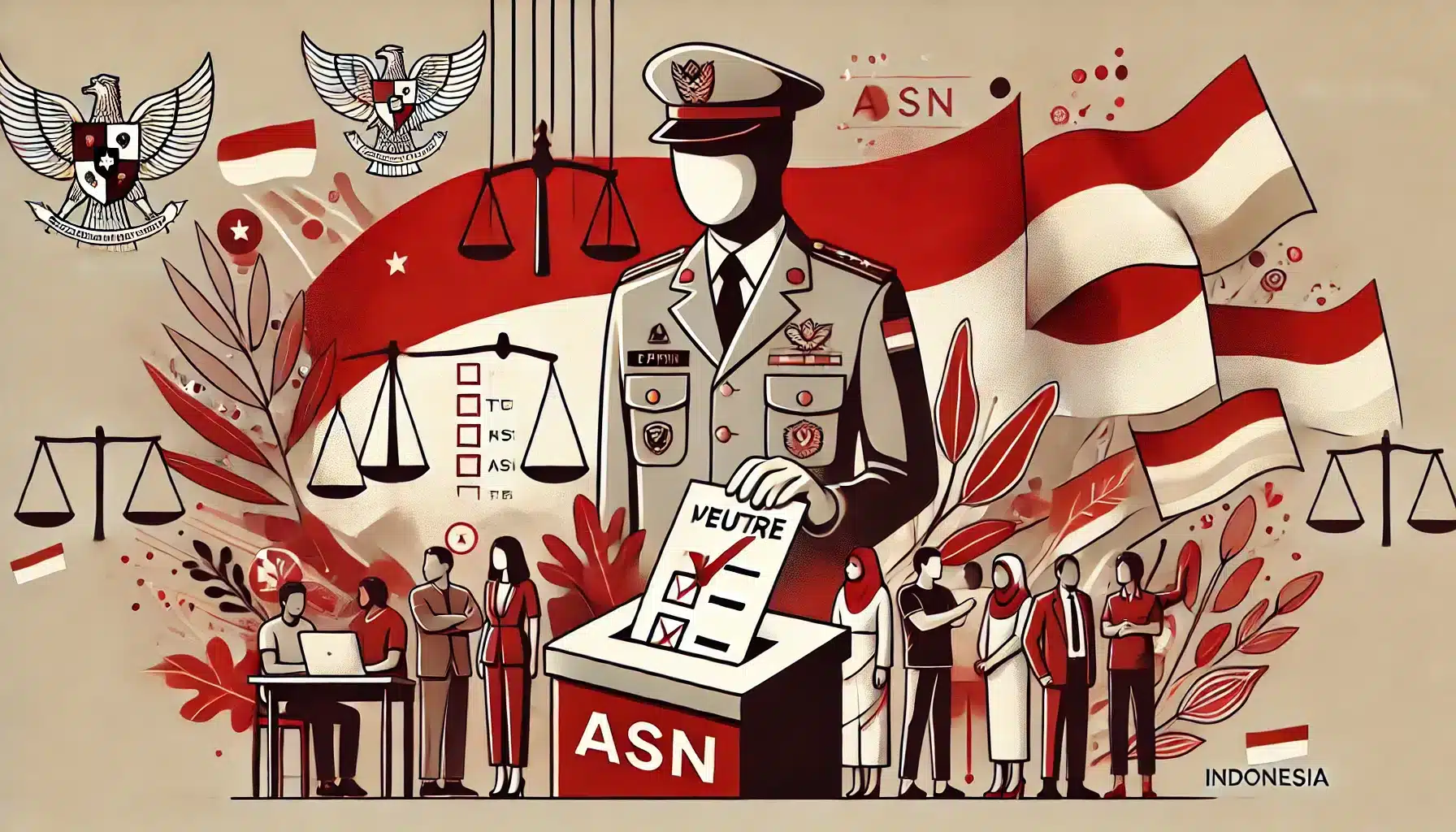
Legal Literacy - This article discusses the importance of the neutrality of the State Civil Apparatus (ASN) in maintaining democracy in Indonesia. It is emphasized that ASN neutrality is key to the implementation of fair and non-interventionist elections, even though it contradicts freedom of expression as part of human rights. This article explores the conflict between ASN neutrality and freedom of speech and the urgency of maintaining democratic stability.
The Destruction of Democracy Without ASN Neutrality
Democracy is a system that can be said to be the worst system, but there is no better system than it. The system offered by democracy opens up opportunities for everyone to participate, both directly and representatively. The application of representative democracy is influenced by the fact that the application of direct democracy cannot and is not ethically realized.[1] Therefore, elections and regional elections are implemented as a form of participation and control from the people.


As a democratic celebration, the implementation of elections and regional elections demands the readiness of the state as the organizer of the democratic celebration. Independent state institutions such as the General Election Commission (KPU), the Election Supervisory Body (Bawaslu), and the Election Organizer Honorary Council (DKPP) are deployed so that the democratic celebration runs as it should. One form of concrete state preparation is the impartiality of the state which can influence the process to the results in the democratic celebration. The dark stain of state intervention once occurred during the New Order (Orba) era which then reduced the meaning of democracy itself.
One of Orba's accomplices in influencing the democratic celebration was the alignment of ASN in accordance with the Government's direction. ASN as one of the state instruments was deployed to perpetuate the rulers together with other state instruments, such as the Indonesian Armed Forces (ABRI). The fall of Orba, which was marked by the entry of the reform era, gave rise to massive changes, especially those concerning the neutrality of the state instrument. The state began to fix ASN so that ASN was no longer used as a tool to perpetuate power with ASN involvement during the democratic celebration.
The Clash of ASN Neutrality with Human Rights
Among the indicators that can be used as a benchmark for ASN non-involvement or neutrality are not being involved in practical politics and not using their positions and authorities to facilitate election or regional election participants with state facilities.[2] ASN as a state instrument is obliged to prioritize the principle of neutrality as regulated in Article 24 paragraph (1) letter d. The application of this principle is explicitly contrary to freedom of speech (freedom of speech) as one of the human rights (HAM) because it limits the space for ASN to express themselves.
Jan Materson from the UN Human Rights Commission defines human rights as rights inherent in humans that are necessary to ensure a full human life.[3] One of the rights contained in human rights is freedom of speech (freedom of speech). This freedom was born from Socio-Political Rights (Sipol) as normalized in International Covenant on Civil and Political Rights (ICCPR). Sipol rights require negative actions from the state because the fulfillment of this right comes from the absence of state intervention.[4]
The Indonesian Constitution in Article 28E paragraph (3) also affirms that everyone has the right to freedom of association, assembly, and expression. The phrase “everyone” signifies that this constitutional norm includes every individual, even ASN who are state administrators. It should be noted that Article 28J paragraph (2) of the 1945 Constitution recognizes the concept of limitation, namely the state's authority to limit human rights under certain conditions and requirements.[5] Such restrictions on human rights can only be carried out by national law.
According to Soewoto, freedom of assembly and expression is indeed universal, but its implementation in the form of laws and regulations is not universal.[6] It is very possible that there are differences, such as restrictions on these basic rights. Restrictions on basic rights (human rights) are carried out using legal instruments as a form of application of the principle of narrow legality, namely wetmatigheid van bestuur.[7]
Based on the principle of legality, the restrictions imposed by law, in this case human rights, can be justified. This is also reinforced by the willingness of civil servants to sign “Contract Suigeneris”. With the signing of “Contract Suigeneris”, civil servants who hold public service relations cannot fully exercise their human rights. This is an implication of the application of the “special contract” theory which demands monoloyalty.[8]
Harmonization of Human Rights with ASN Neutrality
If neutrality is compared with freedom of expression, the urgency of ASN neutrality is far higher than prioritizing this freedom. State stability will be threatened because without ASN neutrality, the implementation of democratic celebrations will be disrupted because it will be influenced by conflicts of interest. If the implementation of democratic celebrations is disrupted, leadership succession will be affected. In addition, freedom of expression is also legally limited by law. By looking at these aspects, it can be concluded that prioritizing neutrality over freedom of expression has a higher level of urgency.
Source:
[1] Franz Magnis-Suseno, Political Ethics: Basic Moral Principles of Modern Statehood (Jakarta: Gramedia Pustaka Utama, 2023), p. 370
[2] Dairani & Fadlail (2023), “The Concept of Regulating ASN Neutrality in the 2024 Simultaneous Elections and Regional Head Elections” in Lisan Al-Hal: Journal for the Development of Thought and Culture, Vol. XVII, No. 2/2023, p. 253
[3] Aswanto & W. Silahi, Protection, Respect, and Fulfillment of Domestic and International Human Rights (Depok: Rajawali Pers, 2021), p. 3.
[4] Eko Riyadi, Human Rights Law: International, Regional, and National Perspectives (Depok: Rajawali Pers, 2020, p. 163
[5] Ibid, p. 58
[6] Tedi Sudrajat & Agus Mulya Karsona (2016), “Questioning the Meaning of Civil Servant Neutrality in Law Number 5 of 2014 Concerning State Civil Apparatus” in Jurnal Media Hukum, Vol. XXIII, No. 1/2016, p. 89
[7] Aditya et al., Contemporary State Administrative Law: Concepts, Theories, and Applications in Indonesia (Depok: Rajawali Pers, 2023), p. 34
[8] Marbun & Mahfud, Fundamentals of State Administrative Law (Yogyakarta: Liberty, 1987), p. 100



















Comments
0Share your perspective politely, stay relevant, and focus on the article. Comments appear after moderation.
Join the discussion
Write a clear, polite response that stays on topic.
No comments yet. Be the first to discuss.
Comments will appear after moderation.