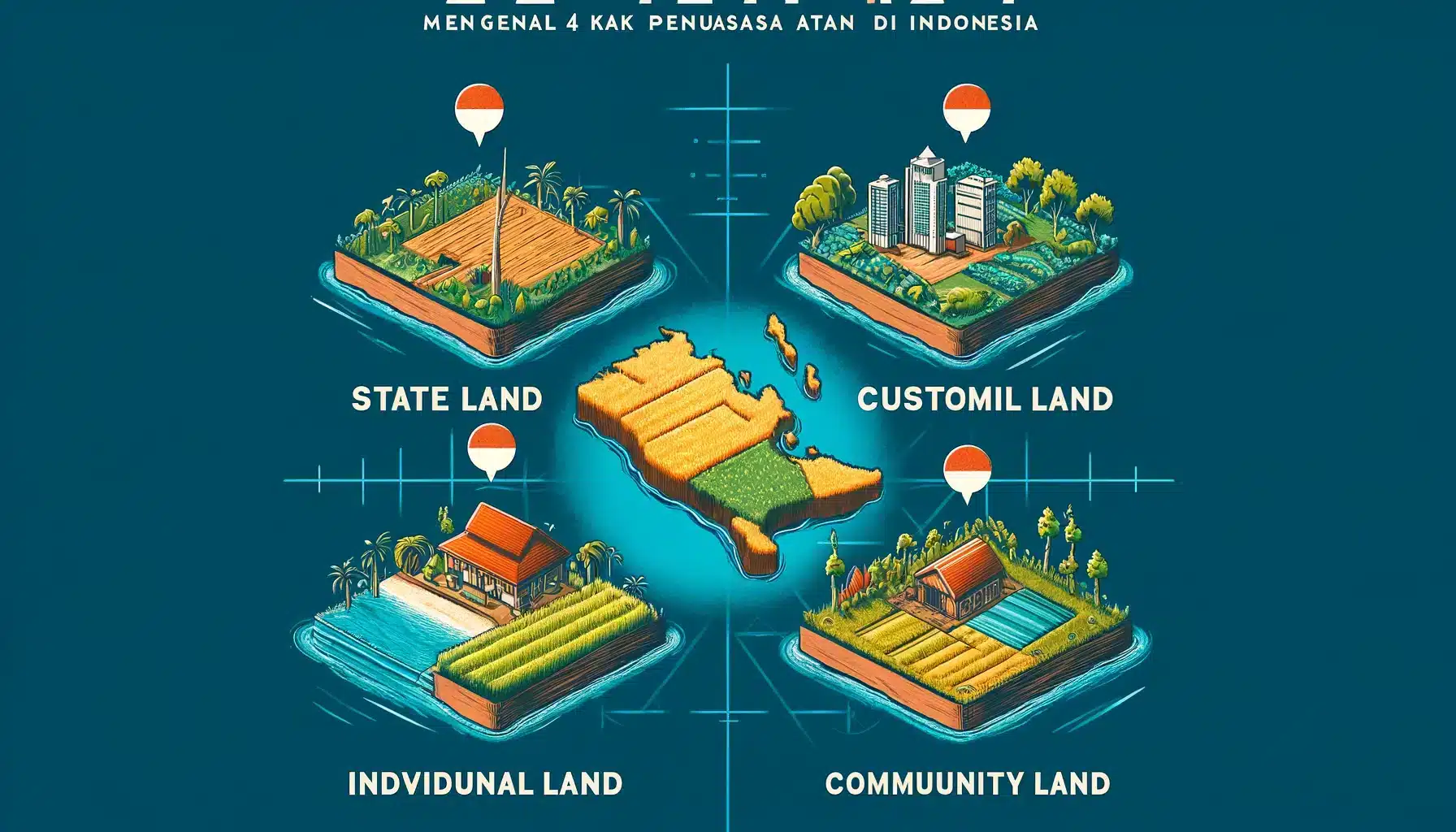
Legal Literacy - In everyday life, we often witness many legal cases that go viral in the mass media that are directly related to land disputes. In many land dispute cases, the object of the dispute is the ownership and legal control of the land itself. Referring to Law Number 5 of 1960 concerning Basic Regulations on Agrarian Principles or UUPA, land control rights are classified into 4 types of rights, namely the rights of the Indonesian nation, state control rights, customary law community rights, and individual rights to land.
The Meaning of Land Control Rights
According to Prof. Boedi Harsono in his book “Indonesian Agrarian Law: History of the Formation of the Basic Agrarian Law Content and Implementation - Volume 1”, land control rights give authority to the rights holder which is public and private in nature. Public authority exists in the rights of the Indonesian nation, state control rights, and rights of customary law communities which are regulated in administrative land law.


Meanwhile, private authority exists in the right to use land individually. All land control rights contain a series of authorities, obligations or prohibitions for rights holders to do something regarding the land they have rights to. Something that is allowed, obligatory, or prohibited is what differentiates land control rights from one another. The following is a more detailed explanation of the four land control rights in Indonesia.
1. Rights of the Indonesian Nation
This right arises from the legal relationship between the Indonesian nation and the land located throughout Indonesia, and gives authority to the Indonesian nation to do something with the land. Doing something here consists of private civil authority and public authority delegated to the state. This right is the highest land control right and is also the source of other land rights. Article 1 number 1 UUPA (Law Number 5 of 1960) further defines the scope of the rights of the Indonesian nation, stating that “the entire territory of Indonesia is a unitary homeland of all Indonesian people, who are united as the Indonesian nation”.
2. State Control Rights
State control right is a right that arises from the legal relationship between the Indonesian state and the land located throughout Indonesia, and gives authority to the state to do something with the land. Doing something here is interpreted as the authority to carry out the public duties of the Indonesian nation, such as regulating and organizing the allocation of the use, provision and maintenance of land together, determining and regulating legal relations between people with shared land, as well as determining and regulating legal relations between people and legal actions regarding land.
The state's position in this right is as an organization of power of the Indonesian nation, the exercise of which is carried out by the government through the Ministry of Agrarian Affairs and Spatial Planning/National Land Agency (ATR/BPN). The state, through the Indonesian government, has the authority to control all land in the territory of Indonesia, playing an active role in regulating and implementing the objectives of national land politics so that Indonesian land can be used for the prosperity of the people, in accordance with the written constitution in article 33 paragraph 3 of the Constitution of the Republic of Indonesia, Article 2 of the UUPA, and its implementing regulations. An example of the state's right to control is the state's authority to grant land ownership rights to Indonesian people who apply for ownership rights on state land.
3. Customary Law Community Rights
Land control by customary law communities arises from the legal relationship between customary law communities in a certain area and the land in that area, and gives authority to the customary community to do something to the land in question. Doing something here is divided into civil authority which is permanent as long as the customary community exists, and public authority whose management is handed over to the traditional leader. The existence of customary law community rights is still recognized by the UUPA as long as the customary community that owns the land in question can prove its existence.
Since the enactment of the UUPA (Law No. 5 of 1960), customary rights have been included as part of the rights of the Indonesian nation. Land included in the scope of customary rights is resolved in such a way that if the land has the status of freehold or right to use, its status is converted into a new right according to the UUPA, or if its status is customary land (vacant land), then the land is considered to be part of state land. This right is further explained in article 3 of the UUPA.
4. Individual Land Rights (HPAT)
HPAT is a land right that arises because of a legal relationship with a plot of land whose subject/right holder is an individual or legal entity. The authority of individual land right holders is the authority to do something to a plot of land they control, and juridical control of the land which is marked by a certificate of proof of rights or STBH which signifies legal control of the land. There are various types of individual land rights, consisting of land rights (freehold, HGU, HGB, Right of Use, and the like), land collateral rights, waqf land rights, and Ownership Rights to Condominium Units.
Reference source:
- The 1945 Constitution of the Republic of Indonesia (article 33 paragraph 3).
- Law Number 5 of 1960 concerning Basic Regulations on Agrarian Principles.
- Harsono, Boedi. Rev. Ed. 2020. Indonesian Agrarian Law: History of the Formation of the Basic Agrarian Law Act Contents and Implementation - Volume 1. Trisakti University Publisher: West Jakarta.


















Comments
0Share your perspective politely, stay relevant, and focus on the article. Comments appear after moderation.
Join the discussion
Write a clear, polite response that stays on topic.
No comments yet. Be the first to discuss.
Comments will appear after moderation.