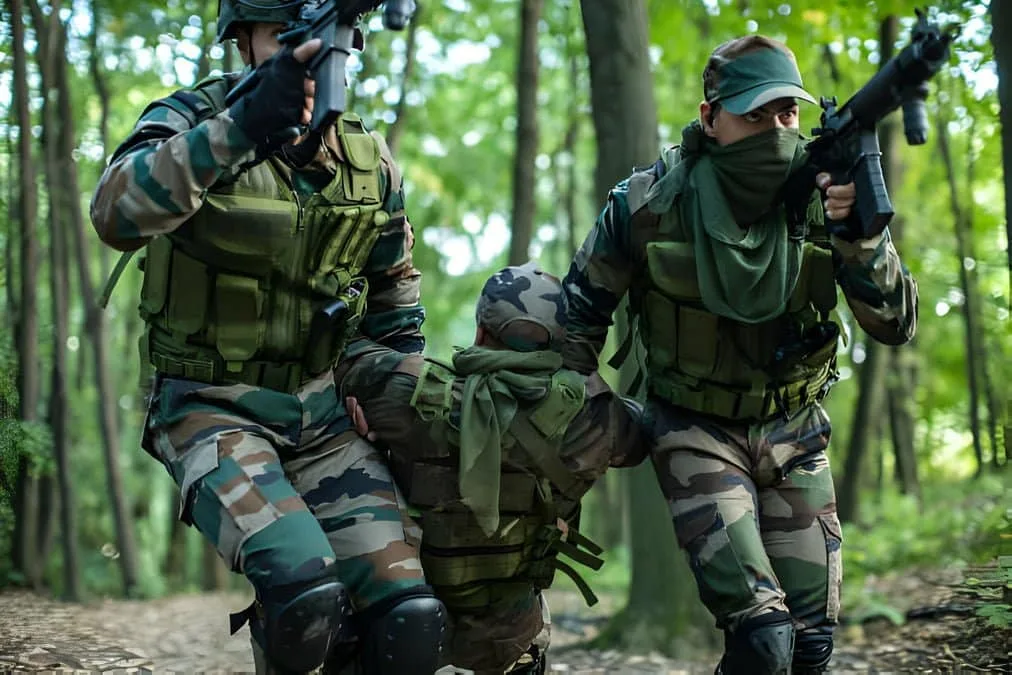
Legal Literacy - This article discusses special criminal law in the context of military criminal law in Indonesia. This article explains a case involving a member of the Indonesian National Armed Forces (TNI) Air Force who committed a special criminal act by controlling and storing ammunition and explosives.
This article also discusses the provisions of military criminal law and outlines the articles related to this case. Finally, this article discusses the judge's considerations in deciding military criminal penalties and explains the elements of the TNI member's actions that violate the law.


According to Pompe, the criteria for special criminal law can be seen from the subject or perpetrator, for example, military criminal law, and the second is the specific act. Military criminal law states that members of the military have the same position as ordinary members of society, meaning that as citizens, all applicable legal rules apply, both criminal law and civil law.
Provisions of Military Criminal Law
There is a case example of a military criminal act involving one member of the Indonesian National Armed Forces (TNI) Air Force as the Defendant who committed a special criminal act, namely controlling and storing ammunition and explosive materials. The case has been decided based on Decision Number 22-K/PM.III-13/AU/VI/2020.
Every TNI soldier must submit to and obey the legal provisions that apply to the military, namely the Military Criminal Code, Military Disciplinary Regulations and Law Number 31 of 1997 concerning Military Courts. These legal regulations are applied at the levels of Enlisted, Non-Commissioned Officers, and Officers who commit actions that are detrimental to the unit, society or the state. Of course, it cannot be separated from other regulations that apply to the general public.
Basically, a military criminal act has been determined as regulated in Article 9 paragraph (1) of Law Number 31 of 1997 concerning Military Courts as follows: “The court within the military court environment has the authority to try criminal acts committed by someone who at the time of committing the criminal act is:
- Soldier;
- who based on law are equated with Soldier;
- members of a group or department or body or who are equated or considered as Soldiers based on law;
- someone who does not fall into the categories in letters a, b, and c but by decision of the Commander with the approval of the Minister of Justice must be tried by a Court within the military court environment.”
Thus, in accordance with the provisions of the legislation above, the court authorized to try the case is the court within the military court environment, namely the Military Court, because the Defendant is a member of the TNI with the rank of Serka (Chief Sergeant).
Article 40 letter (a) of Law Number 31 of 1997 concerning Military Courts: The Military Court examines and decides at the first level criminal cases in which the Defendant is a Soldier with the rank of Captain and below.
Judge's Considerations in Decision Number 22-K/PM.III-13/AU/VI/2020
In the judge's considerations, it was stated that the actions of TNI members who control and store ammunition and explosive materials violate Article 1 paragraph (1) of the Emergency Law of the Republic of Indonesia Number 12 of 1951, which reads: “Anyone who without right imports into Indonesia, makes, receives, attempts to obtain, hands over or attempts to hand over, controls, carries, possesses in his possession or has in his ownership, stores, hides, ammunition or explosive materials”.
What is meant by anyone is a legal subject (person), as referred to in Articles 2 to 9 of the Criminal Code, in this case all people who are Indonesian citizens and foreign citizens, including members of the TNI and must be able to take responsibility for the actions they take.
The second element stated that the actions of TNI members taking and storing ammunition, explosives and other military equipment from the Yonko 463 Paskhas unit were actions that were against the law and dangerous because the TNI members guarding the ammunition warehouse did not have the authority to take and store ammunition, explosives and other military equipment to be owned privately without permission from the authorized official.
According to criminal law, the elements of a crime consist of subjective and objective elements. Subjective element is an element that comes from within the perpetrator. The principle of criminal law states “no crime without fault”. The fault referred to here is a fault caused by intent or negligence. In this case, it is emphasized that the nature of the TNI member's actions was intentional, taking advantage of his position to take a number of ammunition and explosives from Yonko 463 during training for personal gain.
Meanwhile, the objective element is an element from outside the perpetrator consisting of: human actions, the consequences of human actions, circumstances, and elements against the law. In this case, the consequences of the TNI member's actions were detrimental to Yonko 463 Paskhas because they had to lose a number of ammunition and explosives during training and had the potential to disrupt the training program organized by the Yonko 463 Paskhas Unit.
In addition, the actions of TNI members storing a number of ammunition and explosives in their room also have the potential to create danger both for themselves and the surrounding community because the storage of a number of ammunition and explosives is not in accordance with the standards set in the TNI environment.
Actions of TNI Members a quo What Regulations are Violated?
The essence of the TNI member's actions is that they are contrary to applicable law and also contrary to the duties and responsibilities of TNI members as regulated in Article 7 paragraph (1) of Law Number 3 of 2004 concerning the Indonesian National Armed Forces, especially their duties and responsibilities as Yonko 463 ammunition warehouse officers and as demolition officers when Yonko 463 carries out training.
If a member of the military has committed a military crime by illegally controlling and storing ammunition and explosive materials, it means that the action is contrary to Sapta Marga 5, which reads: “We, Soldiers of the Indonesian National Armed Forces, uphold discipline, are obedient and obedient to our leaders and uphold the attitude and honor of Soldiers” and Soldier's Oath 2: “That I will submit to the law and uphold military discipline” and Soldier's Oath 4: “That I will carry out all obligations with a full sense of responsibility to the Army and the State of the Republic of Indonesia.”
This action has a negative impact on the unit where the soldier serves and on the TNI institution because the actions taken will create a negative assessment by the public towards the TNI institution. Therefore, a military criminal threat is needed that is heavier than the previous Military Prosecutor's demand, namely 1 (one) year and 6 (six) months because in the provisions of Article 1 paragraph (1) of the Emergency Law of the Republic of Indonesia Number 12 of 1951, the punishment that can be imposed is the death penalty or life imprisonment or temporary imprisonment for a maximum of twenty years.
However, the judge considers it too severe when compared to the actions of the TNI member, thus it is necessary to mitigate the sentence by imposing a lighter punishment which is 1 (one) year, considering the many mitigating factors for the defendant with evidence that convinces the judge.
To overcome military criminal acts committed by TNI members, the following can be done: Commanders at each unit level must pay attention to the quality of legal awareness and discipline of TNI soldiers under their command authority, improve the professionalism of TNI soldiers, and improve the performance of law enforcement officials within the TNI organizational structure.
References
- Law Number 31 of 1997 concerning Military Courts
- Decision Number 22-K/PM.III-13/AU/VI/2020
- Andi Hamzah, Development of Special Criminal Law, Jakarta: Ragunan, 1991.
*This article represents the personal opinion of the author and does not represent the views of the editors Legal Literacy Indonesia.






















Comments
0Share your perspective politely, stay relevant, and focus on the article. Comments appear after moderation.
Join the discussion
Write a clear, polite response that stays on topic.
No comments yet. Be the first to discuss.
Comments will appear after moderation.