
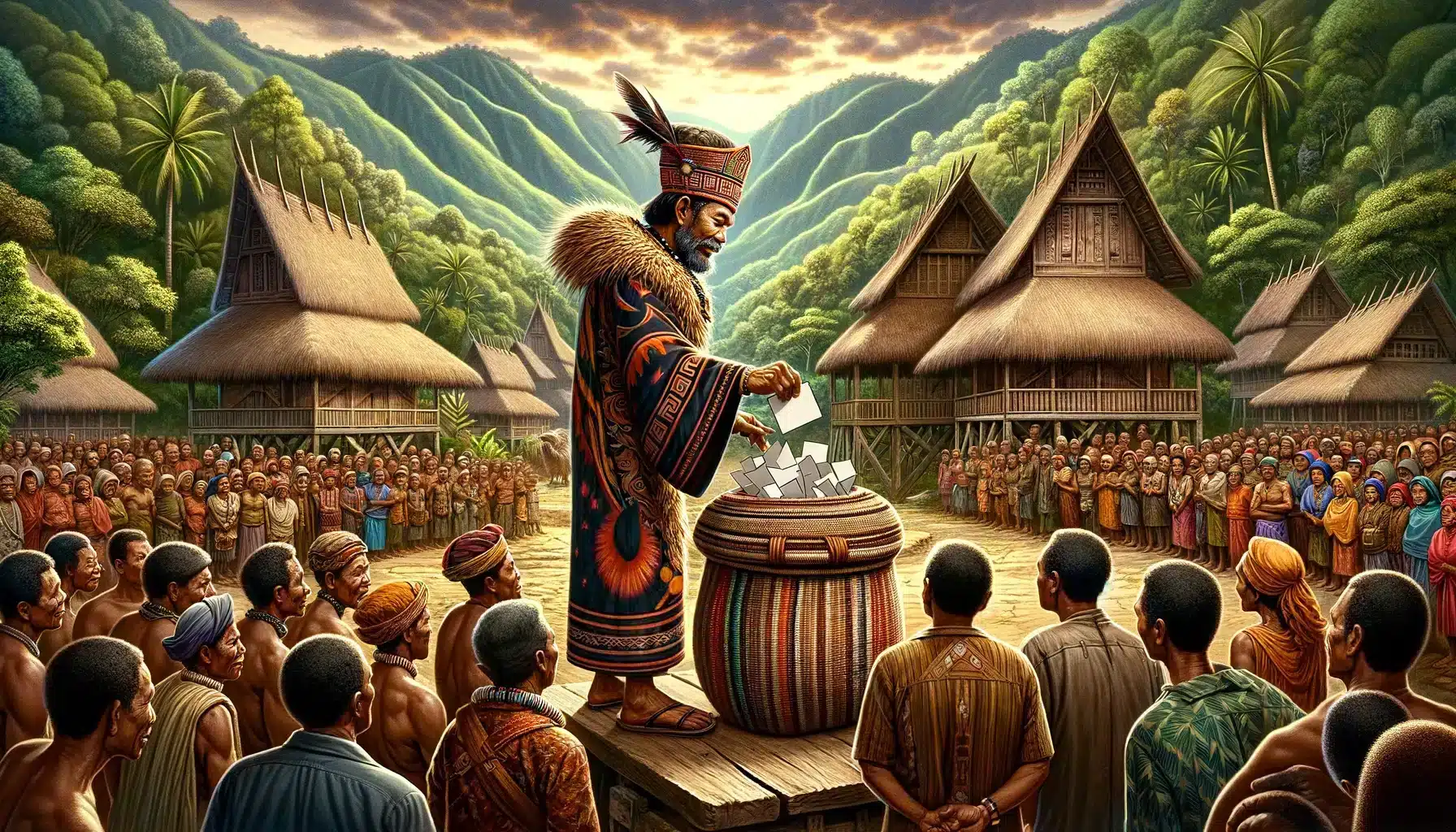
Legal Literacy - The Noken System is a unique and controversial election mechanism used in some areas of Papua, Indonesia. This system has gained attention because of its implementation which differs from the direct voting methods commonly used in various democratic countries. In this system, voters' votes are not given individually, but through collective decisions represented by traditional leaders or tribal chiefs. Traditional pouches called "noken" are used as containers to hold these votes. This article will discuss the Noken System in depth, including its advantages, disadvantages, and implications in the context of modern democracy.
Background of the Noken System
The Noken System is the result of the traditions and local wisdom of the Papuan people who highly respect hierarchical structures and traditional leadership. In Papuan society, traditional leaders or tribal chiefs play an important role in various aspects of life, including politics. Therefore, in elections, traditional leaders have the authority to determine the political choices of their community. This system is recognized by the Indonesian General Election Commission (KPU) and has been used in several regional head elections in Papua.



Advantages of the Noken System
- Respect for Local Wisdom and Culture The Noken System reflects respect for the customs and local habits of the Papuan people. The use of this system shows that modern democratic mechanisms can be adapted to respect and preserve traditional culture. This is important to maintain cultural identity and local wisdom which are an integral part of Papuan society.
- Community Leadership In the Noken System, traditional leaders or tribal chiefs play a central role in determining the political choices of their community. This reflects the community's trust in their leaders, who are considered to have wisdom and knowledge that can be trusted in making the best decisions for their community. Thus, this system strengthens social structures and community cohesion.
- Social Stability The Noken System can minimize the potential for conflict between candidate supporters. With collective decisions through traditional leaders, people are more likely to accept election results calmly, thus maintaining harmony and social stability. This is very important in the context of a society that highly values hierarchical structures and collectivity.
Disadvantages of the Noken System
- Lack of Individualism One of the main criticisms of the Noken System is that it reduces individual voting rights. In modern democracy, every citizen has the right to voice their own political preferences. However, in the Noken System, the political choices of the community are entirely determined by traditional leaders, so individuals do not have the freedom to voice their own political preferences. This can be seen as a violation of the basic principles of democracy, namely freedom and individual rights.
- Potential for Manipulation The Noken System has the potential to be misused by traditional leaders or interested parties for personal or group gain. Without strict oversight mechanisms, the integrity of the election could be threatened. Traditional leaders can be influenced or pressured by certain parties to vote for certain candidates, so that the election results do not reflect the original will of the people.
- Incompatibility with Modern Democracy In principle, modern democracy emphasizes the freedom and equality of every individual in the election process. The Noken System can be considered incompatible with these principles, because it prioritizes collective decisions over individual ones. This raises questions about how democracy should be applied in areas with different cultural characteristics.

Election System in Indonesia
To provide broader context, it is important to understand how the general election system in Indonesia works. The election system in Indonesia consists of several types of elections, namely presidential elections, legislative elections, and regional head elections. All of these elections are basically based on the principles of direct, general, free, secret, honest, and fair voting (LUBER JURDIL).
- Presidential and Vice-Presidential Election The Presidential and Vice-Presidential elections in Indonesia are held every five years. These elections use a two-round system if no candidate pair obtains more than 50% of the vote in the first round. If the first round does not produce a majority, the two candidate pairs with the most votes advance to the second round.
- Legislative Election Legislative elections are held to elect members of the House of Representatives (DPR), the Regional Representative Council (DPD), and the Regional People's Representative Council (DPRD) of provinces and regencies/cities. These elections use an open proportional system, where voters directly elect political parties and legislative candidates.
- Regional Head Election Regional head elections are held to elect governors, regents, and mayors. These elections also use a direct voting system, where the candidate who obtains the most votes is declared the winner.
Implications in the Realm of Democracy
The existence of the Noken System in the realm of Indonesian democracy illustrates the complexity of implementing democracy in regions with high cultural diversity. Democracy cannot always be applied uniformly in all places, especially in areas that have strong local wisdom. Adjustments and adaptations are needed to ensure that the democratic process can run without eliminating local cultural identity.
- Recognition of Democratic Plurality The Noken System shows that democracy must be able to accommodate various forms of different political expression according to the local cultural context. Democracy should not be homogeneous and must be flexible to accept and respect variations in how people express their political will.
- Protection of Individual Rights Although the Noken System reflects respect for local culture, it is important to ensure that individual rights are respected and protected. The government and other stakeholders need to find ways to integrate modern democratic principles with local wisdom without sacrificing individual rights. For example, consideration can be given to providing better political education to the public so that they better understand the importance of individual participation in elections.
- Oversight and Accountability To reduce the potential for manipulation and abuse of the Noken System, there needs to be a stricter oversight mechanism. Effective oversight can help ensure that traditional leaders truly represent the will of their people and are not influenced by pressure from certain parties. In addition, there needs to be an accountability mechanism that ensures that traditional leaders are responsible for the decisions they make.
- Dialogue and Consultation In the long term, dialogue between the government, indigenous peoples, and other stakeholders is needed to find the best solution that accommodates both aspects. This process should involve in-depth consultation with indigenous peoples to understand their needs and aspirations, as well as to find ways to balance local wisdom and modern democratic principles.
Case Study: Implementation of the Noken System in Papua
To understand more deeply about the Noken System, we can look at its implementation in several regional head elections in Papua. One prominent example is the regional head election in Jayawijaya Regency, where the Noken System is widely used.
In the election, traditional leaders in various districts gather to discuss and decide on the candidates they will support. The community's votes are then put into the noken, which is then counted as the collective vote of the district. This process is recognized by the KPU and considered legitimate in the context of regional head elections in Papua.
Although this system receives support from many parties because it is considered to reflect local wisdom, there is also criticism regarding transparency and accountability. Some parties are concerned that the closed decision-making process and the absence of independent oversight could open opportunities for manipulation and abuse of power by traditional leaders.

Comparison of the Noken System with the National Election System
[ninja_tables id="17674"]Reflection and Recommendations
To maintain a balance between respecting local wisdom and ensuring the implementation of modern democratic principles, several recommendations can be considered:
- Political Education Improving political education among the Papuan people so that they better understand their rights as citizens and the importance of individual participation in elections. This education should include information about the electoral system, voter rights, and the importance of transparency and accountability in the electoral process.
- Oversight Mechanism Implementing stricter oversight mechanisms to ensure that traditional leaders truly represent the will of their people. This may involve the participation of independent institutions such as election monitors or civil society organizations that can provide oversight of the election process.
- Continuous Consultation and Dialogue Conducting continuous consultations and dialogues with indigenous peoples to understand their needs and aspirations and to find ways to balance local wisdom and modern democratic principles. This dialogue should be inclusive and involve various stakeholders, including the government, indigenous peoples, civil society organizations, and academic institutions.
- Policy Adjustment The government and KPU need to evaluate and, if necessary, adjust policies related to the use of the Noken System to better align with modern democratic principles. This may include developing clearer guidelines on how the Noken System should be implemented, including criteria for vote validity and oversight mechanisms.
Here is a table summarizing the main points related to the advantages, disadvantages, and recommendations for the Noken System in the context of democracy.
[ninja_tables id="17664"]The table above provides an overview of the advantages, disadvantages, and recommendations related to the Noken System in the context of democracy. This is important to help understand how this system works and what steps can be taken to optimize its implementation to align with modern democratic principles without eliminating local wisdom.
Conclusion
The Noken System is an example of how democracy can adapt to local culture. While it has advantages in maintaining harmony and local wisdom, the system also faces challenges in terms of individual rights and electoral integrity. Therefore, it is important to continue to evaluate and seek a balance between respecting local traditions and implementing modern democratic principles. In the long term, dialogue between the government, indigenous peoples, and other stakeholders is needed to find the best solution that accommodates both aspects. With the right approach, the Noken System can be an example of how democracy can function in a diverse cultural context, while still respecting individual rights and basic democratic principles.





















Comments
0Share your perspective politely, stay relevant, and focus on the article. Comments appear after moderation.
Join the discussion
Write a clear, polite response that stays on topic.
No comments yet. Be the first to discuss.
Comments will appear after moderation.