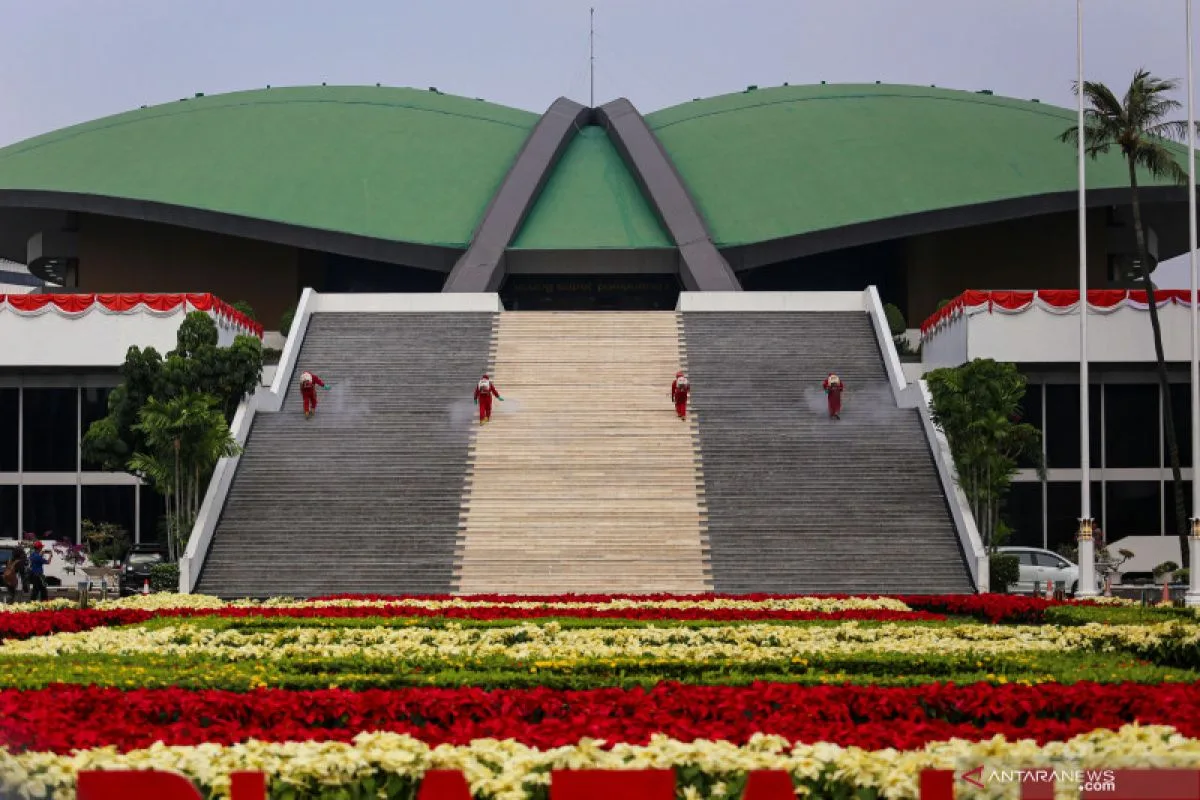
Jakarta, Legal Literacy - The plan to implement DPR Inquiry Right in order to investigate alleged fraud in the 2024 Election is increasingly being discussed. Diverse opinions have emerged from various parties, including constitutional law experts, regarding the proposal.
After both presidential candidate camps agreed to submit a proposal for an inquiry right against the KPU and Bawaslu, various responses emerged from various parties. No exception for constitutional law experts who provided their views on this matter. The following are some pro and con responses from prominent figures regarding the proposal:


1. Jimly Asshiddiqie
Jimly Asshiddiqie expressed the importance of the government accepting the inquiry right as an important mechanism in the democratic process. This statement was conveyed when he met with Coordinating Minister for Economic Affairs Airlangga Hartarto at the Coordinating Ministry for Economic Affairs Office on February 26, 2024. Jimly emphasized that although the Jokowi administration had never used the inquiry right, acceptance of the proposal should be considered. He appreciated the possibility of using the inquiry right in the historical record of the Jokowi administration era. As a Professor of Constitutional Law at the Faculty of Law, University of Indonesia, Jimly had previously highlighted that the inquiry right proposed by the DPR is part of the 'checks and balances' function between the executive and legislative branches, in accordance with constitutional principles based on the 1945 Constitution. Jimly also emphasized that the use of the inquiry right as a political process by the DPR should be seen as an effort to strengthen a quality and integrity democratic system.
2. Feri Amsari
Feri Amsari, a constitutional law expert, explained that the right of inquiry is an instrument that can be used by the DPR (House of Representatives) to investigate irregularities in the 2024 Election. According to him, this right can be directed to investigate executive institutions, including the President. Feri highlighted that during the 2024 Election, there were many actions by the President that required clarification regarding their intent and purpose. Therefore, the use of the right of inquiry by the DPR is a reasonable step to clarify this. Feri asserted that the right of inquiry is an instrument that allows the DPR to investigate whether the President's actions and policies have violated the law or not.
Feri also expressed his concern regarding indications of fraud in the 2024 Election, such as the inflation of votes for candidates in several provinces of Indonesia. According to him, this reinforces the urgency for the DPR to act by using the right of inquiry. However, Feri expressed his concern if the DPR does not act immediately. He emphasized that the implementation of the right of inquiry should not be delayed too much, because the requirements for doing so are relatively easy. Feri asserted that the DPR needs to show courage and seriousness in carrying out its duties.
3. Fahri Bachmid
Constitutional law expert from the Indonesian Muslim University, Fahri Bachmid, asserted that the DPR has the authority to use the right of interpellation, the right of inquiry, and the right to express opinions. However, the use of these rights should be focused on supervising executive institutions, not on discussing election results.
Bachmid emphasized that the use of the right of inquiry to investigate alleged fraud in the election is not in accordance with constitutional principles. According to him, the settlement of election disputes should be carried out through the Constitutional Court in accordance with the provisions of the Basic Law.
"In this case, the process towards the Constitutional Court should be prioritized. Forcing the use of the right of inquiry in the context of elections will only damage the constitutional system," said Fahri Bachmid as reported by Koran Tempo.
Bachmid considers the use of the right of inquiry in election matters as an unreasonable and unconstitutional act. He asserted that issues related to election results should be submitted to the Constitutional Court and the Election Supervisory Body (Bawaslu).
"If the discussion is outside the context of the election, it can be accepted. However, in the case of election results, legal efforts must be pursued through the Constitutional Court and Bawaslu," he asserted, as quoted in the Friday edition of Koran Tempo, dated February 23, 2024.
4. Herdiansyah Hamzah
According to Herdiansyah Hamzah, a constitutional law expert from Mulawarman University, the right of inquiry does not have the authority to annul election results. The annulment of election results and the investigation of fraud are the duties that fall to the Constitutional Court (MK) and the Election Supervisory Body (Bawaslu). Nevertheless, Herdiansyah considers it important to support the right of inquiry as part of the DPR's oversight function. He also suggested that the use of this right of inquiry may lead to the impeachment of President Jokowi, but this process has its own challenges. Herdiansyah explained that the impeachment process can only be carried out through the stage of the right to express an opinion, which requires at least 384 votes from a total of 575 DPR members. However, he highlighted that camps 01 & 03 have not reached the required number of votes, having only obtained 314 votes. This statement was taken from the Koran Tempo report, Friday, February 23, 2024.
5. Mahfud MD
Constitutional law expert and vice presidential candidate number 3, Mahfud MD, stated that the House of Representatives (DPR) has the authority to propose a right of inquiry to investigate alleged fraud in the 2024 elections. Mahfud rejected the view that investigating election fraud is not in accordance with the use of the right of inquiry. "The right of inquiry can be used legitimately. Currently, there are a series of statements stating otherwise, but I affirm that there is nothing preventing the use of the right of inquiry," Mahfud said in a written statement on Sunday, February 25, 2024. Nevertheless, Mahfud emphasized that the right of inquiry does not have the authority to change the decisions of the General Election Commission (KPU) and the Constitutional Court (MK) regarding election results. The right of inquiry can only be used to evaluate government policies related to elections.












Comments (0)
Write a comment