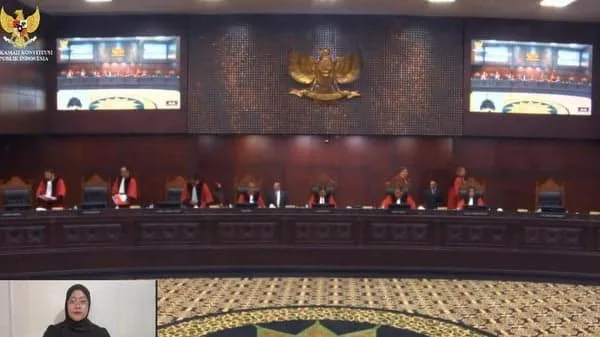
Jakarta, Legal Literacy - The Constitutional Court (MK) concludes that the parliamentary threshold of 4% of the national valid votes, as stipulated in Law Number 7 of 2017 concerning Elections (Election Law), is contrary to the principles of people's sovereignty, electoral justice, and violates the legal certainty guaranteed by the constitution.
Therefore, the threshold is considered constitutional in the 2024 DPR Election, but will be considered conditionally constitutional in the 2029 DPR Election and onwards.


Verdict This was announced in the Constitutional Court's Decision Pronouncement Hearing on Thursday (29/2/2024). Perludem, in its petition, questioned the provision related to the proportional election system.
The Court stated that there is no adequate basis for setting the parliamentary threshold, including in Article 414 paragraph (1) of the Election Law, and found no rationality in determining the amount or percentage according to the legislators' explanation.
Disproportionality Occurs
In addition, Saldi emphasized that the parliamentary threshold significantly affects the transformation of valid votes into DPR seats, which is relevant to the proportional suitability of election results. In other words, in the context of a proportional electoral system, the votes obtained by political parties should be in line with the number of seats they obtain in parliament in order for the election results to remain proportional. Therefore, in a proportional electoral system, it is important to minimize wasted votes so that the election results remain proportional.
In the context of fulfilling the principle of proportionality in legal considerations, the Court noted that in the 2004 Election, approximately 18% of valid votes, or 19,047,481 votes, could not be converted into seats. In the 2019 Election, approximately 9.7% of valid votes, or 13,595,842 votes, suffered a similar fate. Although in the 2014 Election only about 2.4% of valid votes, or 2,964,975 votes, could not be converted into DPR seats, the number of political parties in the DPR was factually higher, namely 10 political parties, compared to the results of the 2009 and 2019 Elections.
Saldi pointed out that the empirical data confirms the disproportionality between voters' votes and the number of political parties in the DPR when the parliamentary threshold is applied in the election of DPR members. This indicates that the constitutional rights of voters become meaningless or ignored due to efforts to simplify the structure of political parties in order to create a strong presidential system of government, supported by an efficient representative institution.
“Whereas the principle of democracy places the people as the holders of sovereignty as referred to in Article 1 paragraph (2) of the 1945 Constitution, the parliamentary threshold policy has apparently reduced the rights of the people as voters. The people's right to be elected is also reduced when they get more votes but do not become members of the DPR because their party does not reach the parliamentary threshold." said Saldi.
According to Saldi, the Court stated that the determination of the figure or percentage of the parliamentary threshold that is not based on adequate methods and arguments has caused disproportionality in the election results, because the number of seats in the DPR is not proportional to the valid national votes. However, according to Decision of the Constitutional Court Number 3/PUU-VII/2009, lawmakers can set a parliamentary threshold by considering political rights, people's sovereignty, and rationality, as long as it does not conflict with these.
“However, in fact, these principles have been violated, resulting in many voters' votes not being converted into seats in the DPR, thus creating disproportionality in the proportional electoral system adopted. Whether realized or not, directly or indirectly, this has undermined the meaning of people's sovereignty, the principle of electoral justice, and fair legal certainty for all election contestants, including voters who exercise their right to vote. Based on this, the Petitioner's argument, which essentially states that the parliamentary threshold and/or the amount of the figure or percentage of the parliamentary threshold that is not prepared according to adequate methodological and argumentative bases, can basically be understood by the Court." explained Saldi.
Legislator's Policy
Furthermore, Saldi explained that the Court maintains its position that the open legal policy of lawmakers regarding the parliamentary threshold and/or the amount of the figure or percentage of the parliamentary threshold must be based on adequate methods and argumentation. This aims to reduce the disproportionality between valid votes and the determination of the number of seats in the DPR, as well as strengthen efforts to simplify political parties. Thus, efforts to simplify political parties in the DPR should not conflict with the principle of maintaining the proportionality of election results with the determination of the number of seats in the DPR.
Regarding this matter, the Court stated that changes need to be made to the parliamentary threshold as stipulated in Article 414 paragraph (1) of the Election Law by considering several things. First, the changes must be designed for sustainability. Second, changes to the parliamentary threshold must remain proportional within the framework of the proportional electoral system to avoid votes not being represented in the DPR. Third, the changes must aim to simplify political parties. Fourth, the changes must be completed before the 2029 Election. And fifth, the changes must involve all parties concerned with the election, including political parties that do not have representation in the DPR, with the principle of significant public participation.
Furthermore, Saldi conveyed the Petitioner's argument stating that there was a constitutional issue regarding the norm of Article 414 paragraph (1) of Law 7/2017 as it relates to the procedures for determining the parliamentary threshold and the magnitude of the figure or percentage of the parliamentary threshold not being based on adequate methods and arguments could be proven. However, regarding the Petitioner's request for an interpretation of the norm a quo to be,
“Political parties participating in elections must meet the national effective vote acquisition threshold to be included in determining the acquisition of DPR members' votes with the following provisions:
- the number 75% (seventy-five percent) divided by the average electoral district, plus one, and multiplied by the square root of the number of 127 electoral districts; and
- in the event that the quotient of the parliamentary threshold as intended, letter a, produces a decimal number, rounding is performed”,
The aforementioned petition cannot be granted by the Court because it is part of the legislature's policy to further formulate the parliamentary threshold, including determining the magnitude of the figure or percentage of the parliamentary threshold. “Thus, the Petitioner's argument is legally justified in part,” Saldi stated.
Unacceptable
In the session, the Court also rejected the application from the UMMAT Party. The Petitioner previously referred to the same norm as Case Number 116/PUU-XXI/2023, namely testing the constitutionality of Article 414 paragraph (1) of the Election Law. In the considerations read out by Constitutional Justice Daniel Yusmic P. Foekh, the Court considered that Article 414 paragraph (1) of the Election Law had undergone a new interpretation since the pronouncement of the Constitutional Court Decision Number 116/PUU-XXI/2023. Therefore, although redactorially it remains the same, the meaning of Article 414 paragraph (1) of the Election Law no longer corresponds to what was requested by the Petitioner.
“This means that the a quo norm still applies to the 2024 DPR Election, but substantively the a quo norm has undergone a change in meaning based on Constitutional Court Decision Number 116/PUUXXI/2023. Thus, regardless of whether the provisions of Article 60 of the Constitutional Court Law and Article 78 of Constitutional Court Regulation Number 2 of 2021 concerning Procedures in Cases of Judicial Review of Laws are met by the Petitioner's application, the Petitioner's argument regarding the conditional unconstitutionality review of the norm of Article 414 paragraph (1) of Law 7/2017 has lost its object,” said Daniel, reading out the considerations of Decision Number 124/PUU-XXI/2023 thereof.






















Comments (0)
Write a comment