
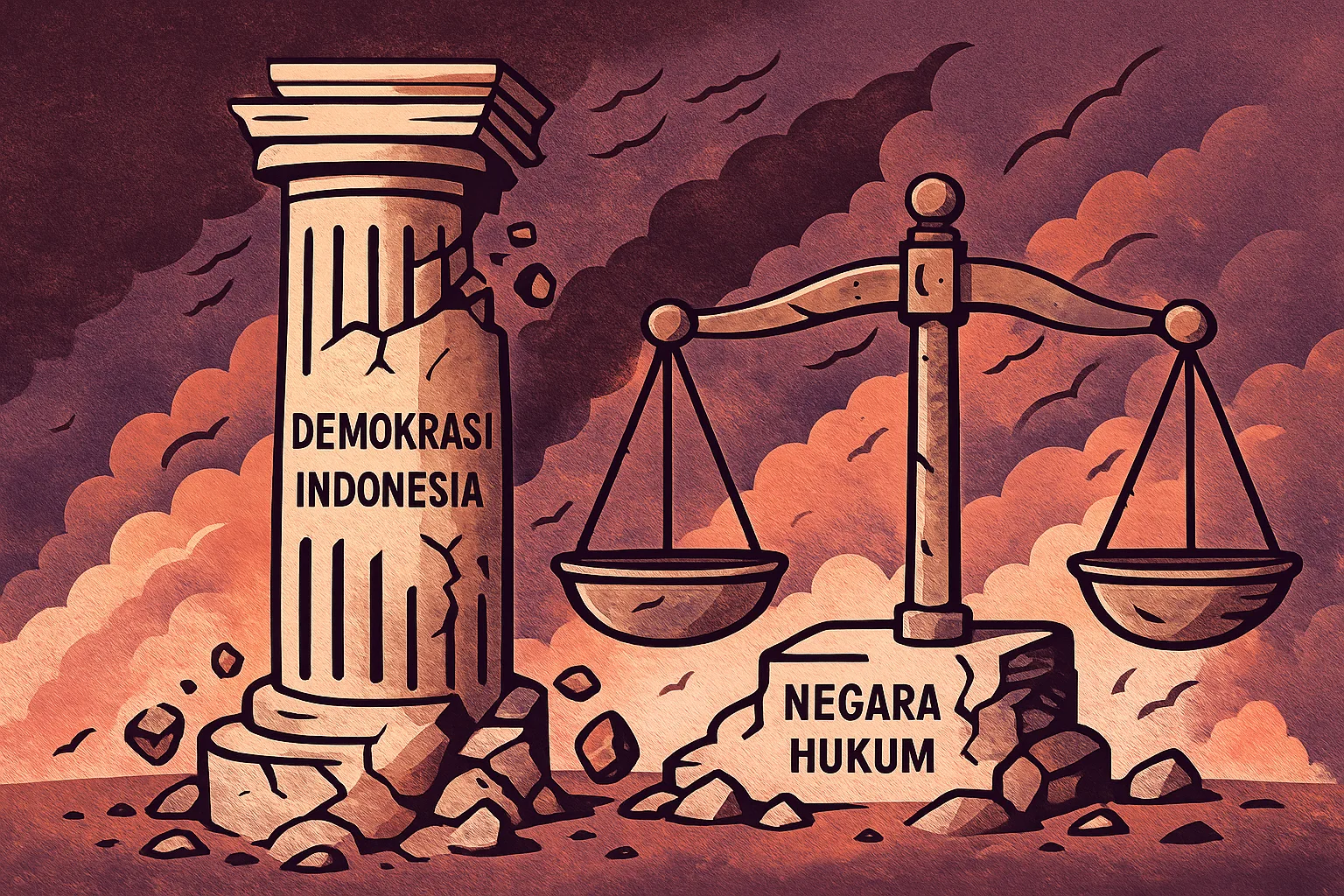
Legal Literacy - In the 21st century, the world is witnessing a worrying phenomenon: the decline of democracy and the fragility of the rule of law in various countries. Rule of law presupposes the supremacy of fair law and protects the rights of citizens, while democracy guarantees public participation and limitation of power. However, signs of erosion of these two pillars are becoming increasingly apparent globally. Reports from independent institutions show that world freedom has declined for a dozen consecutive years turkishminute.com. This means that the collapse of democracy is no longer just a theory – it is happening before our eyes, slowly but surely.
The Global Phenomenon of Erosion of Democracy and the Rule of Law
The collapse of democracy usually does not happen instantly with the roar of revolution, but through gradual decline. A number of factors often contribute to weakening the foundations of democracy. Corruption and abuse of power erode public trust, undermine the integrity of institutions, and create inequality kompasiana.com. Extreme political polarization makes society sharply divided; when compromise is impossible, the democratic process stalls and opens opportunities for authoritarianism kompasiana.com. The emergence of authoritarian populist leaders who make grand promises but then ignore the law, weaken independent institutions, and silence civil liberties can turn a democratic system into a dictatorship in a cloak of legality kompasiana.com. In addition, economic and social crisis can trigger public despair, making them vulnerable to the temptation of authoritarian “shortcuts” for instant stability kompasiana.com. If added weak democratic institutions – such as the judiciary, parliament, and the media – that fail to work independently, then democracy becomes increasingly vulnerable to being seized by anti-democratic forces kompasiana.com. All these factors often interact, creating a perfect storm for the collapse of the rule of law and democracy from within kompasiana.com.


Warnings from Venezuela, Turkey, and Hungary
We can learn from real examples in various parts of the world. Venezuela was once known as one of the most stable democracies in Latin America after 1958, when the dictatorial regime was overthrown. However, the election of Hugo Chávez in 1999 became a bleak turning point. Armed with populist promises, Chávez consolidated power, changed the constitution, and weakened democratic institutions. Gradually, Venezuela became increasingly authoritarian, especially under his successor, Nicolás Maduro, who ruled in the midst of a severe economic and political crisis kompasiana.com. A similar fate befell Turkey. The country, once seen as a progressive Muslim democracy, has experienced a drastic decline in the last decade. Following the failed military coup of 2016, President Recep Tayyip Erdoğan used the event to remove checks and balances democratic as well as eliminating his political opponents turkishminute.com. Freedom House even rates Turkey as now “not free” with a score of only 32/100 – on par with authoritarian countries like Russia and China turkishminute.com. The Erdoğan government tightened control over the courts (by regulating the appointment of judges) and passed “disinformation” laws that are considered to further silence the opposition and independent media ahead of the elections turkishminute.com. Another example comes from Hungary in the heart of Europe. Under Viktor Orbán, Hungary has transformed into what the European Parliament calls an “electoral autocracy hybrid regime” – a country that still holds elections but no longer respects democratic norms europarl.europa.eu. The 2022 European Parliament report states firmly: “Hungary is no longer a democracy.” The rule of law has deteriorated at an alarming rate due to the Hungarian government's systematic efforts to weaken democratic institutions, to the point where a large majority of MEPs agree that this is a wake-up call for Europe europarl.europa.eu. These three cases warn us that without vigilance, a state of law can turn into a state of power in a short time.
Indonesia: Signs of Democratic Regression and the Rule of Law
Post-1998 Reform Indonesia is often praised as a successful democratic transition. The Constitution affirms Indonesia as a rule of law (rechtsstaat) where power is subject to law, not the other way around. For two decades, people have enjoyed free elections, peaceful transfers of power, and greater civil liberties than in the New Order era. However, lately a question has arisen: is democracy and the rule of law in Indonesia beginning to decline? The latest data gives reason to be vigilant. The global Democracy Index shows a negative trend. The Economist Intelligence Unit (EIU) classifies Indonesia as a “flawed democracy” with a score of 6.53 in 2023, down from 6.71 the previous year greennetwork.id. Freedom House reports a similar trend: Indonesia's freedom score fell from 62 (“Partially Free” category) in 2019 to just 57 in 2024 greennetwork.id. This decline indicates a decline in political rights and civil liberties, triggered by a number of domestic issues. One of the main highlights is dynastic politics. Freedom House notes that dynastic politics are becoming increasingly prominent through various "tactics" greennetwork.id. A concrete example occurred in October 2023, when the Constitutional Court (MK) granted a change to the age limit rules for prospective leaders. The MK's decision allowed someone who had served as a regional head to run for president or vice president even if they had not reached the minimum age requirement of 40 years greennetwork.id. The wider public viewed this decision as an attempt to pave the way for Gibran Rakabuming, President Jokowi's 36-year-old son who was then the Mayor of Solo, to run as vice president in the 2024 Election. Unsurprisingly, a wave of protests and sharp criticism arose – many felt that Indonesian democracy was being "hijacked" by political nepotism greennetwork.id. Not long after, the Indonesian Parliament even attempted to revise the law to annul another MK decision that was deemed unfavorable to those in power, triggering public anxiety about rule of law being manipulated for the interests of the elite greennetwork.id.
Besides the phenomenon of dynastic politics, there are serious concerns about the weakening of law enforcement and anti-corruption institutions. For years, the Corruption Eradication Commission (KPK) has been at the forefront of corruption eradication, a symbol of the rule of law over those who abuse power. However, the 2019 revision of the KPK Law has proven to cripple the agency's fangs. The KPK has lost some of its authority, coupled with the selection of leaders whose integrity is doubted by the public, so that the "spirit" of corruption eradication seems to fade csis.or.id. The practice of obstruction of justice in various major cases and the slow enforcement of the law against big-time corruptors reinforce the impression of a weakening rule of law. More worryingly, the two main pillars of justice – the Constitutional Court (MK) and the Supreme Court (MA) – have recently been shaken by issues of independence. Political pressure and intrusion of executive-legislative interests have made these two institutions falter; some of their important decisions are considered "shadowed by nepotism" and the interests of the rulers csis.or.id. When even the highest courts are doubted for their impartiality to the constitution and justice, the principle of the rule of law is clearly eroding.
The decline of Indonesian democracy is also evident from the worsening climate of civil liberties. Freedom of expression and opinion is beginning to feel constricted. In the academic sphere, for example, a number of campuses are suspected of imposing sanctions or reprimands on lecturers/students who vocally criticize the government or discuss sensitive issues such as the Papua conflict greennetwork.id. Activists and demonstrators who voice opposition to government policies face intimidation and criminalization with elastic articles greennetwork.id. Meanwhile, religious and belief minorities outside the country's six official religions still often experience discrimination, and the state fails to provide equal protection for them greennetwork.id. Indicators of press freedom have also declined: according to Reporters Without Borders, Indonesia's press freedom index score plummeted from 63.23 in 2019 to just 51.15 in 2024 greennetwork.id. This drastic decline reflects the pressure on journalists and the media, both through regulations such as the ITE Law and through violence and hacking against media workers. In short, a number of yellow light signals have been lit indicating a decline in Indonesian democracy – from increasingly oligarchic politics, legal institutions that are vulnerable to intervention, to reduced space for criticism for civil society.
Preventing the Collapse of Democracy and the Rule of Law in Indonesia
The good news is, this decline is not unstoppable. Indonesia has not fallen as far as Venezuela or Turkey, and there is still a wide opportunity to correct its direction. What needs to be done? First of all, all elements of the nation must realize that a healthy democracy requires rule of law a strong one. All improvement efforts must be supported by the upholding of the principle of the rule of law which protects every citizen from arbitrariness, and ensures that the law applies fairly and equally to everyone – including those in power greennetwork.id. The government as the holder of power is obliged to lead by setting an example of compliance with the law and the constitution. Every policy and regulation should be in line with democratic values, not erode them. Integrity of state institutions needs to be restored and strengthened. The KPK, as a representation of guts law against corruption, must be restored to its independence – for example by reviewing the controversial revision of the KPK Law and ensuring that the KPK leadership has high integrity. Likewise, the Constitutional Court and the Supreme Court must be protected from political intervention; checks and balances mechanisms need to be arranged so that legal decisions are truly born from the conscience of the constitution, not the pressure of power.
Furthermore, transparency and accountability in government must be improved greennetwork.id. Open public services and strict supervision of the use of authority can prevent opportunities for abuse of power. Strengthening independent supervisory institutions – such as the Ombudsman, Komnas HAM, or press institutions – should be supported, not weakened. In the political realm, the rules of democracy must be consistently enforced: honest and fair elections, enforcement of anti-money politics rules, and rejection of legal manipulation for the benefit of a handful of elites. Discourses to outsmart term limits or facilitate political dynasties should be opposed because they undermine the essence fair play democracy.
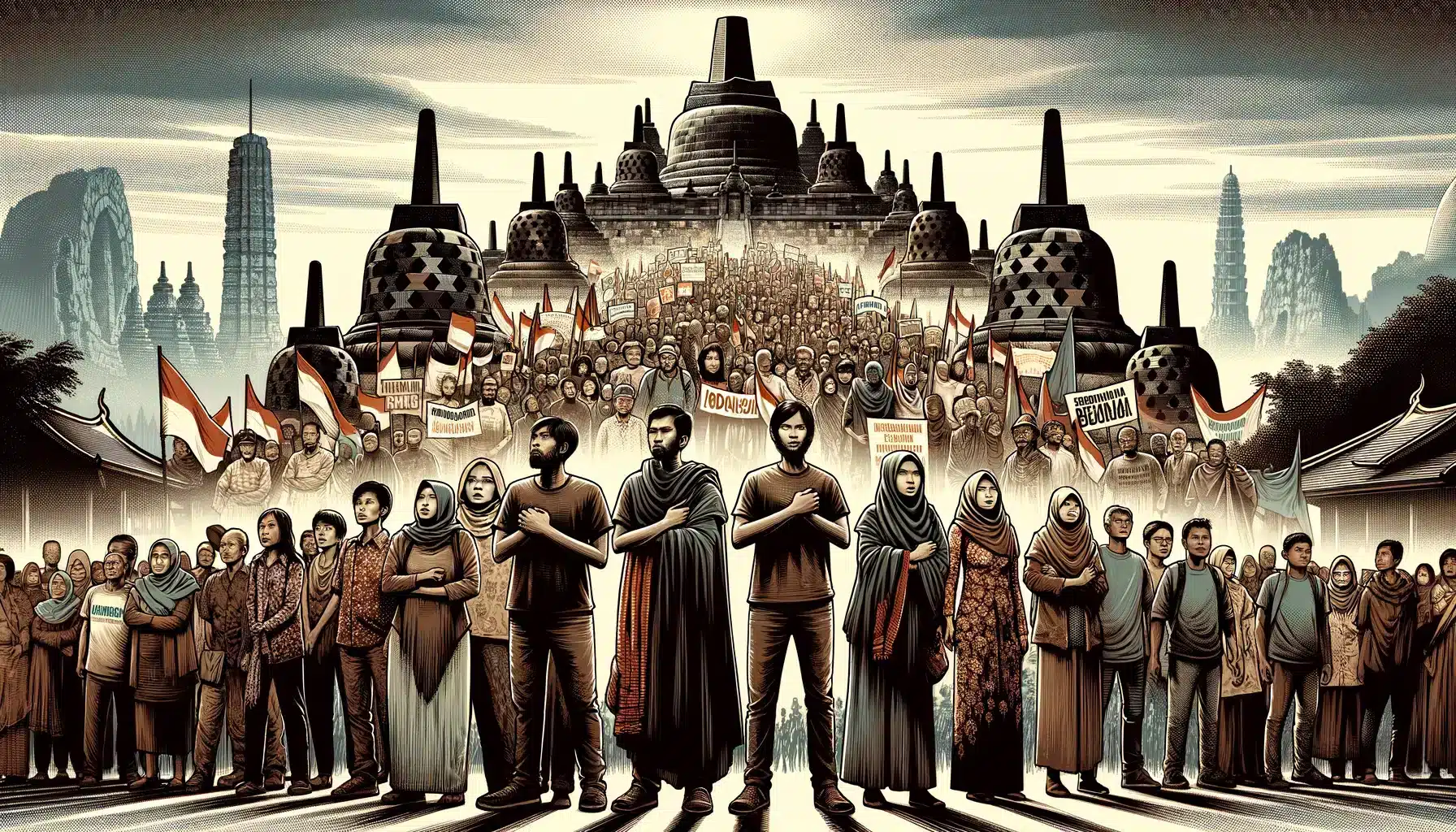
No less important is the role of civil society and citizens. Democracy will die if its citizens are apathetic. Civil society, the media, academics and young people need to continue to oversee the running of government. We must not be complacent or "feel satisfied" so that we are oblivious to opportunistic-minded politicians who are cloaked in the jargon of democracy csis.or.id. On the contrary, the public must be critical and dare to voice control when there are signs of deviation. Freedom of expression must be maintained - for example by revising the elastic articles in the ITE Law and ensuring protection for whistleblower or human rights defenders. Freedom of the press as the fourth pillar of democracy must be secured; all forms of violence or criminalization of journalists must be thoroughly investigated.
In the end, maintaining democracy is a never-ending job. It requires collective commitment and constant vigilance. The bitter experience of other countries shows that democracy can collapse not only through coups, but through slow erosion from within the system. Indonesia still has a golden opportunity to prevent the twilight of the rule of law and democracy from arriving. By fixing the existing weaknesses - from eradicating corruption, enforcing the law without discrimination, to ensuring that every citizen is free to speak - we can strengthen the foundations of democracy so that supremacy of law remains upright. This is the task of our generation: to ensure that Indonesia does not repeat the footsteps of Venezuela, Turkey or Hungary, but becomes a shining example of how democracy and the rule of law can rise and survive in the midst of the onslaught of the times. Hopefully alarm this warning will be heard before it is too late, for the future of Indonesia which remains democratic and just. csis.or.idgreennetwork.id
















Comments
0Share your perspective politely, stay relevant, and focus on the article. Comments appear after moderation.
Join the discussion
Write a clear, polite response that stays on topic.
No comments yet. Be the first to discuss.
Comments will appear after moderation.