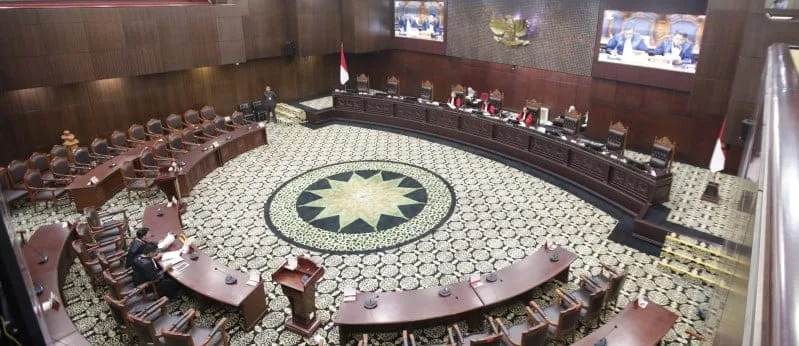
Jakarta, Legal Literacy - Jovi Andrea Bachtiar, a prosecutor, requested the Constitutional Court to strengthen the authority of prosecutors in investigating certain criminal acts by including it in the Criminal Procedure Code (KUHAP), along with the police and civil servant investigators (PPNS). The aim is to reduce legal uncertainty in law enforcement by the Prosecutor's Office.
According to Jovi, the multiagency approach in criminal investigation, including corruption, has become a global trend. He mentioned that a number of countries have granted investigative authority to prosecutors.


The Authority of Prosecutors to Conduct Corruption Investigations Has Not Been Regulated in the Criminal Procedure Code
In the preliminary examination hearing of the material review of Law Number 8 of 1981 concerning the Criminal Procedure Code, Jovi examined several articles as well as Article 45 Paragraph (1) Law 30/2022 concerning the Commission for the Eradication of Corruption. He emphasized that although the investigative authority of prosecutors is regulated in several laws, the Criminal Procedure Code has not accommodated this.
Jovi hopes that the Constitutional Court can clarify the authority of prosecutors in investigating certain criminal acts, especially corruption, in the Criminal Procedure Code and the KPK Law to provide legal certainty in the conception of the rule of law. He also reminded that the Prosecutor's Office has successfully handled many corruption cases in recent years.
Mentioning data from Indonesia Corruption Watch, Jovi noted that the Attorney General's Office of the Republic of Indonesia has handled a large number of corruption cases with significant state losses. He also compared the performance of the Prosecutor's Office with the Corruption Eradication Commission in handling corruption cases.
During the petition revision hearing, Nawa Syarief added that several countries also grant investigative authority to the prosecutor's office, including the United States, Germany, France, Brazil, Sweden, Australia, and the United Kingdom.
Legal Politics of the Authority to Investigate Corruption by Prosecutors
The political and legal reasons behind granting investigative authority to the Prosecutor's Office were also highlighted by the petitioners. They argued that this could strengthen the check and balances mechanism in handling corruption cases.
Regarding the petition, Chief Justice of the Constitutional Court (MK) Suhartoyo promised to discuss it in a judges' deliberation meeting to determine whether the judicial review of the norms in the Criminal Procedure Code (KUHAP) and the KPK Law would be continued. The petitioners were asked to await the official decision from the Constitutional Court.
It should be noted that the Constitutional Court had previously rejected a similar petition in January 2023 because it was considered to create legal uncertainty and eliminate the function of checks and balances in handling cases.



















Comments (0)
Write a comment