
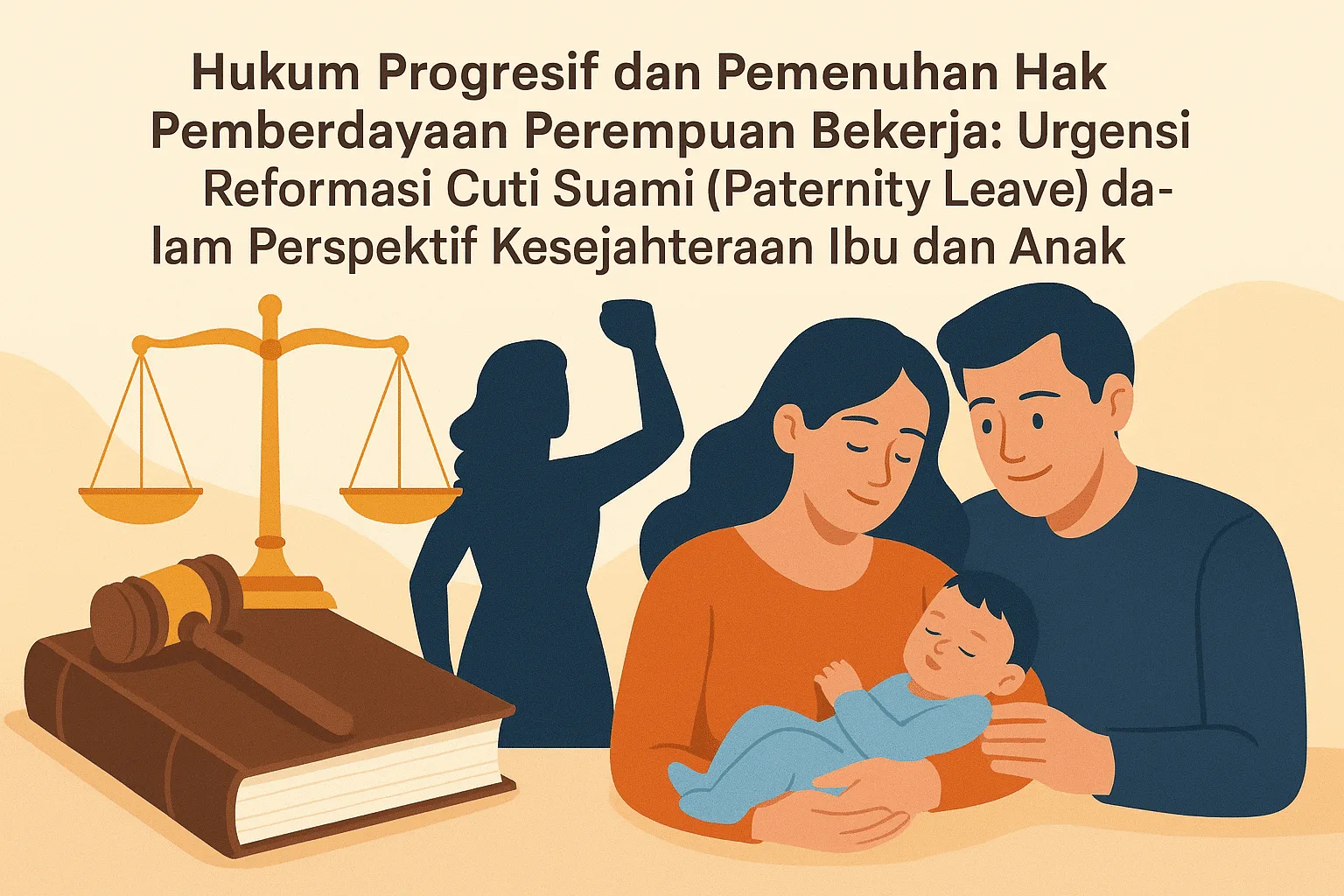
Study of Paternity Leave Provisions in a Progressive Legal Perspective for Gender Equality
The concept of progressive law initiated by Prof. Satjipto Rahardjo emphasizes that the law should not be trapped in the text alone, but must be responsive to the needs and values of social justice. In this context, labor law related to husband's leave needs to be reviewed to answer the challenges of the times, namely promoting gender equality and a fairer division of childcare roles.
Studies show that the presence of the father during the postpartum period not only helps the mother's physical and psychological recovery, but also strengthens the bond between father and child from an early age. Emotional and physical support from the husband can accelerate the mother's recovery, reduce the risk of postpartum depression, and help the mother return to being productive in the workplace. Therefore, paternity leave is not only a labor issue, but also has relevance to family welfare.
Reviewing Indonesia's Paternity Leave Through a Comparison of Japanese and Malaysian Regulations
Several countries have developed more progressive paternity leave policies, which demonstrate the country's commitment to encouraging fathers' involvement in childcare and supporting working women (mothers). Compared to Indonesia, which currently only provides two days of leave for husbands when their wives give birth, policies in a number of other countries show a more progressive approach and support the role of fathers after their partners give birth. This indicates that there is room for improvement in labor regulations in Indonesia to be more responsive to the dynamics of family needs and the welfare of mothers and children.
In Japan, for example, there is the Child Care and Family Care Leave Law which gives male and female workers the right to take leave to care for children and care for families. The Japanese government also regulates provisions for male workers (fathers) to take leave for the first eight weeks after the birth of a child to take leave again.
Furthermore, in Malaysia based on the Employment (Amendment) Act 2022, male workers who meet the requirements are entitled to paternity leave for seven consecutive days for each child, up to the birth of the fifth child. In addition, employers are not allowed to reject applications for father's leave from eligible workers without valid reasons because such rejection can lead to legal consequences in the form of industrial relations disputes.
The examples above show that other countries have realized the importance of the father's role in supporting the welfare of mothers and children. By giving fathers sufficient leave time, mothers are not only helped physically and emotionally, but are also empowered in maintaining the continuity of their careers and professional roles. Indonesia can learn from these policies to improve the provisions for male workers' leave (husbands) in order to promote gender justice, family protection, and better human resource development.




















Write a comment